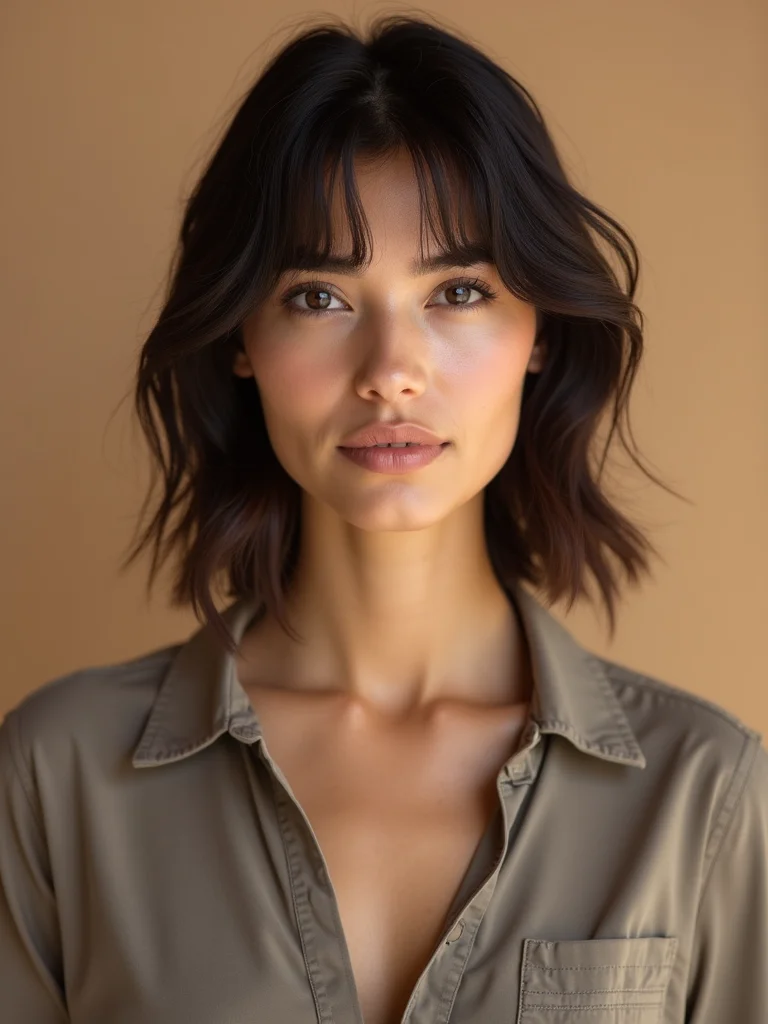
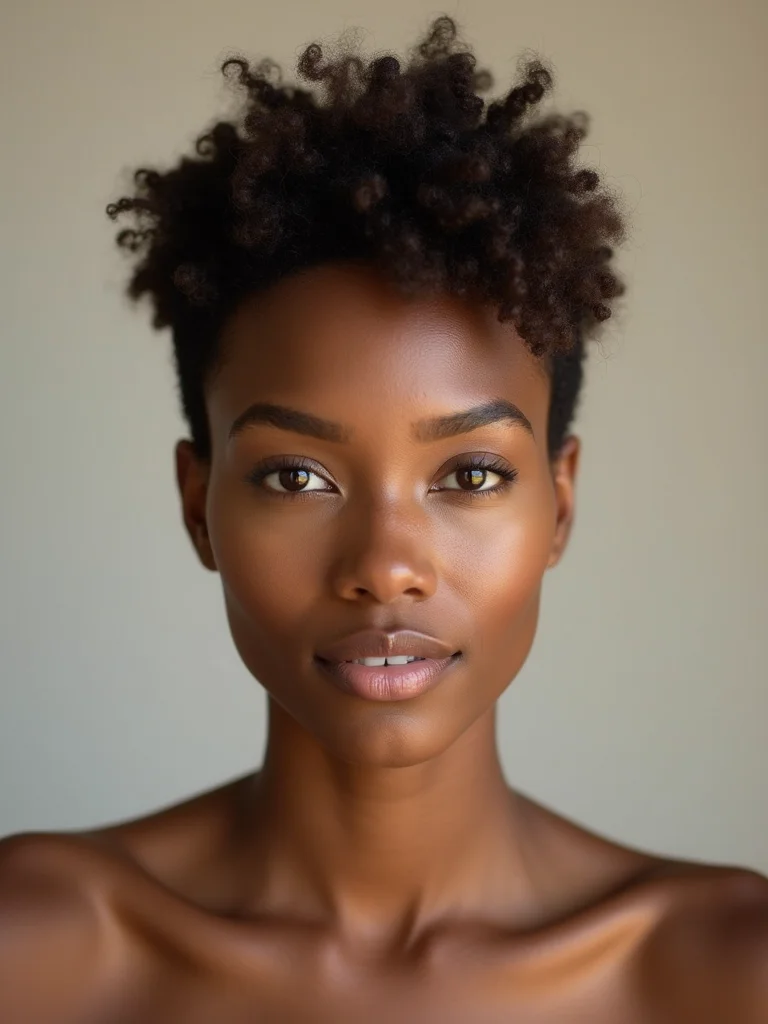
The advice that round faces should skip bangs entirely only captures half the picture. What actually widens a round face is a heavy, blunt fringe cut in one straight line across the forehead; a solid horizontal bar does nothing but emphasize width.
Wispy bangs work on the opposite principle. Broken, see-through texture creates vertical movement and lets the forehead show through in places, which stretches a round face rather than shortening it. Fifteen versions follow, chosen specifically for that effect.
Wispy Bangs and Round Faces, Quick Answers
Can a round face actually wear bangs? Yes, provided the fringe is wispy, angled, or long rather than blunt and horizontal. Broken texture reads as vertical lines; a solid line reads as width.
Which version flatters a round face most? Long, side-swept, or center-parted styles that fall toward the cheekbones tend to work hardest, since they pull the eye straight down toward the jaw.
Do wispy bangs need constant upkeep? Less than a blunt fringe. The soft edge grows out without an obvious hard line, though the shape benefits from a quick tidy every few weeks to stay sharp.
Center-Parted Wispy Curtain Bangs

A soft center part sends two feathered halves sweeping away toward the cheekbones, opening into a long vertical V that most stylists reach for first on a round-faced client. The shape works because the part itself becomes a visual anchor, splitting the forehead into two narrower sections.
- The open shape at the center draws the eye down rather than across
- Falling at or just below the cheekbone gives the most lengthening effect
- Grows out with almost no awkward in-between stage
- A light-hold spray keeps the two halves holding their separation through the day

Side-Swept Wispy Bangs

A fringe swept across the forehead at an angle builds a strong diagonal line, and on a round face that single line does more slimming work than almost any other cutting choice on this list.
Why the Angle Does the Work
The steeper the angle, the more pronounced the lengthening effect tends to be, though most people find a moderate sweep easier to live with day to day.
Feathered, broken ends matter as much as the angle itself; a blunt diagonal reads heavier and loses some of the softening effect.
ℹ️The Diagonal Advantage
A fringe swept on an angle creates a longer visual line than one cut straight across, simply because a diagonal covers more distance between two points than a horizontal ever can. That’s the geometry behind why side-swept styles read as more slimming.
Airy Wispy Baby Bangs

Baby bangs sit high above the brow, a placement that conventional advice usually rules out for round faces entirely. A wispy, see-through version is the exception worth knowing about.
Because the fringe stays sheer, plenty of forehead still shows through it, which keeps the bold shape from closing off or widening the face the way a dense micro fringe would.
This lands as the boldest option here, suited to anyone truly comfortable with a graphic, fashion-forward statement.
Piecey Wispy Fringe on a Lob

Pairing a piecey, wispy fringe with a long bob gives a round face vertical drop below the chin along with a soft, unstructured forehead. The two elements pull in the same direction, reinforcing each other.
Keeping the lob long enough to clear the jawline matters here; a shorter length loses some of the stretching effect the pairing is built around. A texturizing spray worked through the ends keeps the piecey look going without a flat iron most mornings.
Choosing between two ways to keep length in front:
🎯Want the fringe to stay a distinct piece?
The piecey lob pairing keeps the bangs separate from the length below it.
🎯Want everything to blend into one shape?
Wispy bangs flowing into face-framing layers erase the line between fringe and length.
Wispy Bangs Into Face-Framing Layers

When a wispy fringe flows directly into longer face-framing layers with no hard seam, the whole front of the hair becomes one continuous line traveling from the forehead down past the jaw.
That continuity is what makes this combination especially slimming: there’s no horizontal break for the eye to catch on, just one long vertical frame around the face.
Requesting the bangs cut as one continuous piece with the surrounding layers keeps the whole thing growing out evenly together.
Feathered Wispy Bangs for Fine Hair

Fine hair and wispy bangs suit each other naturally, since feathered texture reads as intentional on fine strands where a blunt, dense fringe would look thin.
On a round face specifically, feathering adds a touch of lift right at the root, and that added height is what balances out width through the cheeks.
Keeping the fringe feathered without over-thinning it matters; too little hair left in the section removes the body needed for that lift to show.
🅰️Fine, flat hair
Feathered bangs with a root-lifting spray build height where the hair naturally lacks it.
🅱️Thick, dense hair
A piecey or see-through cut removes bulk so the fringe doesn’t sit heavy across the forehead.
See-Through Wispy Bangs

See-through bangs sit at the sheerest end of this whole list, thin enough that the forehead reads clearly through the strands, and that transparency is exactly the mechanism that flatters a round face. Most stylists point clients here specifically when they want the softening effect of a fringe without much visual weight added to the front of the face.
- Visible skin between the strands keeps the whole face feeling open
- Cut with deliberate space between pieces, not evenly dense
- The super wispy bangs page covers even sparser variations
Long Cheekbone-Skimming Wisps

Wispy bangs that skim all the way down to the cheekbones rank among the most lengthening options here, simply because of how far they travel past the brow.
Why Extra Length Adds Extra Lengthening
The extra distance pulls the eye downward and builds real vertical space, while feathered ends keep the length from reading heavy.
This version also blends into face-framing layers with almost no visible seam, which makes it one of the easier long fringes to grow out gracefully.
A couple of terms worth knowing before a fringe consultation:
📖Point-cutting
Snipping upward into the ends with scissors angled vertically, the technique behind a soft, wispy edge instead of a hard, blunt one.
📖Face-framing layers
Longer layers left around the front of the face that blend into a fringe, extending its effect down past the cheekbones.
Tousled Shag With a Wispy Fringe

A tousled shag brings texture and movement through the whole head, and a delicate wispy fringe extends that same energy into the front. The layered volume at the crown adds height that counters width lower down the face.
Keeping the fringe light and cut as one piece with the surrounding shag layers lets the texture carry through the entire style. A texture spray scrunched through damp hair before drying keeps the whole shape looking loose and undone.
Wispy Bangs With a High Ponytail

Pulling hair into a high ponytail can expose a round face more than most people expect. Leaving the wispy fringe and a couple of face-framing pieces out softens that hard pull-back considerably.
- The height of the pony adds lift; the loose wisps soften the effect
- A couple of pieces left loose near the cheekbones help slim the silhouette
- Works well as a quick style-up on a day the fringe needs less attention
Curly Wispy Bangs

Curly hair carries wispy bangs just as well as straight hair, contrary to an old assumption that curls and fringes don’t mix. Defined curly bangs frame the face with bounce, and the natural height curls bring adds exactly the vertical lift a round face benefits from.
The technique that matters most is cutting the fringe dry, in its curl pattern, so the stylist can see precisely where each piece lands once it springs up.
- Cut wet, a curly fringe reliably ends up shorter than intended once it dries
- A curl cream defines the shape without weighing the springy pieces down
- The curly bangs page has more curl-specific cutting notes
Micro Wispy Bangs

Micro wispy bangs are the most delicate version on this list, a small scattering of fine strands barely grazing the top of the forehead.
For a round face, the appeal is entirely in the lightness: enough texture to add interest without adding any perceived width across the front.
This also counts as the lowest-commitment fringe here, since so little hair is involved that it grows out almost invisibly.
Blow-Drying Wispy Bangs

How wispy bangs get dried matters almost as much as how they’re cut, especially on a round face where lift and movement do real visual work.
- Dry the fringe section first, leaving the rest of the head still damp
- A small round brush lifts at the root and sweeps the ends outward
- A blast of cool air at the end locks in the floaty shape before it can fall flat
Trimming Wispy Bangs at Home
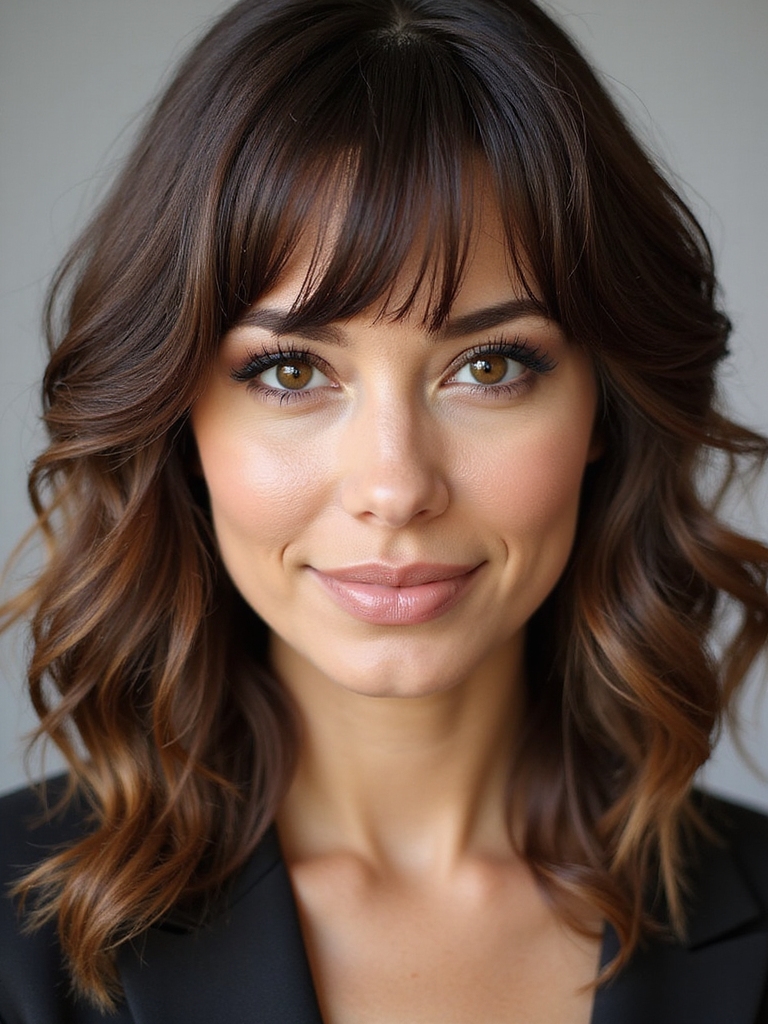
Wispy bangs count among the few fringes that can be safely tidied between salon visits, since the technique itself is fairly forgiving of small errors, unlike a blunt line that shows every uneven snip immediately.
- Trim on completely dry hair; damp bangs spring shorter than they look wet
- Hold scissors vertically and snip upward into the ends, never straight across
- Take small snips and stop often; more length can always come off later, not put back
- A pair of proper hair-cutting shears makes a noticeably cleaner cut than kitchen scissors
Lightweight Products for Wispy Bangs

The right products keep a wispy fringe separated and floaty; the wrong ones turn it into a flat, clumped strip stuck to the forehead within an hour. A little goes a long way on a section this fine, so most people need far less product than instinct suggests.
- A light texture or sea-salt spray adds separation without any real weight
- A dry shampoo at the root keeps the fringe lifted between washes
- Heavy creams and oils are the most common cause of flat, clumpy bangs
- A tiny amount of flexible-hold gel on damp fringe can add definition without stiffness
Styling Tips
A wispy fringe on a round face works hardest when it’s kept truly light: too much product weighs it flat and erases the vertical lift that makes the whole style work in the first place.
Booking a trim close to every four weeks, on a fixed schedule instead of waiting for an obviously overgrown line, keeps the shape doing its job. A fringe-only trim between full haircuts typically runs around $15, a small price for keeping the effect sharp.
The Fringe That Actually Works Against Roundness
Every version on this list runs on the same underlying rule: broken, vertical, or angled beats solid and horizontal, every time, on a round face. The only fringe truly worth avoiding is the heavy, blunt, straight-across one.
Worth picking whichever version matches the nerve available, a foolproof side-swept curtain if easing in feels safer, an airy baby fringe if a bolder change sounds appealing, and bringing a clear photo to a stylist who cuts fringes often.
More Ideas Here