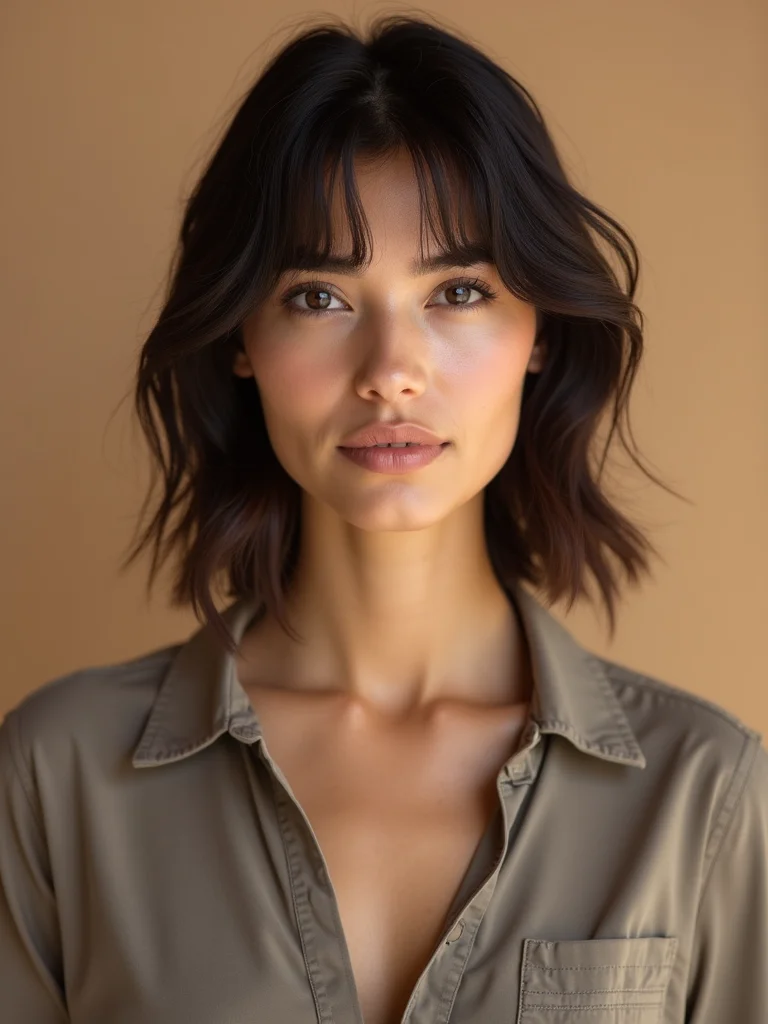
There is a particular client who walks into my chair with naturally wavy hair she has spent years trying to flatten, fight, or hide. By the time she leaves with a wavy wolf cut, she usually cannot stop touching it.
The wolf cut and wavy hair are a near-perfect match: the cut’s choppy, stacked layers give your waves somewhere to spring, turning what felt like frizzy bulk into deliberate, beachy movement. Wavy hair barely has to be styled to look like the trend. What follows covers layering and length, fringe, color, and the habits that keep it healthy, plus the mistakes worth avoiding along the way.
The Short Version
- The choppy, stacked layers work with your wave pattern instead of against it, which is why the cut needs almost no extra styling.
- Works across every wave pattern and density, but placement is by feel, not formula, so look for a stylist experienced with wavy or curly texture specifically.
- It air-dries into shape; expect a trim every 8 to 10 weeks and a cut around $60 to $130.
What Makes the Wolf Cut Perfect for Wavy Hair

If you have wavy hair, the wolf cut might be the most flattering thing you ever do with it. The reason comes down to one simple match: the cut’s layers and your wave’s natural movement amplify each other rather than fighting for control of the shape.
- The choppy layers give your waves room to spring instead of clumping.
- Your natural texture does the styling, so the cut air-dries into shape.
- Stacked crown layers add the volume wavy hair often loses to weight.
The Airy Crown and Tapered Ends

The signature of a wavy wolf cut is an airy, lifted crown over soft, tapered ends. The short layers up top create height, while the tapered perimeter lets the waves fall into loose, beachy pieces.
Why the Taper Matters
I build the crown with short, stacked layers and feather the ends so they taper to a soft point. On wavy hair, that taper is what keeps the bottom from looking heavy or triangular.
The result is a shape that swings, bounces, and moves the moment you shake your head.
“Wavy hair is the most underrated texture for a wolf cut. Straight-haired clients have to work to fake the movement this cut is famous for, but wavy hair has it built in. If you have spent years straightening your waves, this is the cut that finally rewards you for embracing them.”
Face Shapes That Shine With a Wavy Wolf

The wavy wolf cut flatters nearly every face shape, but small tweaks make it sing for each one. The face-framing layers and crown volume can be placed to balance your features, adjusted by where the length lands and how much height the crown carries.
- Round face: longer length and crown height to elongate
- Square jaw: soft, cheekbone-grazing layers to soften
- Long face: keep the volume at the sides, not the crown
Choosing the Right Length for Your Waves

Length is the biggest decision, and your wave pattern should guide it. Tighter waves shrink more as they dry, so I cut them a little longer to land where you want them. Looser waves can go shorter without surprises.
Medium and shoulder length are the sweet spots for most wavy hair, with enough length for the waves to form but enough layering to keep them light. Undecided between lengths? The medium wolf cut page walks through that middle range specifically.
Which wavy wolf cut fits you?
1Want low-effort and soft?
A medium-length wavy wolf with curtain bangs, air-dried.
2Want bold and voluminous?
A choppy, heavily layered wolf with big beachy waves.
Curtain, Baby, or Wispy: Fringe Options to Try

Bangs take a wavy wolf cut to the next level, and three work especially well with waves. Curtain bangs are the easiest, sweeping into the layers with the wave’s natural movement. Wispy bangs stay soft and airy. Baby bangs are the boldest and need the most styling.
Which Fringe for Waves
Whatever you choose, I cut the fringe to follow your wave, never against it, and a touch longer to allow for spring-up.
Curtain bangs are my default suggestion for wavy hair, and the curtain-bang version page has the full styling breakdown if that’s the one calling to you.
Layering Techniques for Natural Movement

The layering is everything on wavy hair, and it has to be done dry. Cutting wavy hair wet hides where the waves actually fall, so I cut it dry, in its natural pattern, placing each layer to enhance the bounce.
I use point cutting and slide cutting to remove weight and shape the waves softly. For anyone chasing serious volume rather than a soft finish, the long layered version page focuses specifically on building layers for more lift.
- Ask for point-cutting over thinning shears, since it frays less on wavy strands
- Looser 2a waves usually need shorter layers than tighter 3a curls for the same bounce
- Bring a photo of the back of the head, not just the front, since stacking shows there first
ℹ️Shrinkage Factor
Tighter waves and curls shrink more as they dry, sometimes an inch or more between wet and set length. Mention your pattern’s typical shrinkage before the first cut so the finished length lands where you actually expect it.
Styling Routine for Air-Dried Texture

The best part of a wavy wolf cut is how little it asks. Air-drying is the whole routine for most wavy types, and it takes about two minutes of actual effort. My go-to order for clients is the same every time:
- Scrunch a curl cream or mousse into damp hair, upward toward the scalp.
- Add a salt spray for extra texture and grip.
- Let it air-dry untouched, then break up the waves with your fingers.
Heat Styling Tips for Soft Beachy Waves

On days you want more polish, a little heat refines the wavy wolf cut into soft, deliberate beachy waves. The point is enhancing your natural wave, not overriding it.
A Little Polish, Not a Full Reset
I use a 1-inch curling iron or a flat iron to bend a few pieces in alternating directions, focusing on the face-framing layers. A diffuser on low also speeds up the air-dry while keeping the wave.
Always use a heat protectant, since the texturized ends are the most fragile part of the cut.
Two wavy wolf cut myths:
❌ Myth: A wolf cut and a shaggy cut are basically the same thing
✅ Reality: Related, not identical. A wolf cut concentrates more height and shorter layers right at the crown, closer to a mullet’s drama than a classic shag’s more even taper.
❌ Myth: You need heat tools to style it
✅ Reality: No. The wolf cut is designed to air-dry into shape on wavy hair, which is most of its appeal.
Best Products for Touchable Hold and Volume

The right products make a wavy wolf cut look touchable and full instead of crunchy or flat. I keep it simple with a few lightweight staples.
A mousse or curl cream for definition, a salt spray for texture, and a light oil for the ends cover almost everything. Use a little of each, since wavy hair flattens under too much product.
- Work curl cream through soaking-wet hair first, before anything else touches it
- Keep salt spray to the mid-lengths and ends; the roots don’t need the extra drying
- Warm a drop of oil between your palms, then press it onto ends rather than pouring it on
Balayage and Color to Amplify Dimension

Color and a wavy wolf cut are a beautiful pairing, because the waves and layers catch light from every angle. Dimensional color like balayage makes that movement look even richer, and I place the brightness around the face and through the ends, where the waves naturally catch the light.
The grown-out nature of balayage suits the relaxed vibe of the cut: most clients stretch four to six months between full appointments, with an optional toning gloss around month two or three to keep the tone from turning brassy.
Low-Maintenance Upkeep and Trims

A wavy wolf cut is built to be low-maintenance, but a little upkeep keeps it looking sharp. The soft grow-out means you can stretch your trims, and the daily routine stays minimal. A few habits keep it healthy between salon visits:
- Trim every 8 to 10 weeks to keep the layers crisp.
- Dust split ends monthly, since texturized ends fray faster.
- Refresh day-two waves with water and a little mousse, no rewash.
Wavy Wolf Cuts for Fine, Medium, and Thick Hair

Wavy hair comes in every density, and the wolf cut adapts to each. Fine wavy hair gets conservative layering to fake fullness without thinning out the ends, while thick wavy hair needs real weight removal so the waves can move freely instead of sitting in one heavy mass.
Medium wavy hair tends to be the easiest of the three, taking layers and texture beautifully with the least adjustment needed.
- Fine density: fewer, softer layers; the fuller fine-hair version page is worth a look if lift is the priority
- Thick density: real internal weight removal, not just surface texturizing
- Waves leaning toward curls: the curly version page covers shaping for tighter patterns specifically
Protective Habits to Keep Ends Healthy

Because the wolf cut relies on texturized, feathered ends, keeping those ends healthy is what keeps the whole cut looking good. Wavy hair is naturally drier than straight hair, so the ends need a little extra care. I tell every wavy client to sleep on a satin pillowcase, ease off the heat, and deep-condition weekly. A few small habits keep the feathered ends from fraying and the waves from frizzing.
- Loosely braid or twist longer layers before bed instead of leaving them fully loose
- Focus deep conditioner from mid-shaft to ends; skip the roots so volume doesn’t collapse
- Keep heat tools under 300°F specifically on the feathered ends, where damage shows first
Transitioning From Other Cuts to a Wolf Shape

If you are coming from a blunt cut or all-one-length hair, transitioning to a wavy wolf takes some planning. Sometimes it happens in one appointment; sometimes a stylist builds the layers gradually to keep length. I assess how much length you are willing to lose and where your waves want to bend, then map the layers around both.
Coming from a heavy, blunt cut, the first wolf cut feels dramatic, since suddenly your waves are free to move. Bring photos and be clear about your length limits, and the transition goes smoothly.
From Subtle Shag to Wild Layered Waves

The beauty of the wavy wolf cut is its range. Toned down, it is a soft, subtle shag with gentle layers and loose waves; turned up, it is a wild, voluminous mane of choppy layers and big beachy texture.
Where you land is entirely up to you and how bold you want to go. The same cut can look polished for work and full-volume loose for the weekend, all depending on how you style your waves that morning.
Common Mistakes to Avoid
The number one mistake with a wavy wolf cut is letting a stylist cut it wet. Wet hair hides the wave entirely, so the layers end up in the wrong places and the bangs dry too short. Always insist on a dry cut, or at least a dry refinement. The second mistake is over-layering: too much texturizing thins wavy hair and leaves the ends stringy, so ask for fewer layers than you think, especially if your hair is fine.
The third is fighting your wave with too much heat or a paddle brush, which flattens the texture the cut is built around. Lean into the wave with a scrunch of product and an air-dry. And do not skip the deep conditioning, since the texturized ends on naturally dry wavy hair need the moisture to stay healthy and frizz-free.
Wavy Wolf Cut Questions, Answered
?Is the wolf cut good for wavy hair?
It is among the best cuts for it. The choppy layers give waves room to spring and add the volume wavy hair often lacks, and because the shape leans on your natural texture, you can usually skip the hot tools entirely.
?Do I have to style a wavy wolf cut?
Barely. Most wavy types just scrunch in a little product and air-dry. A diffuser speeds it up, and a curling iron adds polish on special occasions, but day to day it is close to wash-and-go.
?Will a wolf cut make my wavy hair frizzier?
Usually the reverse. A lot of wavy frizz comes from sheer bulk, and the layers take that bulk out, so the waves clump less and define more. Weekly conditioning and a gentle drying routine handle the rest, and most clients find their frizz improves after the cut.
The Cut Your Waves Were Waiting For
If you have spent years at war with your waves, the wolf cut is the peace treaty. It takes everything wavy hair does naturally, the bounce, the texture, the volume, and turns it into a deliberate, modern shape that needs almost no styling. The layers carry the shape; your waves fill in the rest. It is rare to find a cut that works this well with natural texture.
Whether you want a soft shag or a wild, voluminous mane, the wavy wolf cut meets you there. Find a stylist experienced with wavy texture specifically, bring a photo of the movement you love, and let your waves finally take the lead.
Worth a Look