A blunt bob and a stacked bob can look identical from the front and belong to different families from behind. One hangs as a single flat curtain to the nape. The other climbs, layer sitting on layer, into a rounded shelf of volume that nobody built with a brush.
That difference is an angle, not a length. Everything a stacked bob haircut does for you comes from the steepness of that climb and where the resulting weight line ends up sitting, so identical requests routinely produce hair that behaves nothing alike. What follows is sixteen entries: the variations worth knowing, and the decisions that produce them.
Three Things the Angle Decides
What makes a bob stacked instead of layered? Graduation. The back is cut with the hair held out from the head at an increasing angle, so each layer falls slightly shorter than the one beneath it and stacks into a rounded shelf. Where a layered bob removes weight, a stacked bob relocates it upward.
Why does it suit fine hair so well? Because the volume is structural. Fine hair collapses the moment you tease it, while graduation puts shorter hair underneath longer hair permanently, and that stack holds its shape whether or not you touched it this morning.
How fast does it lose its shape? Faster than a blunt bob. The stack is short hair, and short hair shows growth first, so plan on a shape-up every five to seven weeks, somewhere in the $40 to $80 bracket depending on your salon. Skip two and the shelf softens into an ordinary bob.
The Short, Graduated Stacked Bob

This is the shape in its purest form: nape cut close, graduation climbing steeply, front left longer. You will notice the effect in profile before you notice it head-on, because the whole silhouette gains a bump at the back of the skull that flat hair simply does not have.
The steeper the graduation, the higher that bump sits and the shorter the nape has to be. That trade is worth understanding before you sit down, because a high stack on a short neck can crowd the head, and the fix there is a gentler angle, never more length.
- Ask for graduation starting at the occipital bone, which is the curve you can feel at the back of your skull
- Nape length under an inch gives the sharpest shelf and the fastest regrowth
- Bring a photo of the back, since the front view tells your stylist almost nothing

Rounded Volume at the Back, and Why It Flatters

Most heads are flatter at the back than the mirror suggests, and a flat occiput is why so many bobs look heavy from the side. Building volume exactly there does more for a profile than length anywhere else, which is the quiet reason this cut keeps getting saved.
- Check your own profile in two mirrors before deciding; a naturally round skull needs less stack
- Fine, flat, or straight hair gains the most, since none of it produces lift on its own
- Round and heart-shaped faces balance best when the front stays at or past the jaw
The Classic Stacked Bob With a Layered Back

The version everyone pictures sits at moderate graduation with the front angling gently toward the chin. Nothing about it is extreme, which is the point: it flatters across face shapes with small adjustments, grows out without a hard stage, and reads polished rather than fashion-forward. Our layered bob write-up covers the softer relative if this feels too structured.
- Moderate graduation, chin-length front, clean perimeter through the sides
- Works on straight and wavy hair as cut; wavy hair gains a little extra lift for free
- The safest first stacked bob, and the easiest to make steeper next time
The Precision Angled Stacked Bob

Push the front past the jaw while keeping the back short and you get a hard diagonal running from nape to chin. It is the most graphic thing this cut can do, and it needs a precise hand, because an angled line shows every millimeter of unevenness. Our A-line bob piece takes on the closely related shape without a stacked back.
- Ask for a steep front angle over a short, stacked back; a soft slope loses the effect
- Straight hair shows the line best; heavy wave blurs it within a day
- The angle grows out unevenly, so this version wants the tightest trim schedule
How steep should your angle be?
🎯Gentle graduation
Softer shelf, longer nape, forgiving grow-out. Best on a naturally round skull, on wavy hair, and for anyone unsure about short hair.
🎯Steep graduation
High, defined shelf and a short nape. Best on fine straight hair that needs structure, and only if a shape-up every five weeks fits your life.
A Chin-Length Stack That Boosts Curl

Curls arrive with volume already installed, so the job of the stack changes. Here graduation stops the bottom from spreading wide and pushes fullness up toward the crown, where curls look their best.
Insist on dry cutting. A curl cut wet sits an inch or more higher once dry, and on a graduated shape that error compounds through every layer. Our curly bob guide goes deeper on short curly shaping.
Tightly Graduated Nape Layers for Fine Hair

Fine hair is where this cut earns its reputation, and it is the request I say yes to fastest. Tight graduation at the nape stacks short hair beneath longer hair, and that structure produces body no product can fake, which matters because fine hair is exactly the type that collapses under anything you spray on it. Expect the difference to show up most on day two, when a blunt bob would already have gone flat.
- Keep the perimeter blunt so the ends do not thin out and undo the density
- Product at the root helps a little, though the cut is doing the real work here
- Avoid thinning shears anywhere on fine hair, since the regrowth shows as fuzz
Debulking a Stack on Thick Hair

Thick hair can wear this beautifully, but only after weight comes out. Graduation adds volume by design, and density adds volume by accident, and the two together produce the pyramid nobody asked for.
The request is internal debulking: weight removed from underneath the stack while the surface stays intact. Done well it is invisible, and the stack falls in a controlled curve that stays close to the head.
Budget more chair time than a blunt cut on the same head would take. Every section has to be checked against the one below it, and a debulk done at speed leaves you with a shelf that kicks outward at the bottom edge.
ℹ️Density Changes the Math
Two heads cut at the identical angle can end up with completely different shapes, because graduation multiplies whatever density is already there. On fine hair a steep stack produces a neat shelf; on very thick hair the same angle produces a triangle. On dense hair debulking stops being a preference and becomes part of the cut.
A Short Nape With a Long Front

The boldest configuration takes the nape very short, sometimes tapered with clippers, and leaves the front well past the jaw. Contrast is the whole idea.
What the Contrast Costs You
You will feel this one before you see it. A tapered nape is bare skin against a collar, and the cut becomes noticeably cooler to wear, which several clients discover they love in July and reconsider in January.
It is also the highest-maintenance version here. Tapered hair blurs within two weeks, and a blurred taper under a long front simply looks neglected.
Chin-Length Versus Neck-Grazing
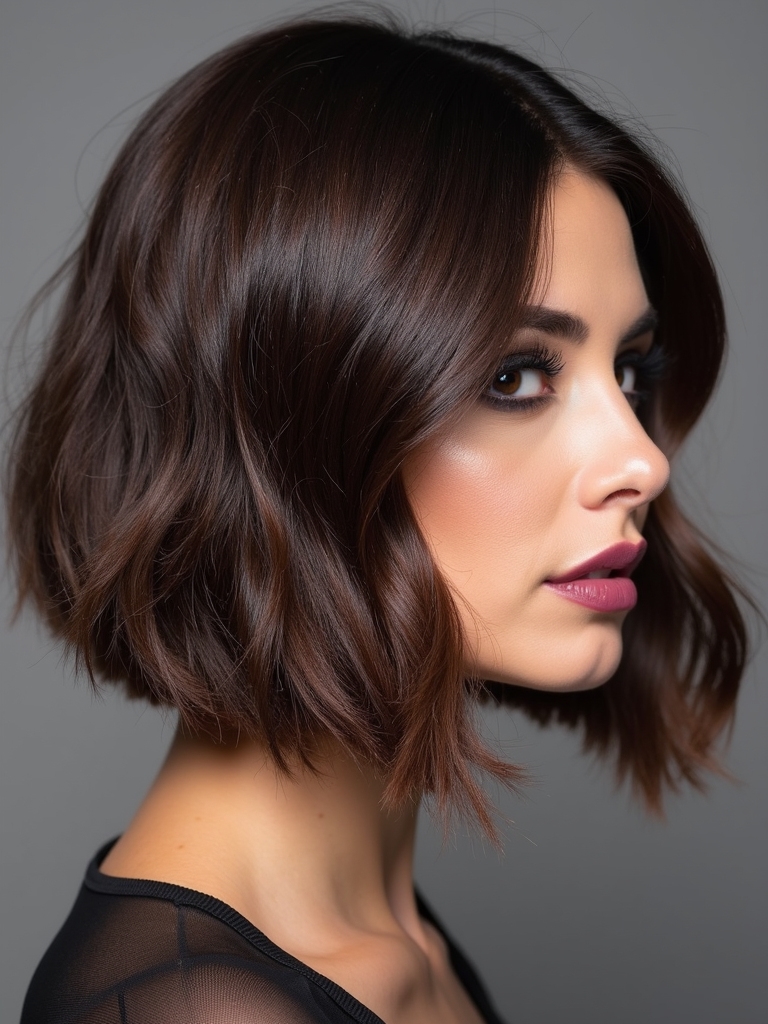
Two inches of front length separates the most-requested version from the boldest, and they behave differently in every way that matters. Chin length keeps the cut soft, forgiving, and easy to grow out. Neck-grazing sharpens everything, showing more jaw and more neck, and it commits you to a longer road back. Our chin-length bob roundup sits entirely at the softer end.
- Chin length: flatters nearly every face, tucks behind an ear, grows out invisibly
- Neck-grazing: stronger line, needs confidence in your jaw, grows out through an awkward stage
- Unsure? Start at the chin. Going shorter next time takes ten minutes
Pairing Bangs With the Stack

A stacked bob puts weight at the back, and a fringe answers it at the front. Without one, the whole silhouette can lean backward, especially at steeper angles.
Curtain bangs and side-swept pieces both work because they connect into the angled front and travel with it. A blunt fringe fights the diagonal, which is why it rarely turns up on a properly angled stack. See our bob with bangs guide for the pairings.
- Ask for the fringe to blend down into the front angle with no hard edge
- Curtain bangs suit steeper angles; a soft fringe suits gentler ones
- Skip a blunt fringe unless your front sits level all the way across
“The sentence that gets the right fringe is blend the bangs into the front angle. Asking simply for bangs on a stacked bob usually returns a blunt fringe, which sits at odds with a diagonal front and leaves you pinning it back within a week.”
Sculpted, Dimensional Color Through the Stack

Flat color hides a graduated shape. Every layer reflects light identically, the stack disappears into a single tone, and the cut you paid for becomes invisible in photographs.
Dimension fixes that mechanically. Lighter pieces catch light at the top of each layer while darker ones fall back, so the eye finds depth exactly where the shape has depth.
Placement matters more than technique here. Ask the colorist to weave brightness through the stacked section specifically. Almost nobody thinks to, because the instinct is always to lighten around the face.
Rough-Dry, Then Polish

One tool does nearly all of this: a round brush, medium barrel, used at the back. The motion is a curve under, following the shape the cut already has.
Five Minutes, Once You Know the Motion
Sequence saves you time. Rough-dry to about eighty percent with your fingers first, then section and brush only the back and front perimeter, which takes five minutes once the movement is familiar.
Finish with cool air before you let a section go. Hair sets in whatever shape it cools in, and skipping that step is why a morning blow-dry can drop by lunchtime.
Keeping the Silhouette Intentional as It Grows

Grow-out on a stacked bob is a specific problem: the short nape lengthens fastest in visual terms, the shelf softens, and around week ten the cut becomes an unremarkable bob with a slightly heavy back.
Plan the Exit at the First Appointment
Planned properly, that is fine. Tell your stylist at the start that you intend to grow it, and each visit can lower the graduation slightly instead of resetting the same angle, so you migrate toward a longer bob without ever passing through a bad stage.
Left unplanned, it goes the other way. Repeated shape-ups at the same angle keep the nape short indefinitely, which is fine if you want the cut and frustrating if you were quietly hoping for length. I ask about this at the first appointment now, because the answer changes how I cut the back.
Tailoring the Stack by Face Shape

Face shape changes two settings on this cut, and only two: how steep the graduation runs and where the front stops. Everything else stays the same.
Two Settings, Not Twelve
Round and square faces do better with front length at or past the jaw, since a diagonal line breaks up width. Long or oval faces can carry a shorter front, and often benefit from a gentler stack that avoids adding height to an already long profile.
Heart-shaped faces sit in the middle. A moderate stack with a chin-length front balances a wider forehead against a narrower chin without needing a fringe to do it.
Three words that make a stacked bob consultation go faster
📖Elevation
How far the hair is lifted away from the head while it is cut. Higher elevation produces shorter layers underneath, which is what builds the stack.
📖Weight line
The point where the shortest layers stop and the length begins. On a stacked bob it sits high at the back, and moving it up or down changes the whole silhouette.
📖Occipital
The curve you can feel at the back of your skull. Graduation usually starts here, so naming it tells your stylist exactly where you want the shelf to sit.
Bring Crisp Back-View Reference Photos

This is the one cut where a front-facing photo is close to useless. The information your stylist needs, meaning the elevation used at the back and how short the nape sits, is only visible from behind.
Bring two or three back views, and be honest about your morning routine. A stack cut for someone who blow-dries daily is a different cut from one built to air-dry, and that gets decided at the consultation, well before any shears move.
The Details That Make It Transformative

The before-and-afters getting saved right now almost always show the same trade: long, flat, one-length hair replaced by a shape with structure. The drama comes from volume arriving where there was none, and the lost length is incidental.
That is worth knowing if you are hesitating. What you would be buying is a silhouette, and if your hair currently hangs without ever quite doing anything, that is the exact problem this cut was designed for. Our short stacked bob page handles the shorter end of the family.
- Biggest change on fine, straight, one-length hair that has never held volume
- Smallest change on hair that is already layered and already has movement
- Reversible in roughly a year, which is worth hearing before you book
Stacked Bob Questions Answered
?What is the actual difference between a stacked bob and an A-line bob?
An A-line describes the front: short at the back, angling longer toward the face. A stacked bob describes the back: graduated layers building a rounded shelf. Most A-lines are stacked, but a bob can be stacked with a level front, and it can be A-line with a blunt, unlayered back. Naming both at the consultation is clearer than naming either.
?Can a stacked bob be cut into a naturally flat, straight head of hair?
That is the ideal candidate. Straight hair shows graduation most clearly because nothing distorts the line, and hair with no natural body benefits most from volume being built in structurally. The only caution is precision, since straight hair also shows any unevenness in the stack.
?Will the back look flipped-out or shelf-like after a few weeks?
It can, and the usual culprit is density. As the stack grows, the shortest layers gain weight and start pushing outward where they used to curve under. A five-minute round-brush pass fixes it day to day, and light internal debulking at the next visit fixes it properly.
?Is this cut wearable if I never blow-dry?
Yes, but ask for it to be cut that way. An air-dry version needs slightly less elevation and a slightly longer nape, so the shape holds without a brush. Cutting a steep, blow-dry-dependent stack for someone who air-dries is the most common mismatch on this cut.
?Does a stacked bob work on coily or tightly curled hair?
It does, with two adjustments. The shaping has to be done on dry hair so each curl is cut where it actually sits, and the graduation runs gentler than it would on straight hair, since coils already supply the volume that graduation is normally there to create.
One Angle, Sixteen Outcomes
Every version on this page comes back to the same two decisions: the steepness of the graduation, and where the front stops. Curl, density, face shape, and color all adjust those two settings, which is worth knowing at a consultation where you have four minutes to describe what you want.
So the useful things to say are steepness, nape length, front length, and how much time you spend drying your hair. Say those four and a stylist can build any version on this page. Say only that you want a stacked bob and you will get whichever one they cut most often.
Worth a Look