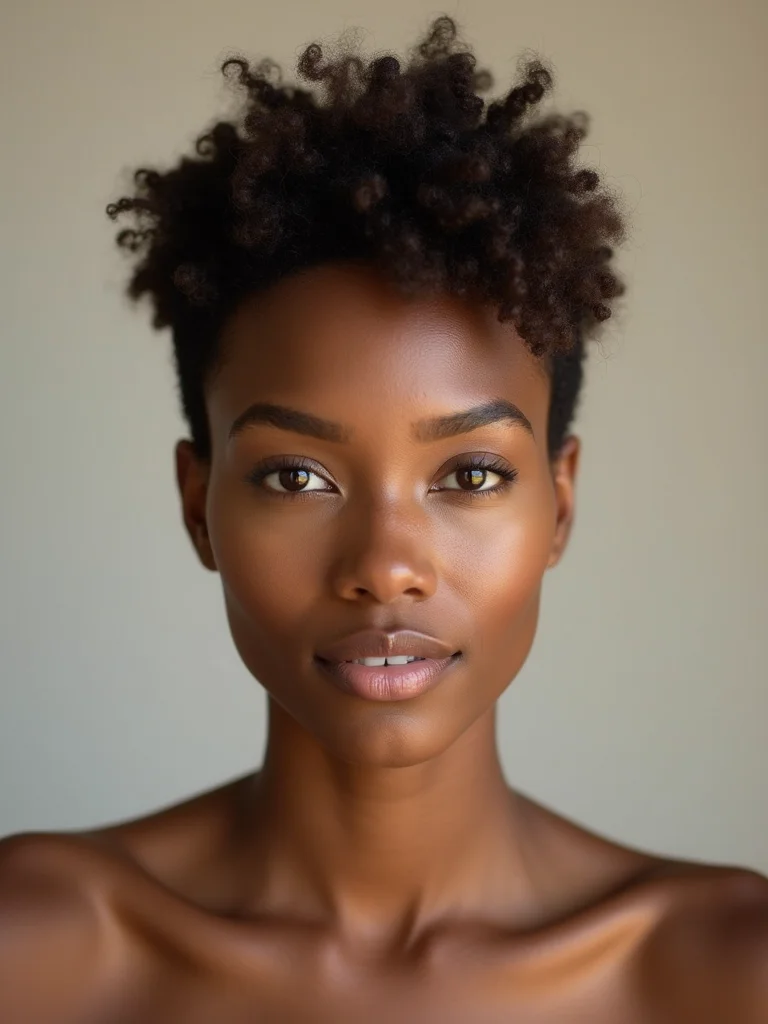
Most bobs go flat in the same spot: the back of the crown, where the hair sinks and the shape collapses by mid-afternoon. Short stacked bob haircuts are built specifically to fix that, graduating short layers up the back of the head into a rounded cushion that holds its own lift all day.
Eighteen versions follow, sorted by face shape, texture, and how much drama you want, along with the honest styling, color, and trim details that decide whether this is the bob that finally stays full where yours falls flat.
Matching Stack Height to What You Want
| Stack Style | Best For | Trim Rhythm |
|---|---|---|
| High stack, sharp angle | Round or heart-shaped faces wanting maximum volume | Every five to seven weeks |
| Low, soft stack | Long faces or anyone wanting subtle body | Every seven to nine weeks |
| Textured, undone stack | Anyone who wants a more forgiving, lower-maintenance finish | Every eight to ten weeks |
How the Stack Actually Builds Volume

The stack is a simple idea, executed precisely: short layers graduate up the back of the head, each one a little shorter than the layer beneath it, so they pile up and support each other the way shingles overlap on a roof.
Lift Built Into the Cut
The result is standing volume that doesn’t depend on teasing or spraying it into place. The shape itself does the work, which is why a stacked bob holds its body long after a one-length bob would have collapsed.
By the third wash after a fresh cut, the difference shows clearly: a one-length bob is already sinking at the crown, while the stack is still holding its shelf of lift.

Matching the Stack to Your Face Shape

A stacked bob isn’t one fixed shape. The two levers a stylist actually moves are how high the stack is built and how long the front is left, and adjusting both is what tailors the cut to a specific face.
Two Levers, Many Faces
More height at the back paired with a longer, angled front draws the eye up and down, which flatters round and heart-shaped faces. A lower, softer stack with a shorter front suits long faces better, since extra height only stretches them further.
Square jaws get a gentler treatment: the front pieces stay long and lightly face-framing, softening the hard line at the jaw.
Match your face shape to a starting point:
🎯Round or heart-shaped face
Go higher at the back and keep the front long and angled to draw the eye up and down.
🎯Long face
Keep the stack low and soft, and cut the front shorter so it doesn’t add extra length.
🎯Square jaw
Leave the front pieces long and lightly face-framing instead of blunt at the jawline.
The Round Brush Is the Real Styling Tool
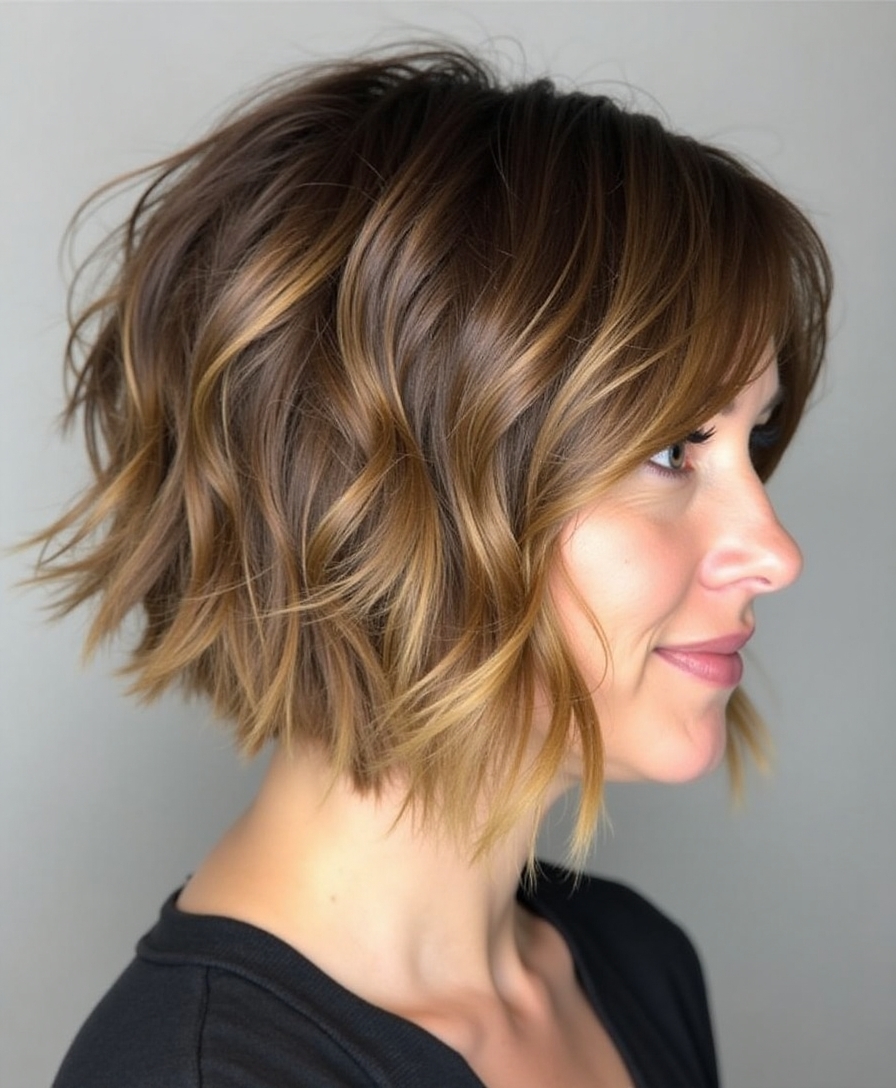
A stacked bob is only half-finished until a round brush shapes it. The cut creates the potential for volume, but the brush is what lifts and rounds it into its final form while it dries, earning its place more than any other tool in the routine.
- A medium round brush to lift the roots at the back and round the ends under
- A blow-dryer with a nozzle and a cool-shot button to set the lift
- A light volumizing mousse before drying, plus a flexible-hold spray to finish
Keeping the Stacked Back From Losing Its Shape

There’s one honest catch with this cut: the stacked back is the first part to lose definition, and it happens faster than a one-length bob’s grow-out ever would, since the closely graduated layers blur together as everything grows at once.
- A shape-up on roughly a five-to-seven-week cycle keeps the stack from flattening
- The back loses shape before the front does, so the cut can look fine head-on and flat from behind
- Ask specifically for the back to be re-stacked at each visit if you’re stretching between full cuts
The A-Line Stacked Bob

Combine a stack with an A-line and the result is the most striking version here: a short, lifted back paired with long, dramatically angled front pieces, closer to a dedicated a-line bob up front than to a standard stack. The contrast between the two is what makes the whole shape read as intentional.
Lift Meets a Sweeping Line
The forward angle elongates the neck and slims the face, while the stacked back supplies the volume, so the cut delivers lift and a lengthening line at the same time.
The trade is upkeep: both the precise angle and the stacked back show growth quickly, so this version rewards someone who keeps their appointments on schedule.
The Textured, Undone Stack
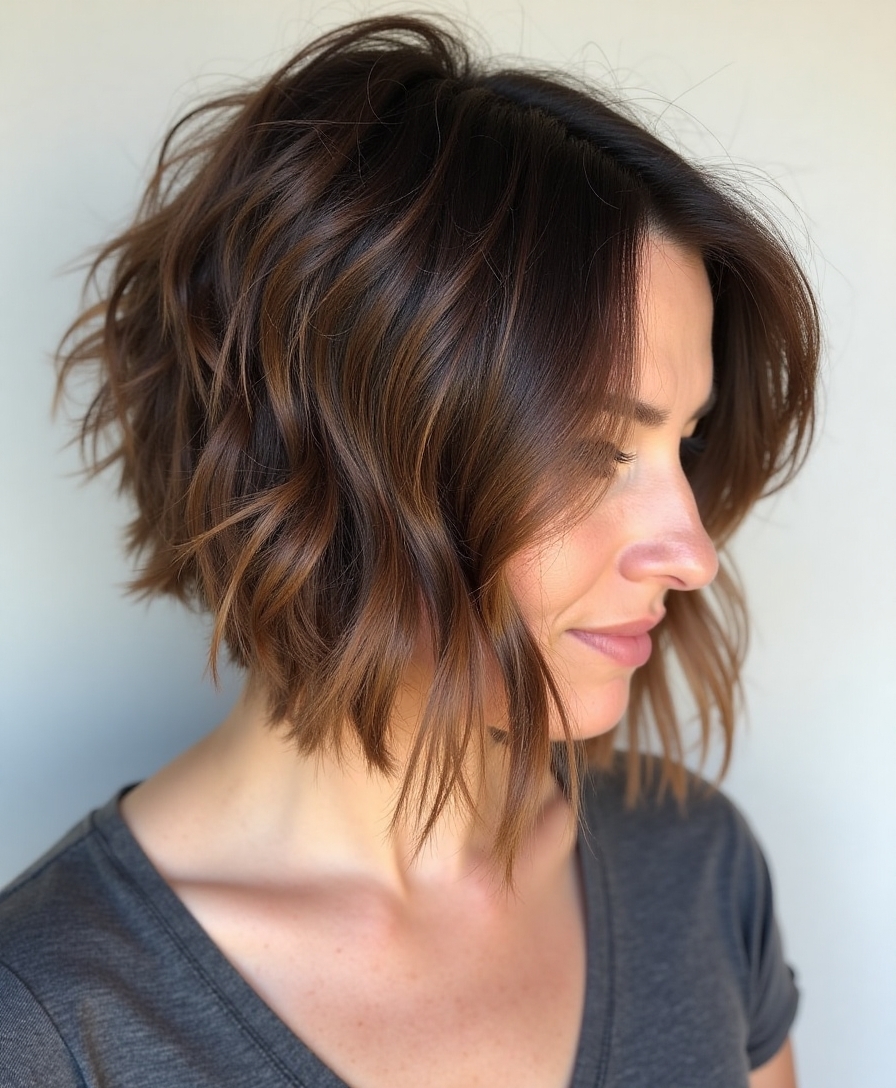
If a smooth, rounded stack feels too polished for your taste, texture is the fix. Point-cutting and a little choppiness through the stacked layers soften the shape into something casual and current.
It’s also more forgiving day to day, since textured ends don’t need to be brushed into perfect formation to look intentional. This is the version that bridges the classic stack and a looser, more modern layered bob mood.
Color That Makes the Stack Look Fuller
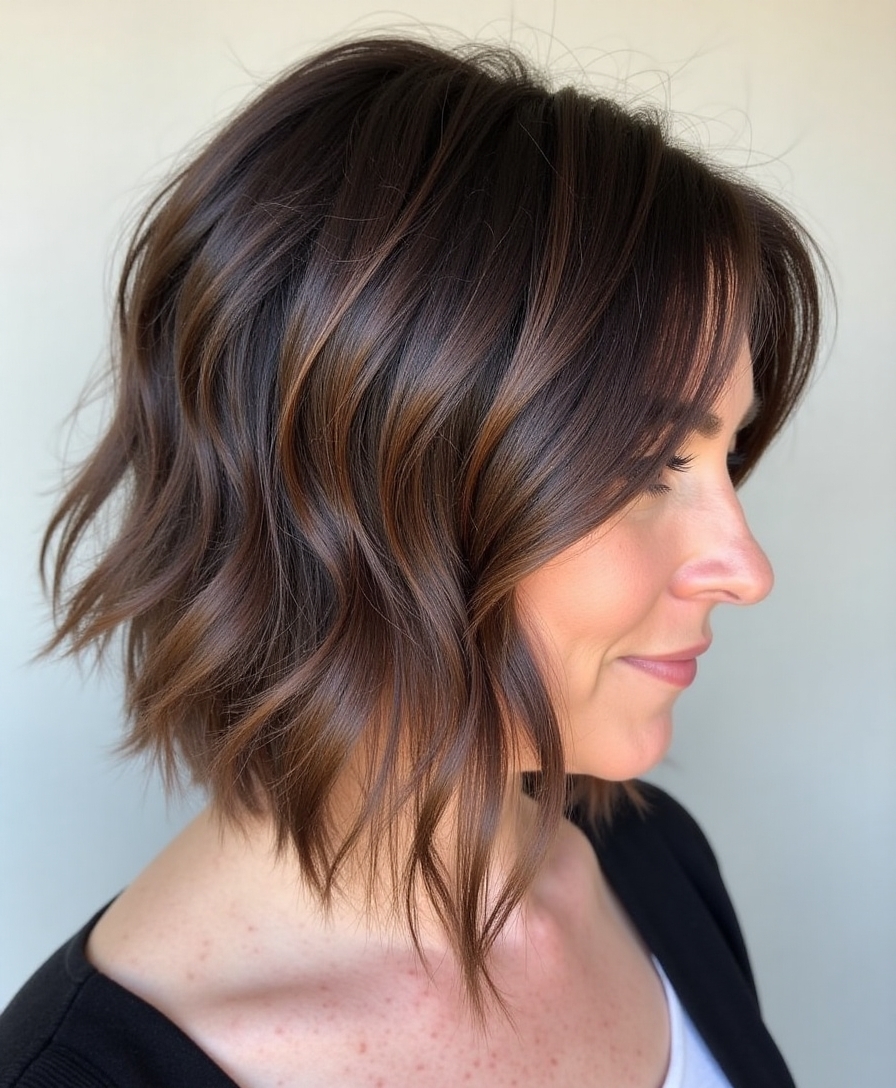
Color is a quiet volume trick on a stacked bob, since dimension reads as density. Weaving darker lowlights underneath and brighter pieces on top creates shadow and light that make the layers look deeper than a single flat shade ever could.
Lowlights especially work as the fine-hair fix here: a darker shade tucked under the stack creates the illusion of more hair packed into the same space, a trick that flatters any layered bob but shows best on a stacked one.
🅰️Flat, Single-Process Color
One even shade across the whole cut, which reads as flat as the stack does when the roots are due.
🅱️Lowlights Under, Brighter On Top
Shadow underneath and light on top, so the color itself adds the illusion of depth the stack is already building.
Bring Photos of the Back, Not Just the Front

The single most useful thing to bring to this appointment is a photo of the back, not the front. The entire point of this cut lives behind your head, somewhere you can’t see it yourself and most reference photos never show it.
- Find images shot from behind or in profile that show the stack and its angle
- A front-on glamour shot tells a stylist almost nothing about how the back is built
- Save two or three so a stylist can see the range of back-volume you’re picturing
Saying It So Your Stylist Gets It

Beyond photos, a few precise words save you from a miscommunication. Tell your stylist how much height you want in the stack, since ‘stacked bob’ covers everything from a soft graduation to a dramatic, rounded shelf of volume.
Be specific about the front too: name where you want it to land against your face, and whether you want it angled forward or kept even. The clearer the height and angle, the closer the result lands to what’s in your head.
The Five-Minute Morning Routine

The daily routine is short once the technique clicks, and it lives entirely in how the back gets dried.
- Rough-dry to about eighty percent, then mist a little mousse through the back
- Lift the roots straight up at the crown with the round brush and roll the ends under
- Finish the back with the cool-shot button to set the lift
The morning the routine finally clicks is the morning the back stops getting smoothed flat and starts getting rolled under instead.
Growing It Out Without the Awkward Middle

Growing out a stacked bob takes a plan, because the stacked back is what makes the grow-out tricky. Left alone, the short back layers grow into a mushrooming shape while the front races ahead of it.
- Keep trimming on schedule to soften the stack gradually as it lengthens
- Ask a stylist to blend the back layers down toward the front’s length over several cuts
- A longer layered bob is the natural next stop once the stack has mostly grown out
Seasonal Finishing Tweaks

The cut itself stays constant year-round, but the finish needs small adjustments to keep the volume holding, since humidity and dry winter air each work against a stacked shape in their own way.
Same Cut, Shifting Finish
In humid months, a little anti-humidity cream and a firmer hold spray keep the stack from falling and frizzing. In dry winter air, a touch of light oil on the ends only, kept off the roots, stops the static that flattens fine hair.
Year-round, the rule holds steady: moisture stays on the ends, lift stays at the roots, and the stack keeps its shape either way.
Mistakes That Flatten the Stack

A stack cut correctly at the salon can still collapse at home, and the habits that undo it are easy to fall into without noticing.
What Actually Undoes It
The biggest is skipping the round brush and letting the back air-dry, which leaves the stack pressed flat against the head. The others are about weight: heavy conditioner and rich serum applied at the roots drag the volume straight down.
Stretching the trim schedule too long lets the stacked back blur into a shapeless lump. Keep conditioner on the ends, keep the round brush in rotation, and stay close to schedule, and the stack keeps delivering the body it was cut for.
Stacking Across Hair Textures

Every texture can wear a stacked bob, but the approach shifts a lot from one to the next, since the stack behaves very differently on straight hair than it does on curls.
- Straight, fine hair is the classic match, since the stack builds volume it can’t grow on its own
- Thick hair wants internal weight removed before stacking, so it lifts cleanly at the crown
- Curly and coily hair can stack beautifully; the curly bob guide covers the dry-cutting technique this needs
📋Before You Book, by Texture
- ✓Fine, straight hair: ask for the stack cut close to the scalp for maximum lift
- ✓Thick hair: request internal thinning before the stack is built
- ✓Curly or coily hair: confirm the cut happens dry, on your natural pattern
The Modern, Softer Stack
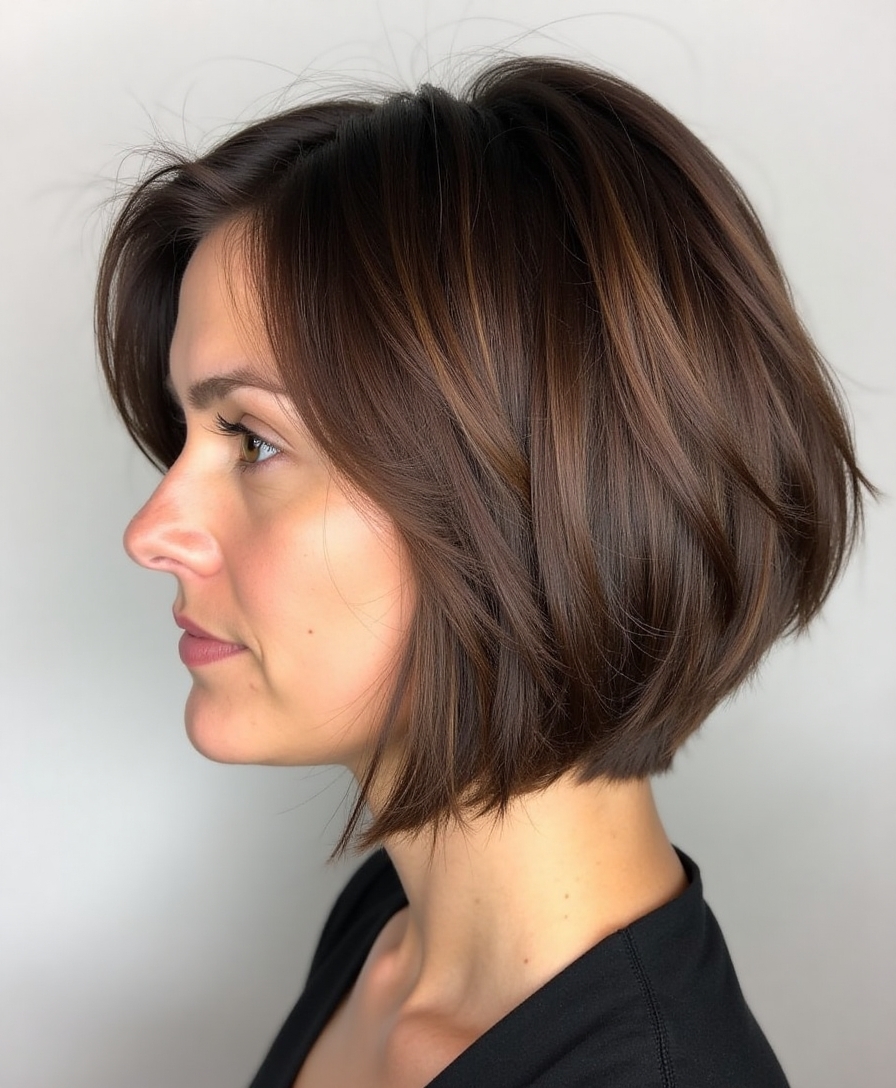
If the words ‘stacked bob’ bring to mind a stiff, rounded helmet from decades past, the modern version will change that picture, even next to a classic stacked bob haircut. The shift is mostly in how it’s worn.
Volume Without the Helmet
Today’s stack is finished with movement and a slightly imperfect shape, styled loose after the blow-dry rather than sealed into a hard, glossy dome. The volume is identical to the classic version; what changed is the attitude.
It gets worn tousled and a little undone, styled with a matte product, with a piece or two left out of formation on purpose.
Customizing Height and Angle
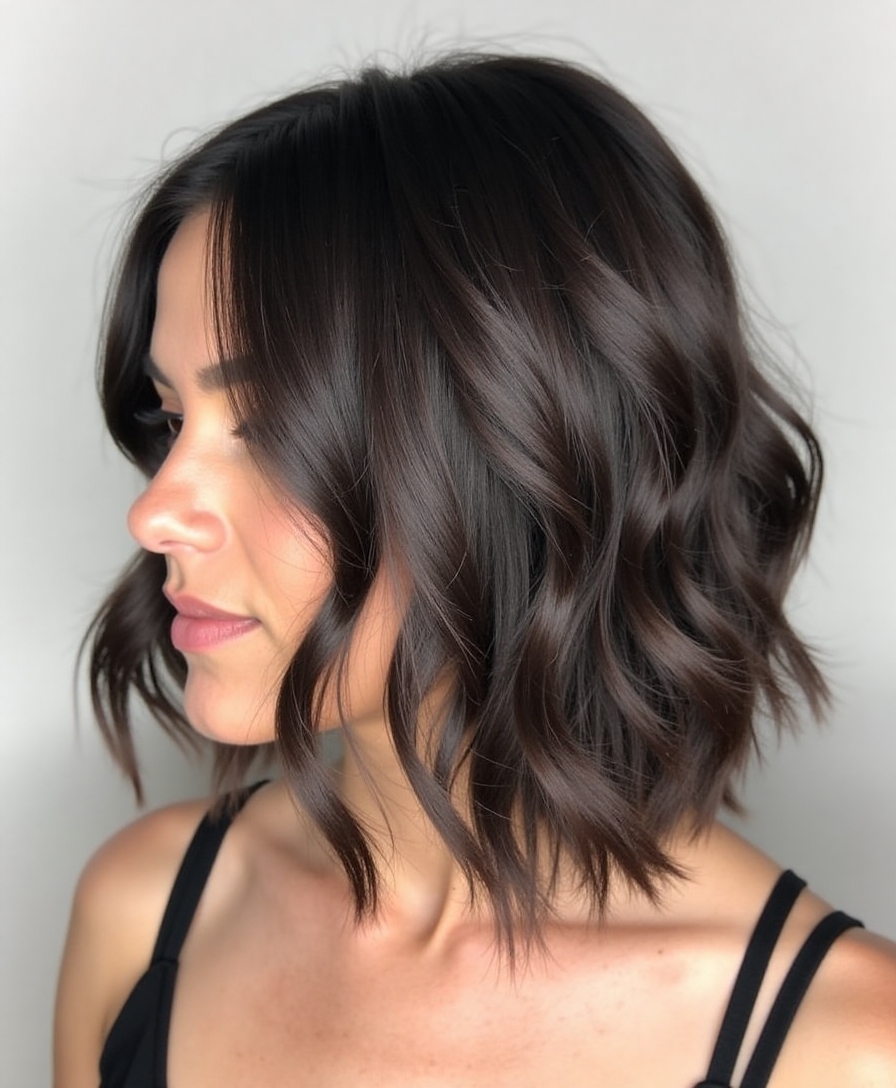
Once the two main dials, stack height and front angle, are understood, a stacked bob can be built to fit a specific face and hair, not just a photo pulled off the internet.
There’s no single correct setting, only the one that matches your face, your hair, and how much volume and drama you actually want to carry.
- Higher stack, sharper angle: bold and dramatic, with maximum volume and a strong line
- Lower stack, softer angle: subtle and easy, with gentle body and less upkeep
- Mixing the two settings to taste is completely normal; there’s no fixed combination
Why This Cut Belongs at the Salon, Not at Home
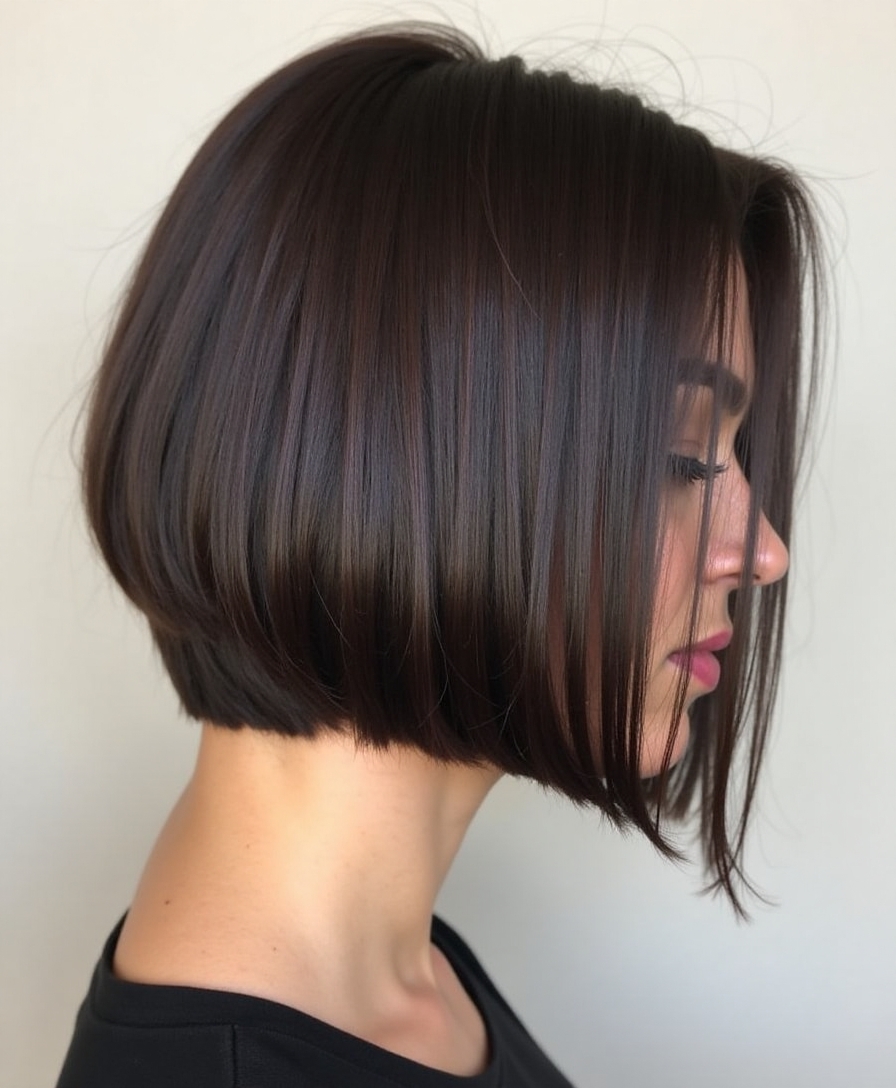
This is one cut worth talking yourself out of attempting at home. The stacked back is precise, graduated work happening outside your own sightline, which is exactly how home attempts end up lopsided and choppy.
It’s also the part of the cut doing all the work, so getting it wrong undoes the entire point. A box-store trim can run as little as $20, while a stylist who builds a stack correctly typically charges $55 to $90, and that price gap is also the gap between a stack that lifts and one that just looks uneven.
- The graduated back is technical work and outside your own line of sight
- A professional builds the stack to match your head shape and hair density
- Save the at-home effort for styling the finished cut, not cutting it yourself
What to Expect
This cut answers one specific complaint better than almost anything else: hair that goes limp at the crown and a bob that deflates by lunch. In exchange, it asks for a round brush in rotation and a tighter trim schedule than a blunt bob needs.
Anyone willing to pick up the brush and keep the appointments gets body that lasts all day. Anyone who wants zero styling and zero upkeep is probably better served by a softer, textured shape instead.
Short Stacked Bob Questions
?Will a stacked bob suit a round or fuller face?
It can flatter beautifully with one adjustment: keep the front pieces long and angled so they fall past the chin, pulling the eye downward. Pair that with height built into the back rather than the very top, so volume gets added without widening the silhouette.
?Can a stacked bob be air-dried instead of round-brushed?
It can, but expect softer, lower volume than a brushed finish delivers. If air-drying is the plan, say so upfront so the stylist cuts a textured version designed to hold shape without the extra styling step.
?What happens if the trim schedule slips by a few weeks?
The back loses its definition first, so the cut still looks fine from the front while flattening out behind. A quick re-stacking trim usually fixes it faster than waiting for a full cut, and it costs less than starting the whole shape over from scratch.
?Does a stacked bob work on hair that’s already color-treated?
Yes, though a stylist may adjust the internal layering if the ends are fragile from processing, since a heavily stacked back puts more finished edges through regular round-brush heat. A bond-building treatment beforehand can leave those edges in better condition for it.
Body Right Where You’ve Needed It
A stacked bob earns its following honestly. It doesn’t promise to suit everyone or do everything; it does one thing exceptionally well, building lasting volume into the exact spot where most bobs give up first. For a wider spread of stack heights and angles to browse first, the best short stacked bob haircuts roundup is a good next stop.
Does your hair fall flat at the back by midday, and are you willing to keep a round brush and a steady trim schedule to fix that?
More to Try