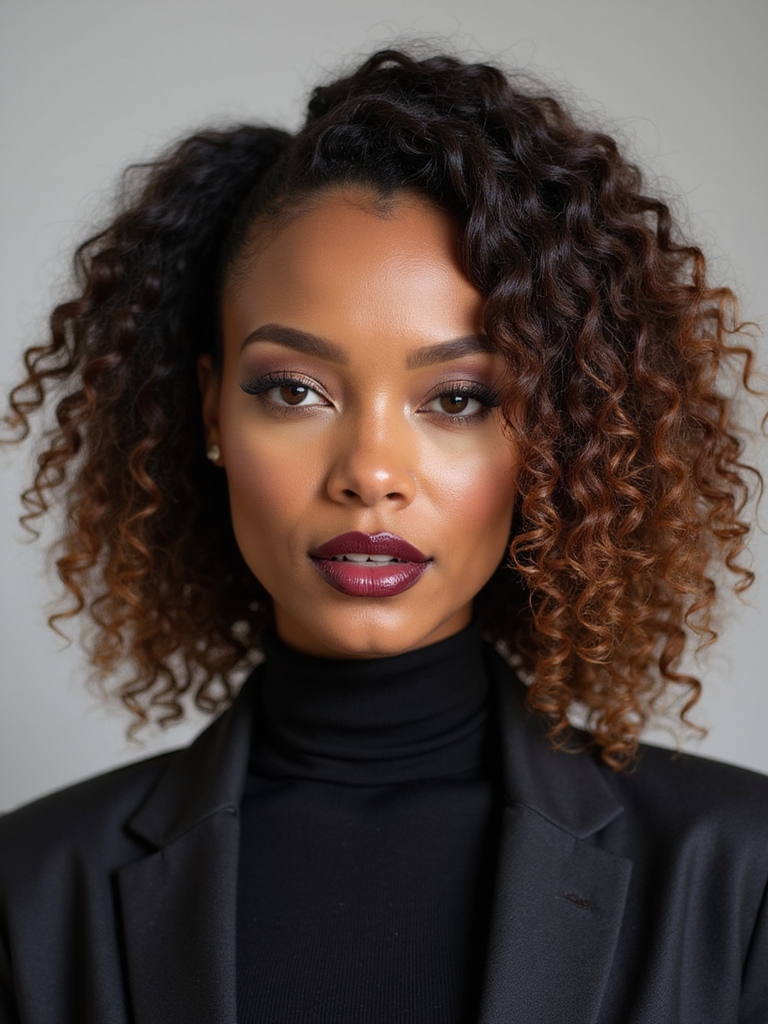
Winter does not damage hair. Knitwear does. A wool collar rubbing the same three inches of hair for eight hours a day is a mechanical problem, and it is why the ends of everyone’s hair look worse in February than they did in October.
Which reframes what a good cold-weather style actually is: the one that keeps your hair off a collar, out of a hood, and away from a hat brim. Fifteen follow, each chosen for what it survives.
What Actually Wrecks Hair in Winter
Three things do nearly all the damage, and none of them is temperature. Friction against wool and synthetic collars roughens the cuticle along the exact stretch of hair that sits at your shoulders. Static builds because dry indoor air strips moisture from the strand. And hats compress the roots for hours, which is why hair looks flat rather than damaged when you take one off.
Every style below deals with at least one of those. Anything gathered above the collar removes the friction problem entirely, anything with texture built in survives being flattened, and a silk-lined hat solves more than any product on the shelf. A $12 silk scrunchie outperforms a $50 blowout for winter hair by a wide margin, because the blowout is gone by the time you have walked to the car.
A Cozy, Textured Messy Bun

The default winter style, and it earns the position honestly: everything is above the collar, nothing is touching wool, and it takes about forty seconds.
Why This Is a Day-Two Style
Texture is what keeps it from sliding out. Hair with a little grip stays where it was put; freshly washed hair works its way loose inside an hour, which is why this is a day-two style.
Leave a few pieces down at the front and keep the gather loose. A bun pulled tight at the crown all winter puts the same tension on the same section every day, and that is worth rotating.
A Low Ponytail With Soft Volume

A low ponytail sits exactly where a collar sits, which makes it the one gathered style that does not solve the friction problem. It solves a different one.
Under a coat with a hood, everything gathered high gets crushed the moment you pull the hood up. Low ponytails survive that, which is why they turn up on anyone who spends the season outdoors.
Build volume at the crown before you gather, then keep the band loose. Volume added first survives; volume added after the ponytail is tied never does.
Loose Boho Braids Tucked Into a Scarf

Braiding before you tuck is the whole trick. Loose hair pushed into a scarf comes out tangled and roughened along its length; braided hair pushed into the same scarf comes out as a braid.
Two loose braids sit flatter under layers than one thick one, and they take about the same time. Our layered braids guide covers the variations.
- Braid loosely, so the scarf is not compressing an already tight pattern
- Tuck the ends fully inside; exposed tips are the part that frays against wool
- Undo them the moment you are indoors, since braids left damp under a scarf stay damp
Three terms worth knowing for cold-weather hair
📖Static
Charge building on dry hair as it rubs against synthetic fabric. It is a moisture problem, which is why a humidifier fixes more of it than any spray.
📖Pancaking
Tugging gently at the outer edges of a finished braid until it widens. It adds visible thickness without adding hair, turning a thin plait into a substantial one.
📖Silk-lined
Hats and bands with a smooth inner surface. The lining removes friction against the hair. It does nothing for warmth and a great deal for your ends.
A Sleek Donut Bun

The most protective option on this page, since every inch of length is wrapped and nothing is exposed to anything. It is also the one that looks deliberate enough for an office, which is why it survives the whole season on a lot of heads.
- Second-day hair holds this far better than clean hair, which slides against the form
- Anchor the base with two crossed pins before you start wrapping
- A light mist of hairspray on a brush, then over the surface, keeps static down without stiffness
A Tousled Half-Up Knot

Half-up is the compromise style, and in winter it is a compromise in the literal sense: the top half is protected and the bottom half is still against your collar.
That makes it a good indoor style and a poor commuting one. Wear it at a desk, gather it fully before you put a coat on.
- Take the section from temple to temple, no further back, or the knot sits too low
- Twist and pin, so no band presses into the crown under a hat
- Works on second-day hair; on clean hair it needs texture spray to hold at all
Two things everyone believes about winter hair
❌ Myth: Cold air damages hair
✅ Reality: Cold air does very little. Dry indoor heating and constant friction against knitwear do nearly all of it, which is why the damage shows at collar height rather than everywhere.
❌ Myth: Hats cause hair loss
✅ Reality: A hat flattens roots and can rough up the surface, and that is where it ends. Tension is what stresses a hairline, so a tight ponytail worn under a hat every day is the thing worth changing.
Cozy, Relaxed Beachy Waves

Waves are the one loose style that handles a collar reasonably well, because texture that is already broken up does not show friction the way a smooth surface does.
Heat is the thing to be careful about here. Dry winter air plus an iron every morning is a compounding problem, and heatless methods produce a softer wave anyway. Our heatless waves guide covers the overnight versions.
- Set them overnight on damp hair; the air is dry enough that they will hold for two days
- A cream instead of salt spray, since salt on top of winter dryness is a lot
- Refresh with water and your fingers on day two; more product just builds up
A Pinned, Twisted Side Sweep

Sweeping everything to one shoulder and pinning the opposite side is the fastest way to look like you did something, and it has a practical winter advantage nobody mentions: it keeps hair out of one side of a scarf entirely, so the friction happens on half as much hair.
- Twist the swept side back and pin behind the ear, angling the pins toward the scalp
- Sweep away from the side you carry a bag on, since a strap catches whatever hangs there
- It takes ninety seconds and looks intentional in a way a plain ponytail does not
💡Fix Static at the Source
Spraying a flyaway does nothing about why it happened. Static builds because the air in a heated room is dry, so the effective fixes are a humidifier in the room you sleep in, a fabric band instead of a plastic clip, and a silk pillowcase. If you need something immediate, a little hand cream smoothed over your palms and skimmed across the surface works better than most anti-static sprays.
A Chunky Braided Headband

A braid taken across the crown does the job a headband does without adding anything that will slip. In winter that matters more than usual, since plastic headbands and hats are a bad combination.
Pancaking is what gives it presence. Once it is pinned, tug gently at the outer edges of each crossing until the braid widens, which turns a thin plait into something substantial without any extra hair.
A Soft Layered Lob

Everything else here is styling. This one is a cut, and it is the most useful decision on the page for anyone who spends winter fighting their hair. A lob sitting just past the shoulder clears a collar instead of resting on it.
That single inch changes how the ends look by March. Our layered lob guide covers the length in detail.
- Ask for the perimeter to clear the shoulder rather than land on it
- Layers give a lob enough movement to survive being flattened under a coat
- It is the length that suits the most winter styles, since it gathers and also wears down
A Velvet-Accented Low Chignon

Fabric accessories come into their own in cold months for a reason beyond looks: velvet and satin generate far less static against hair than plastic or metal do, so a fabric-wrapped chignon behaves better than a clipped one all day.
- Wrap the velvet around the base once everything is already pinned
- Satin-lined bands are the same principle and cost very little
- It reads dressy enough for evening while still being a chignon you did in four minutes
A Textured Top Knot Under a Beanie

Wearing a knot under a hat sounds like it should not work and does, provided the knot sits far enough forward. Placed at the very top of the head it lifts the beanie into a shape nobody wants; placed slightly forward of the crown it disappears under the fabric and keeps the hat from flattening your roots.
- Position the knot ahead of the crown, roughly above your hairline peak
- A silk-lined beanie stops the friction and the static in one purchase
- Take the knot down as soon as the hat comes off, so the crown can recover its lift
A Loose Low Chignon With Tendrils

The soft version of the gathered look, and the one that suits faces that find a scraped-back style severe. Two pieces left loose at the temples change the whole effect.
It sits low enough to be worn under a hood without being crushed, which is more than most gathered styles manage.
- Pull the tendrils out before you pin, since doing it after shifts the whole shape
- Curl the loose pieces with your fingers; they only need a bend, not heat
- Keep the chignon itself loose, so the hairline is not being pulled all day
| The layer | What it does | What to wear |
|---|---|---|
| A wool turtleneck or coat collar | Roughens the cuticle along the stretch of hair sitting at the shoulder | Anything gathered above the collar, or a braided tail |
| A hood | Crushes everything gathered high the moment it goes up | A low ponytail or a low chignon |
| A beanie | Compresses the roots for hours and builds static against synthetic linings | A forward-set top knot, and a silk-lined hat |
A Cozy Textured Braided Ponytail

Tie the ponytail, then braid the tail. Two steps, and the second one is what makes this a winter style rather than a summer one.
The Braid Is Doing Protective Work
A loose ponytail tail against a wool coat is exactly the friction problem described at the top of this page. A braided tail is contained: the surface presented to the fabric is smooth and the ends are secured.
It also brushes out cleanly when you get home, where a loose tail worn under layers turns into a knot at the nape that takes ten minutes to unpick.
A Textured, Voluminous Pixie

Short hair sidesteps the collar problem entirely, which is one of the quiet reasons crops get popular in cold months. Nothing is long enough to touch anything.
The winter issue here is hats rather than friction. A crop compresses under a beanie and has no length to fall back into shape, so the recovery move is the thing to learn. Our short layered cuts guide covers the shapes.
- Damp fingers through the roots after a hat comes off reset the lift in about twenty seconds
- Keep the interior texture generous, since texture is what recovers and smoothness is what stays flat
- A silk-lined hat matters more at this length than at any other
Heat-Free Morning Curls

Winter is the season heatless setting actually works best, and the reason is unglamorous: indoor air is dry, so hair set damp overnight is properly dry by morning in a way it never is in July.
Why It Works Better in January
Any method works on the same principle. Damp hair wrapped around something and left until fully dry sets in that shape, whether that is a fabric rod, a robe tie, or two flat twists.
The one rule is to be certain it is dry before you unwrap. Half-dry hair released from a set falls out within the hour, and in cold months going outside with a damp scalp is its own separate misery.
Winter Hair Questions
?Why do my ends look so much worse by February?
Because they have spent four months rubbing against a collar. The damage concentrates at whatever height your coat and sweaters sit, which is why it looks like a band of roughness rather than uniform dryness. Gathering hair above that line for the commute, even if you take it down indoors, removes most of the exposure.
?What actually stops static, since sprays never seem to?
Add moisture to the air, not to your hair. Static builds because dry heated air lets charge accumulate, so a humidifier in your bedroom does more than any product. After that, swapping plastic clips and bands for fabric ones and sleeping on silk removes most of what is left.
?How do I fix hat hair without washing it again?
Damp fingers at the roots and thirty seconds of head-down shaking. Water reactivates whatever product is already there, and the roots lift as they dry. Dry shampoo helps with the oil that builds under a hat but does nothing for the compression, so use both if you have been wearing one all day.
?Is it bad to go outside with wet hair in winter?
It will not make you ill, though it is bad for the hair itself. Wet strands are at their most fragile, and cold makes them stiffer and more prone to snapping when they move. Overnight heatless setting sidesteps the problem entirely, which is part of why it suits the season.
?Which of these works on a lob rather than long hair?
The half-up knot, the twisted side sweep, the braided headband, and the low chignon if you pin generously. Anything requiring a full wrap needs more length, so a donut bun and a braided ponytail want hair past the shoulder blades. The lob’s advantage is that it clears a collar on its own, so it needs less rescuing than long hair does.
It Was Never About the Cold
The useful reframe here is that nothing on this page is really a winter hairstyle. They are collar strategies, hood strategies, and hat strategies, and the cozy look is a side effect of solving a mechanical problem.
Which means the styles worth saving are the ones matching what you actually wear. Someone in a hooded parka every day needs different hair from someone in a wool coat, and knowing which layer is doing the damage tells you which two or three of these to learn properly. Our winter party styles guide covers the evenings when none of this applies.
Keep Reading