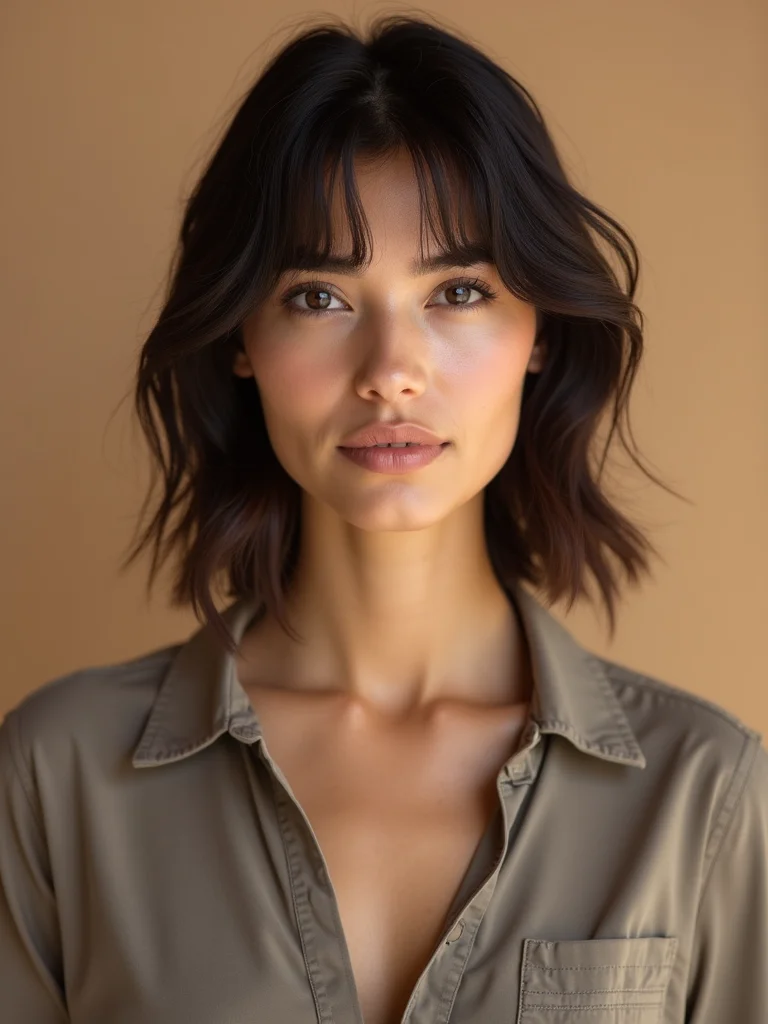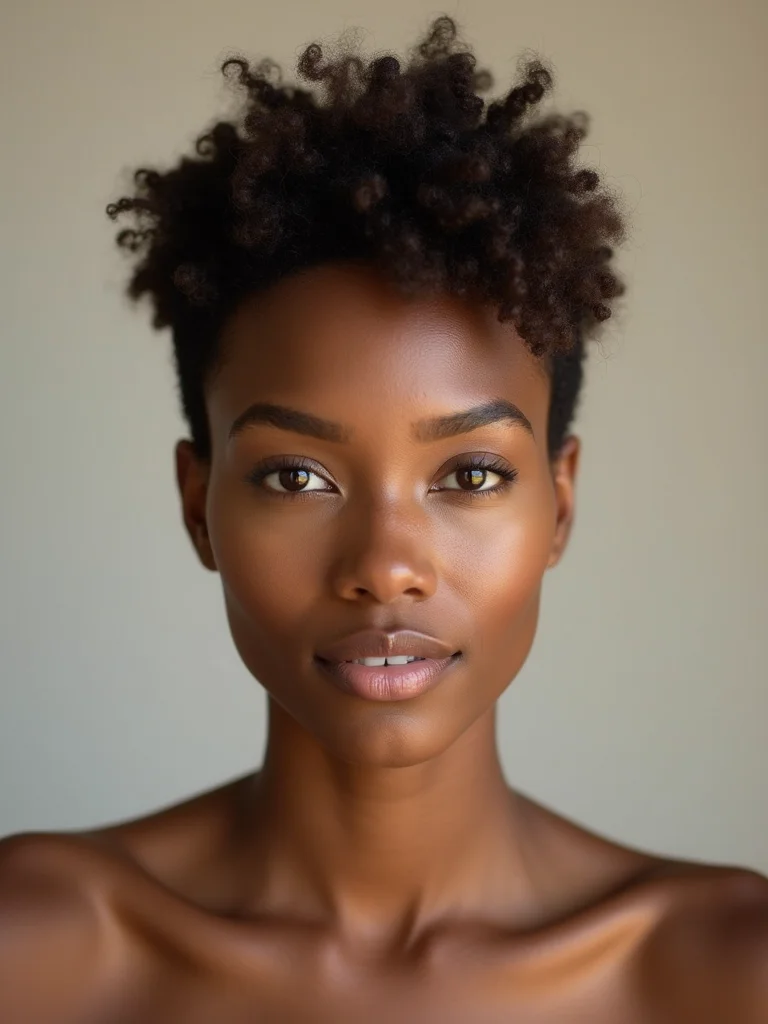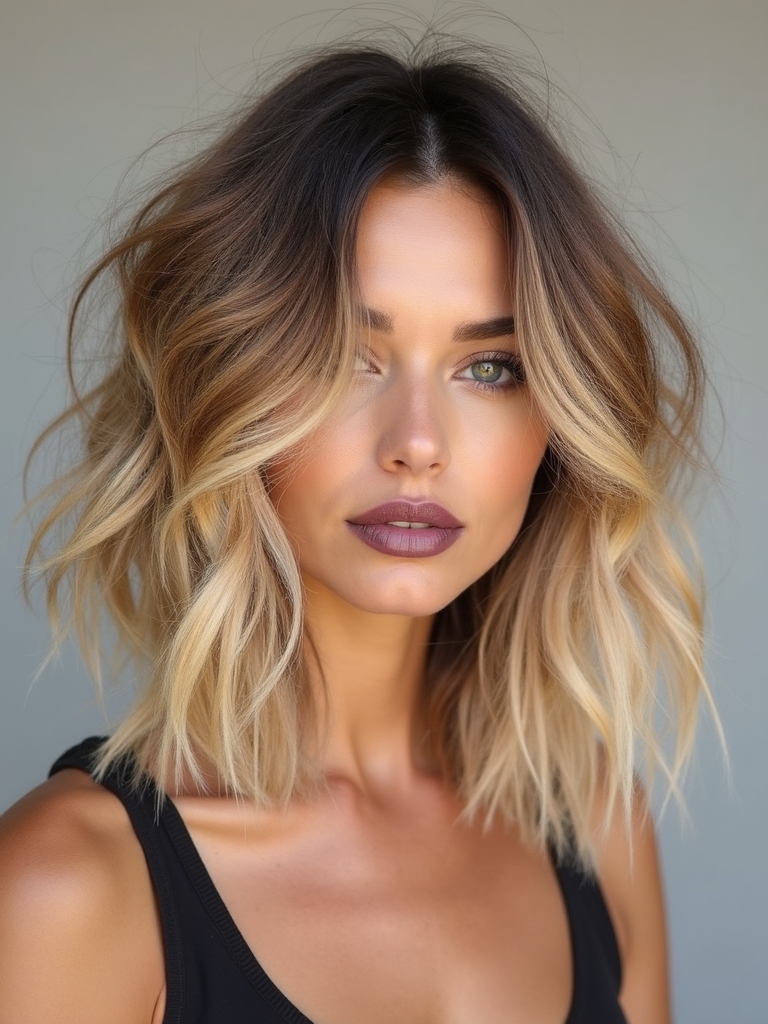
Same haircut, nine on a Monday: smoothed, glossy, ready for a meeting. Same haircut again, eight on a Friday: scrunched, undone, swinging at dinner. No trip back to the chair in between. That two-faced range is the entire appeal of the shaggy lob, a collarbone-length bob with shag texture cut through it.
Fifteen versions follow, along with exactly how to push each one from polished to undone and back, plus what to say at the consultation to get it right the first time.
Shaggy Lob, Quick Guide
| Hair type | What the layers do | Styling note |
|---|---|---|
| Fine | Add lift and the look of density | Root-lift spray plus a light hand with product |
| Thick | Remove interior weight so it moves | Ask specifically for interior de-bulking |
| Curly or coily | Give each curl room to spring without bulk | Cut fully dry, defined with cream |
The Shaggy Lob With Curtain Bangs

Pairing a shaggy lob with curtain bangs creates the most versatile starting point on this list, since the fringe itself swings both directions depending on how it’s styled. The shag haircut foundation underneath makes that flexibility possible in the first place.
- For polished: smooth the bangs and lengths with a round brush, working toward a glossy, finished look.
- For undone: scrunch a texture spray through and let the fringe fall in separated pieces.
- Either way, the fringe blends into the surrounding layers as it grows, with no obvious line to manage.
The Wavy Piecey Shaggy Lob
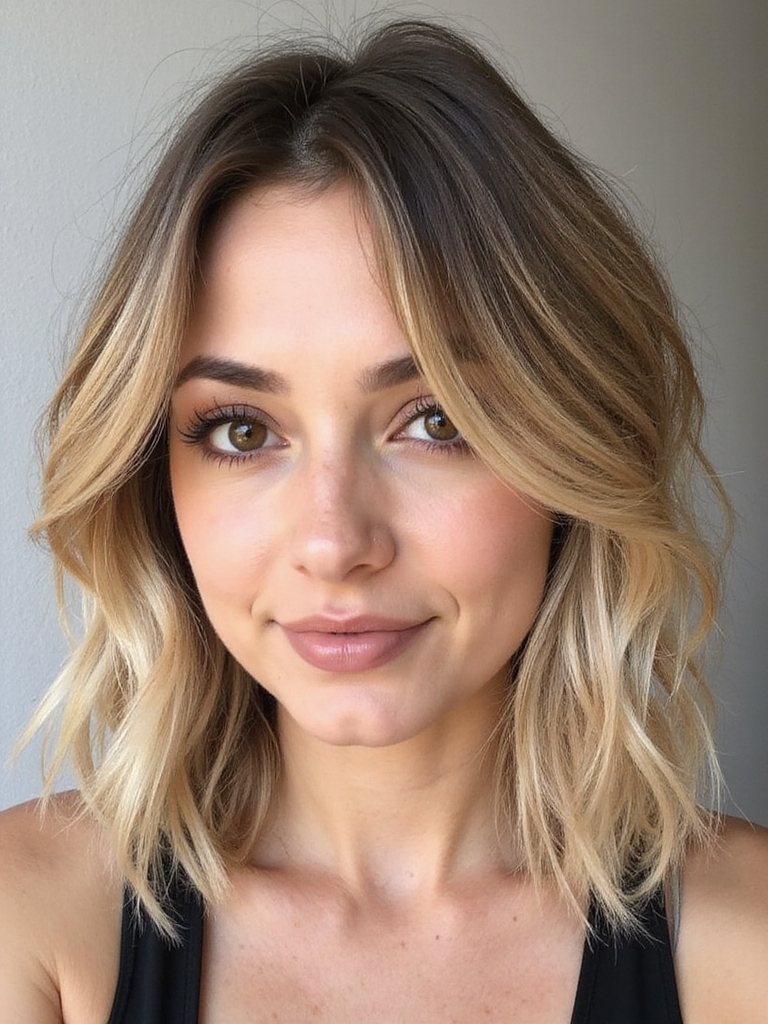
On naturally wavy hair, the piecey shaggy lob sits at the undone end of the spectrum with almost no effort involved. The wave pattern and the choppy layers do most of the actual work.
Scrunch or Smooth
The same cut blows out smooth and glossy just as easily when a polished look is the goal. Layers that read piecey when air-dried fall into a sleek, swingy shape under a round brush instead.
Most days skip both extremes, though, and just let the wave run its own course. That’s the quiet advantage of a shaggy lob on wavy hair: two finished looks from one cut, decided entirely by whether product or a brush comes out.
ℹ️What Makes This Cut Work
The shaggy lob earns its versatility from where the length sits. Collarbone-length hair is long enough to hold real body and short enough to bounce back into shape after a scrunch, a balance most longer or shorter cuts can’t match.
The Curly Shaggy Lob

Curly hair wears the shaggy lob well, with the layers giving each curl room to spring at a manageable length instead of piling into a heavy triangle shape. The curly shag haircut guide covers the dry-cutting technique in more depth.
The dual-mood idea holds here too: defined and bouncy straight out of an air-dry, or stretched smoother with a blowout when the occasion calls for it.
- Cutting happens fully dry, one curl section at a time, so each layer lands exactly where the spring settles.
- On tighter coil patterns, hair gets cut on stretched sections and thinned without removing the coil’s definition.
- A curl-defining cream on soaking-wet hair, followed by a diffuser, keeps the shape holding.
The Bottleneck-Fringe Shaggy Lob

A bottleneck fringe, rounded and shorter at the center, winged longer toward the sides, gives the lob its most flattering frame and a fresher alternative to a standard curtain fringe. The shag haircut with bangs guide has more fringe pairings worth comparing.
The winged sides flow directly into the lob’s layers rather than sitting as a separate piece.
- The rounded center reads as a fuller fringe without a heavy, blunt line across the forehead.
- The winged sides open up the eyes and frame the cheekbones at the same time.
- It styles polished when smoothed forward or undone when left to separate naturally, matching whichever mood the lengths are wearing that day.
The Beachy Air-Dry Shag Lob

The beachy version sits at the most relaxed end of the undone mood, all soft, tousled, sea-salt texture built to look its best straight off an air-dry.
- Scrunch a sea-salt spray into damp hair and leave it alone to dry on its own.
- A drop of oil on the ends keeps the texture looking cared-for rather than dried out.
- Bending a few random pieces with a flat iron adds a little more definition for anyone who wants it.
The Razored Shaggy Lob
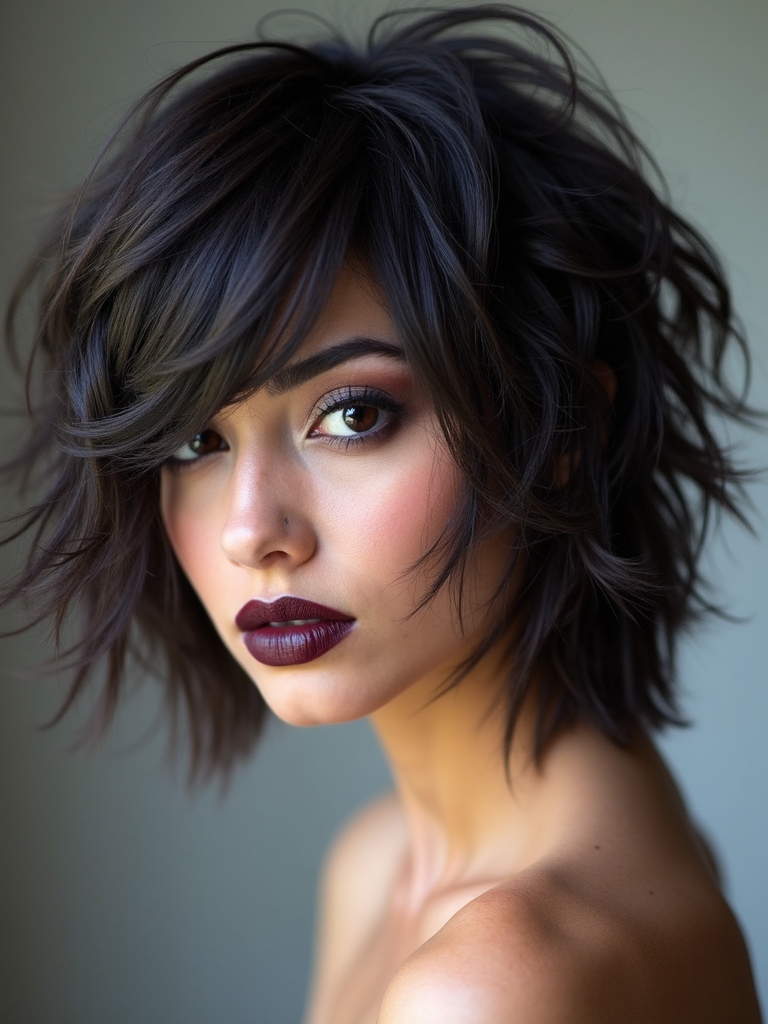
When a shaggy lob looks especially airy and edgy right at the ends, a razor is usually behind it. The blade tapers each piece to a fine point, so the ends feather and separate rather than sitting in a blunt line.
- Produces the lightest, most weightless ends of any technique on this list.
- Works best on healthy, medium to thick hair; fragile or very fine ends fray under the blade.
- The catch is skill: a razor in inexperienced hands damages hair fast, so this isn’t the place to try someone new.
Not sure which mood suits a given morning? Start here.
1Five minutes and a round brush
Go polished: smooth, glossy, one clean part.
2Thirty seconds and a texture spray
Go undone: scrunch, air-dry, break pieces apart.
3Somewhere in between
Flip the part and add a light scrunch; it splits the difference.
The Fine-Hair Shaggy Lob

Fine hair does well in a shaggy lob, since the collarbone length stays short enough to hold real lift while the choppy layers create separation that fakes density.
It sits as a flattering middle ground between a fine-hair pixie and long hair that goes limp under its own weight. The polished-versus-undone range works especially well here too.
A quick round-brush blowout with a root-lift spray gives a fuller, glossy finish for an event; a texture-spray air-dry gives piecey, casual body the rest of the time. Where this struggles is heavy thinning, which strips density instead of adding shape, so soft texturizing is the safer ask.
Thick Hair and De-Bulked Layers
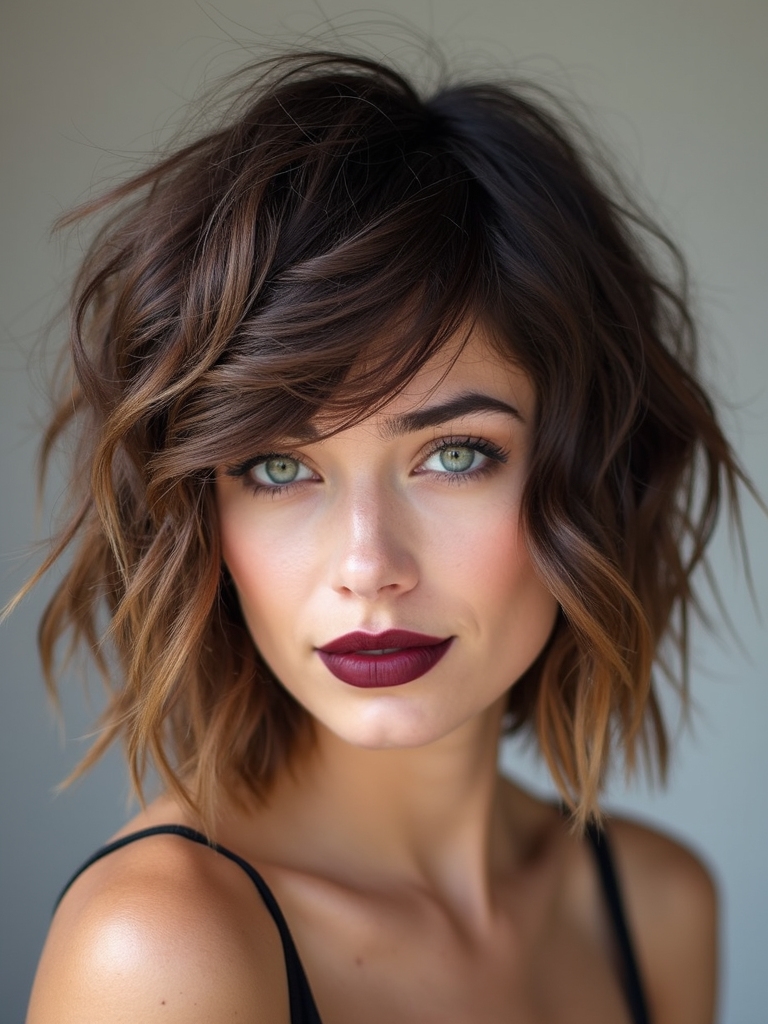
Thick hair can read heavy and blocky at lob length unless the interior gets properly layered. Removing weight from inside while keeping the outer shape intact is what keeps it moving instead of sitting like a solid block.
Where the Skill Actually Matters
Get that balance right, and thick-haired clients end up with one of the easiest versions on this list, since there’s enough natural body to style it almost any direction.
Get it wrong, with weight pulled from the wrong sections, and the shape puffs into a pyramid instead. Asking specifically for interior de-bulking, not just an overall thinning, is what separates the two outcomes.
| Goal | Ask for | Skip |
|---|---|---|
| More body | Soft texturizing through the ends | Heavy thinning shears |
| Event-ready polish | Root-lift spray plus a round-brush blowout | Flat-ironing the whole length |
| Everyday texture | Texture spray on damp or dry hair | Product overload at the roots |
Layers That Elongate the Neck

One underrated detail of the shaggy lob is how the right layer placement flatters the neck and jaw.
Layers lifted at the crown and grazing just below the jawline draw the eye upward, which lengthens the neck as a quiet side effect most people never request by name.
- Ask for lift and shorter layers at the crown to add height.
- Keep front pieces grazing just below the jaw rather than right at it.
- A heavy, blunt line at jaw level does the opposite, shortening the neck and squaring the face.
The Wolf-Cut Shag Lob

For the boldest end of the lob range, a wolf cut influence takes over: the crown gets cut short and choppy, sitting distinctly apart from the longer length below for extra volume and edge.
The Lob With the Volume Turned Up
This version leans toward the undone mood by nature. All that piecey, voluminous texture wants to be tousled rather than smoothed, even though a blowout is still possible on the right day.
It suits anyone drawn to the lob’s range but wanting more attitude built into the base shape. The heavier layering does ask for hair with some natural body to hold the disconnection.
Balayage Color for a Shaggy Lob
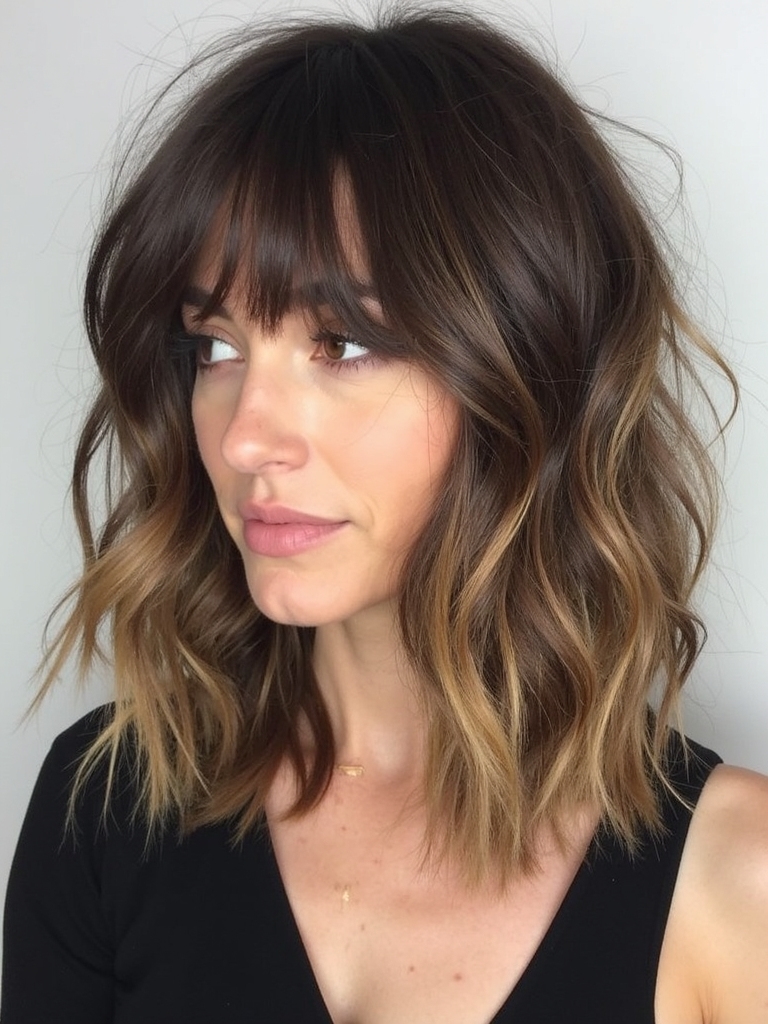
Color makes a shaggy lob’s layers work harder, with painted-in dimension catching the light as the cut actually moves.
A soft balayage suits the shape particularly well and flatters both of its moods at once. Smoothed polished, the color reads as glossy, expensive-looking dimension; scrunched undone, the same lighter pieces look sun-warmed and easy.
Plan on around $200 for a balayage refresh on this length; it’s the priciest single piece of the look but holds for months with minimal upkeep in between.
👍Why people choose the wolf-cut version
- +More volume and edge than a standard shaggy lob
- +Still works polished on the rare day it’s needed
- +Reads current without chasing a full mullet
👎What it asks in return
- –Needs hair with real body to hold the disconnected crown
- –Harder to smooth into a sleek finish than softer versions
- –Regrowth blurs the crown-to-length contrast faster
Part Placement and Styling
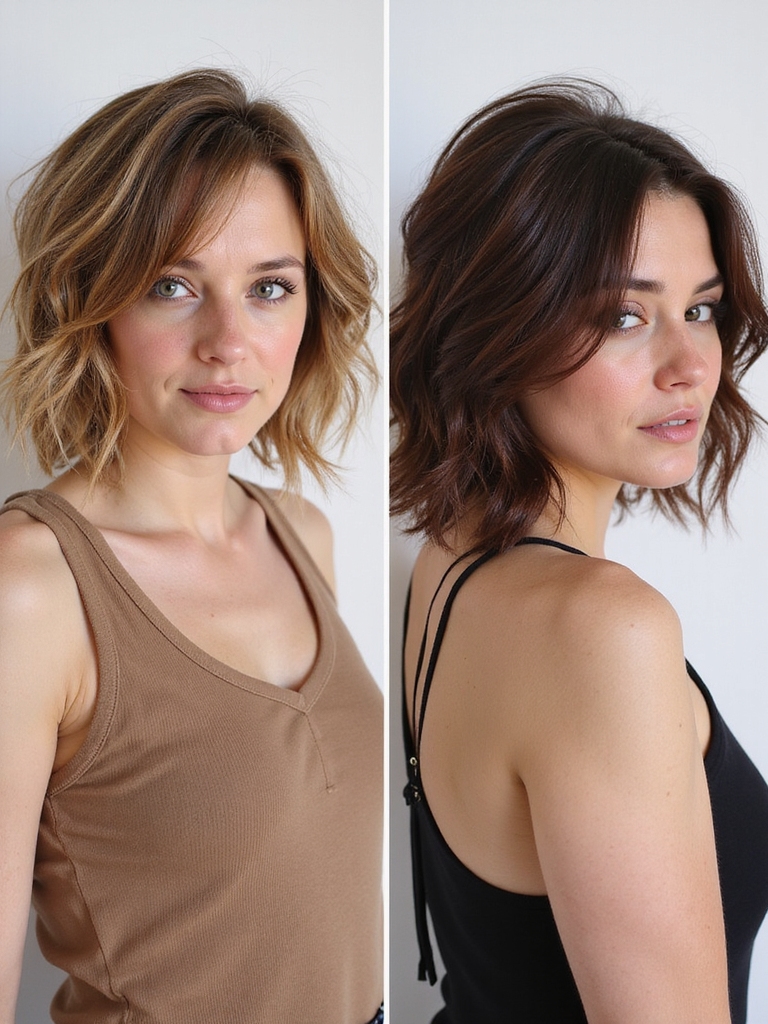
Before any product touches the hair, where the part sits shifts a shaggy lob’s entire mood, at zero extra cost.
A clean center part reads modern and polished. A deep side part adds volume and a softer, more glamorous feel. A zigzag or undone part leans casual. Switching to the opposite side of the natural part gives instant root lift on a flat day, and it takes less time than finding a fresh elastic in a crowded bag.
The Choppy Shaggy Lob

The choppy shaggy lob pushes texture furthest, with shattered, piecey ends cut deep and irregular for maximum separation.
Leaning Hardest Into Texture
Even this version keeps the dual-mood promise. Scrunched, it reads as the most undone, rocker-leaning lob on this list; smoothed with a serum, the same choppy ends settle into a sharp, deliberately imperfect finish instead.
It suits straight and wavy hair especially, where the shattered ends show up most clearly against smoother lengths.
Polished or Tousled, Both Ways

This is the section that proves the entire point: one shaggy lob, styled two completely different ways depending on the five minutes available and the mood of the day.
Learning both versions effectively means owning two haircuts instead of one.
- Polished, about five minutes: round-brush the lengths smooth, finish with a shine serum, comb a clean part.
- Tousled, about thirty seconds: scrunch texture spray into damp hair, air-dry, break pieces apart with fingers.
- Day to night: flip the part and add a light scrunch, and a polished daytime look turns into something going-out ready without a rewash.
Low-Maintenance Movement

For all its range, a shaggy lob stays low-maintenance at its core, which is really the last piece of its appeal. The layers create movement that doesn’t depend on daily heat styling, so most mornings the undone version takes about thirty seconds.
The one real upkeep task is holding the shape itself: a reshape every 8 to 10 weeks, before the layers grow too heavy to move the way they’re supposed to. Skip that window, and both styling moods start to fall flat. The shaggy layered haircut guide covers more on how layering technique affects movement over time.
How to Get the Look
Getting the versatile version, rather than a flat, one-mood bob, comes down to being specific in the consultation. Naming the actual length matters: a lob sits at the collarbone, worth saying outright instead of just asking for a bob.
Asking for shaggy, textured layers cut through the interior gives the cut room to move both directions. Bringing two reference photos, one polished and one undone, tells a stylist exactly what range is expected from a single haircut.
Shaggy Lob Questions, Answered
?Is a shaggy lob the same as a shag bob?
Close cousins, but length separates them. A shag bob typically sits chin to jaw, while a shaggy lob hits at the collarbone. That extra length is what lets the lob blow out sleek and grown-up, where a shorter shag bob leans more casual by nature.
?How is a shaggy lob different from a regular lob?
A regular lob is a fairly blunt, one-length long bob. A shaggy lob keeps that same collarbone length but adds choppy, textured layers through the interior, usually with a fringe. The blunt version stays sleek and structured; the shaggy one moves.
?Can a shaggy lob work if my hair is color-treated and a little damaged?
In most cases, yes, because cutting layers doesn’t touch the hair chemically the way color already has. Razoring is the one technique worth skipping on already-compromised ends, since it adds friction a scissor cut avoids entirely.
?How much length actually gets cut off going from long hair to a shaggy lob?
It depends on the starting point, but most transitions from mid-back or longer length remove somewhere between four and eight inches to reach the collarbone. A stylist can trim closer to the shorter end of that range first and adjust from there.
One Cut, Both Moods
Most haircuts ask for a choice: polished or relaxed, dressed-up or easy. A shaggy lob refuses that trade-off. The collarbone length and shag layers smooth into something sleek on the days that call for it and scrunch into something undone on the days that don’t.
Worth trying first: pick whichever mood matches most mornings, then learn the five-minute version of the other for the days that need it. A haircut that quietly does the work of two is hard to beat.
You Might Also Like