Twenty years ago, green hair meant one thing: rebellion. Today it shows up on movie premieres, in office hallways, and on your neighbor walking her dog, because the shade options have expanded far past neon. Done with the right depth over the right base, green turns out to be one of the easier bright colors to wear well.
This is a walk through the green family, from barely-there sage to deep forest, with straight answers about who each shade suits, how the upkeep actually works, and how to keep the color from drifting swampy. You’ll notice the biggest variable isn’t your personality; it’s your starting base.
Key Takeaways
- Bright greens need a pale, pre-lightened base; deeper, richer tones like olive can sit over hair that’s only partly lifted.
- Green fades toward blue as it lifts, so a color-depositing conditioner and cool washes matter more than any single salon step.
- Braided and protective styles let you wear saturated green with zero lightening on your natural hair.
Why Green Hair Is on the Rise

You’ve probably noticed more green hair around you this year, not just on a stage or in a music video, but on a barista, a coworker, maybe a cousin at a family dinner. The color has moved from costume to everyday choice, and a few shifts explain why:
- Formulas got gentler. Depositing dyes and glosses coat the shaft more kindly than the punk-era bleach jobs did, so the damage trade-off is smaller.
- The shade range widened. Green no longer means one loud neon; it now spans sage, olive, emerald, and teal, so there’s a version quiet enough for a client-facing job.
- Seeing it in ordinary daylight made the color feel like a normal, everyday choice.
Bold Green, On and Off the Red Carpet

Full commitment to a bright green is still the boldest move in this whole family, and the women who go all in tend to be the happiest with the result. A patchy, uneven green over the wrong base looks like an accident. A confident, saturated one comes across as a decision.
Expect more upkeep here than with a softer shade. Bright green needs a pale base to hold true, and that base needs regular refreshing or the roots will show fast against the vivid length.
Emerald tends to hold its saturation longer than lime or chartreuse, so it shows up on red carpets and film sets more often than the brighter, punchier options. Lime and chartreuse fade faster and need more frequent touch-ups to stay photo-ready.
Two assumptions worth clearing up before you commit to a full head of color:
❌ Myth: Myth: bold green only works if the rest of your look matches the energy.
✅ Reality: Reality: the color reads as intentional on its own — a tailored blazer and a saturated emerald look as sharp together as ripped denim and neon lime.
❌ Myth: Myth: bold means neon.
✅ Reality: Reality: bold just means fully saturated. A deep, rich forest green is just as committed as a bright lime, only quieter.
How the Green Trend Spread Online

A single viral clip can send a wave of people into a salon chair asking for the exact shade they just watched scroll by. That’s useful for inspiration and a little misleading about real upkeep. Before you screenshot a photo and bring it in, keep a few things in mind:
- Filters shift green more than almost any other color, so the shade on your screen may be several tones off from what a colorist can actually mix.
- A fifteen-second clip rarely shows the color three weeks later, after the first few wash cycles have pulled some pigment out.
- Photos taken in natural light, on a texture close to yours, are a far better preview than a studio shot under stage lighting.
Finding the Perfect Green Shade for You

The real decision isn’t whether to go green, it’s how bright, and that comes down to how much your hair can take before lightening. Vivid greens need a pale, near-yellow base. Deeper forest and olive tones can sit over hair that’s only lifted partway.
If your hair has already been through color and feels fragile, lean toward the deeper end of the family for your reference shade. You’ll get a color that holds its richness with far less lightening, and the finished result usually looks more polished than an over-processed vivid.
The Green Spectrum, Mint to Forest

Green covers more ground than most people expect once you move past the idea of one single ‘green hair’ shade. Three families are worth knowing:
- Pale greens: mint and sage sit close to the hairline of blonde, soft enough to read as a gentle tint on their own.
- Mid greens: grass and apple tones are the brightest and most playful, closer to what most people picture when you say ‘green hair.’
- Deep greens: emerald, forest, and olive are richer, more forgiving as they grow out, and easier to wear in a conservative office.
Matching Green to Your Skin Tone

Skin tone doesn’t rule green out for anyone, it just changes which shade flatters you most. The idea that bright color only works on pale skin has talked plenty of people out of a green they would have loved.
What actually matters is warmth. Match the undertone of the green to your own undertone and the color settles naturally against your skin.
- Cool undertones tend to glow next to emerald, teal-green, and icy mint.
- Warm and deep skin tones carry chartreuse, olive, and rich forest particularly well.
- Neutral undertones have the widest range and can experiment across nearly the whole family.
Pairing Green With Other Colors

Green rarely needs to stand on its own. Blended with a second color, it feels more custom and a little less loud, which makes it a good entry point if a full head of color feels like too much at once.
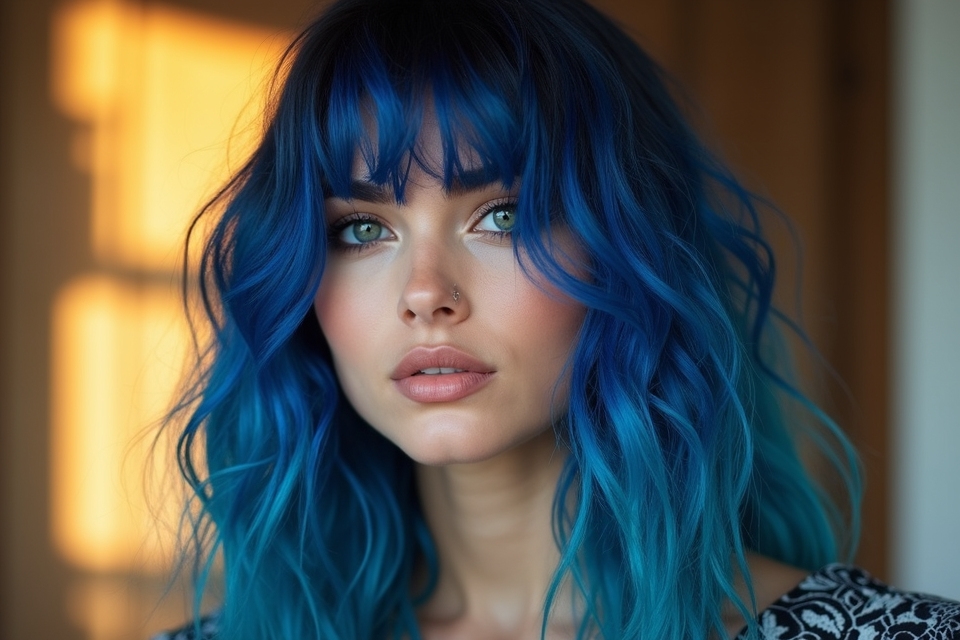
A green melted into blue keeps the two tones close on the color wheel, so the transition looks intentional and blended. A hidden underlayer lets you flash color only when you want to, which suits stricter workplaces.
Not sure how much green you’re ready for? Answer honestly:
1Do you need to hide the color for work sometimes?
If yes, an underlayer or a small money-piece section keeps it out of sight when your hair is down.
2Would uneven fading bother you?
If yes, start with a blend instead of a solid block — uneven fade is far less noticeable across a melt.
Green Hair as Self-Expression

Green says more than most colors. People don’t drift into it the way they drift into caramel highlights; choosing it is a small, visible decision, and that visibility is often the whole point.
Testing the Idea Before You Commit
If you’re circling the idea but not ready to commit, there are lower-stakes ways to live with it first.
A wash-out spray or a clip-in panel lets you wear green for a single event. A single hidden streak lets you test the upkeep without changing your whole look. Both give you real information before you book a full appointment.
Green Braids and Protective Styles

One of the easiest ways to wear green needs no lightening at all. Braiding hair or extensions in a rich green add saturated color through box braids, knotless braids, or twists while your natural hair stays untouched underneath.
Why This Route Skips the Bleach Entirely
For textured and coily hair, this route keeps the natural strands protected inside the style, away from any lightener. It’s a real advantage if you want the color without the commitment of a chemical process. See our Braided Styles for Black Hair guide for install options that pair well with a bold color.
Ask your braider to keep tension comfortable at the hairline, since any tightly installed protective style carries some risk of pulling. When the style comes down, typically after several weeks, your own hair underneath is exactly as it was.
A Soft Green Ombre Melt

An ombre solves the upkeep problem that scares people off bold color. Your natural shade stays at the root, and the green takes over gradually from about ear-level down to the tips, buying months of grow-out room before the line looks off.
Where the Bleach Actually Goes
Because the lightening stays mostly on the lengths, this approach is kinder to the scalp and gentler on hair that’s already been colored before.
Ask for a soft, blurred transition; it grows out far more gracefully than a hard line does. Deeper greens fade more evenly on an ombre than bright ones, and an occasional gloss refresh keeps the transition looking fresh.
Maintaining Green Between Visits

Green holds its saturation better than red does, but it still needs care to resist drifting toward blue or gray. Hot water and frequent washing are the two biggest culprits, so turning the temperature down and stretching out washes matters more than any single product.
What Actually Strips the Color Fastest
Every wash rinses a small amount of pigment down the drain, which is why a sulfate-free, color-safe formula makes a visible difference over a few weeks.
Heat styling fades color too. A lower iron temperature and a heat protectant both buy extra time before the shade needs refreshing.
The Right Products for Green Hair

The single product that changes the most for green is a color-depositing conditioner in a matching shade. Used every few washes, it tops up the pigment you lose to daily life, priced around $15 to $25 a jar, and it can stretch a salon visit by weeks.
A weekly bond-repair or moisture mask keeps bleached hair from turning brittle, since most greens require at least some lightening to hold their color true.
Products to Skip
Clarifying shampoos and anti-dandruff formulas are built to strip buildup, and they’ll strip fashion color right along with it. Keep both out of your green hair’s rotation, even if you use them on the rest of your routine.
Green for a Special Occasion

Green photographs like jewelry, which makes it a natural fit for a wedding, a formal event, or any night where you want the color to do some of the styling work for you. A deep emerald set in soft waves looks polished enough to stand in for an accessory on its own.
When Temporary Color Makes More Sense
If you only want the color for one occasion, this is where temporary options earn their keep. A wash-out spray or a set of clip-ins delivers the drama for a single night and rinses out by morning.
Lean into shine for a styled look. Glossy, smooth hair looks more expensive under event lighting, so a shine spray and a flat iron go further than extra product before a big evening out.
Wearing Green as an Everyday Color

The trick to keeping green from feeling costume-y is treating it as one detail among many in your outfit. Pair a soft sage or a hidden underlayer with your regular clothes and let it read as a single interesting choice.
Letting the Color Speak Quietly
At work, a muted green or an underlayer tucked beneath the top layer looks creative without demanding attention. Plenty of people in fairly conservative jobs wear a smoky green and hear nothing but compliments.
Styling stays simple day to day. Air-dried waves, a low bun, a half-up twist, whatever you already reach for works fine, and the color carries the look on its own.
Styling Green Across Different Textures

Green behaves differently depending on texture, and the styling choices that show it off best change with it.
On straight hair the color sits as a clean, graphic block. On waves and curls it turns dimensional, since every bend catches light differently and reveals lighter and darker tones across the same head.
- Straight hair: a smooth blowout or a glossy flat-iron finish shows the color at its most graphic.
- Wavy or curly hair: minimal product and natural drying let the bends do the work of showing depth.
- Coily and textured hair: keep strands well moisturized, since dryness shows up as dullness against a saturated color faster than it does on natural shades.
DIY Box Dye or the Salon Chair

Green is one of the more forgiving bright colors to touch up at home, but only the depositing step. The bleaching stage is where home attempts tend to go wrong, and a botched lightening job is what sends people into a professional chair in tears.
A semi-permanent, depositing green over hair that’s already a pale, even blonde is reasonable to try yourself. Lifting dark or previously colored hair to that pale base first is a different project and calls for a professional; plan on roughly $150 to $350 for that session.
Whichever route you take, do a strand test first. Porous spots along the length grab pigment darker and more unevenly than the surrounding hair, and testing first is the only way to catch that before you commit your whole head.
The Real Challenges of Going Green

Green has a few quirks worth knowing before you commit to it. The most common is the murky-base problem: green applied over an orange or warm base turns muddy and khaki-toned, which is why getting to a pale, neutral yellow first matters so much.
The second is blue-shift. Many green formulas lean blue underneath, so as the color fades it can drift toward teal or a dull gray.
The third is grow-out. Bright green roots show fast against a much darker natural base, so plan on either a root-touch-up schedule or an ombre style that hides the line as it grows.
If your green has already turned murky, here’s the order of operations to fix it:
1Rule out the base first
A color-safe clarifying rinse removes buildup so you can see the actual shade underneath before doing anything else.
2Book a corrective toner appointment
A colorist can neutralize the murky tone without stripping the green entirely, which a box dye usually can’t do safely.
A Green Shade for Every Season

The green family covers the whole calendar if you’re willing to shift shade with the seasons. A few pairings work particularly well:
- Spring calls for a fresh mint or apple green, light and easy to wear.
- Summer suits a brighter lime or teal-green that pops against a tan.
- Fall and winter lean toward a deep emerald or a rich, mossy shade, cozier against darker layers.
Accessories That Lift a Green Look

Once you’ve committed to green, the right accessories make the color look deliberate and finished.
Contrast matters as much as material. Warm-toned pieces make a cool green glow, and that small pairing shifts the whole feel of the look.
- Gold clips and pins warm up a cool emerald or teal beautifully.
- Cream or rust-toned scarves let the green stay the clear focal point.
- Pearl or crystal pins dress a green look up fast for an evening event.
Green Hair Transformations Worth Bookmarking

Before-and-after photos tend to convince people faster than any explanation can. Watching a natural brunette shift to a melted emerald, or a blonde take on a soft sage, makes the possibility concrete in a way words don’t.
What the Best Results Have in Common
The transformations worth trusting rarely share the boldest color; they share the same starting point, an even, healthy lightening process underneath. The prep matters more than the dye choice on top of it.
Save the examples closest to your own starting color and texture. Those predict your result far better than a transformation on hair that started in a completely different place.
How to Get the Look
Bring your colorist two things: the exact shade you want, ideally a real photo rather than a filtered one, and an honest account of your hair’s history, including how many times it’s been colored and how it’s handling the color it’s wearing now.
A consultation and a strand test before the full appointment catch problems a photo alone can’t. That’s especially true for anyone moving from a dark natural color toward a bright green, where the base needs to be right before the color goes on.
Green Hair Questions, Answered
?Will green hair dye ruin my natural hair color underneath?
Not permanently. Green fades out over several weeks like any semi-permanent depositing color, and the bleaching step underneath a bright green is the same lightening process used for any pastel or vivid shade, not something specific to green.
?Why does my green hair look blue instead of green?
Most green formulas carry a blue base, so as the color fades unevenly, the green pigment often washes out faster than the blue underneath it. A green-specific depositing conditioner used regularly helps keep the two fading at the same rate.
?Can I dye my hair green without bleaching it first?
Only if you already have naturally light hair or want a subtle tint over a medium base. A true saturated green needs a pale yellow base to show true, though braided-in color extensions are a bleach-free way to wear a bold green.
?How long does green hair color typically last?
A salon-applied green usually holds noticeable saturation for four to six weeks before it needs a refresh, though a color-depositing conditioner used between washes can stretch that window meaningfully.
Green Is Worth Trying on Your Own Terms
Green has shed its reputation as a phase you grow out of. The shade options now run wide enough that almost anyone can find a version that suits their skin, their job, and the upkeep they’re actually willing to do.
Start smaller than you think you need to: a streak, a braided section, an underlayer, and let the full commitment come later if it earns it. If green isn’t quite the shade you land on, 26 Blue Hair Ideas, From Navy to Sky, Pink Hair Ideas Bringing a Bold and Playful Vibe, and Rainbow Hair Ideas That Look Bold and Playful cover the same territory in different palettes.
More Ideas Here