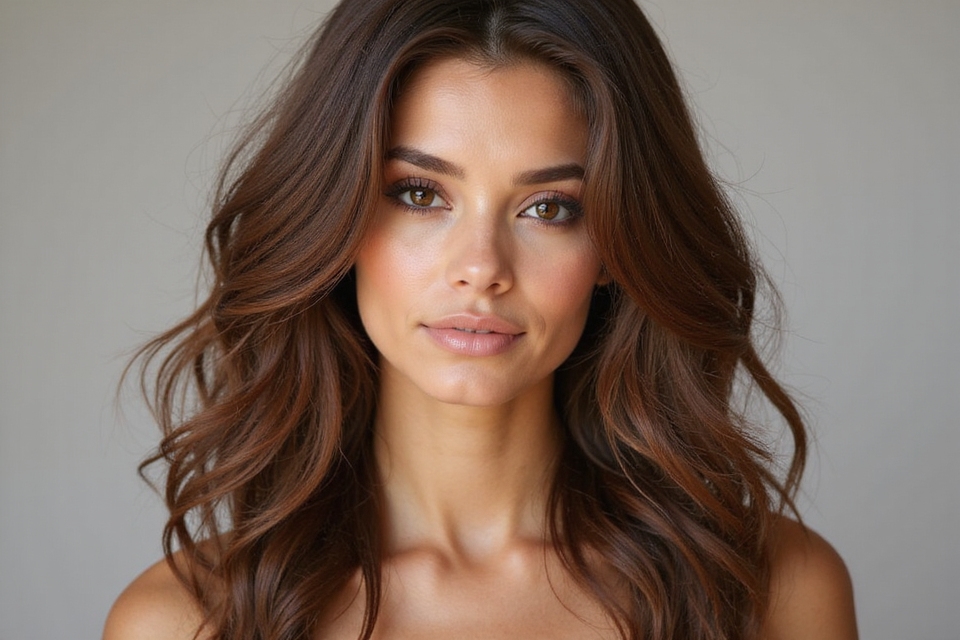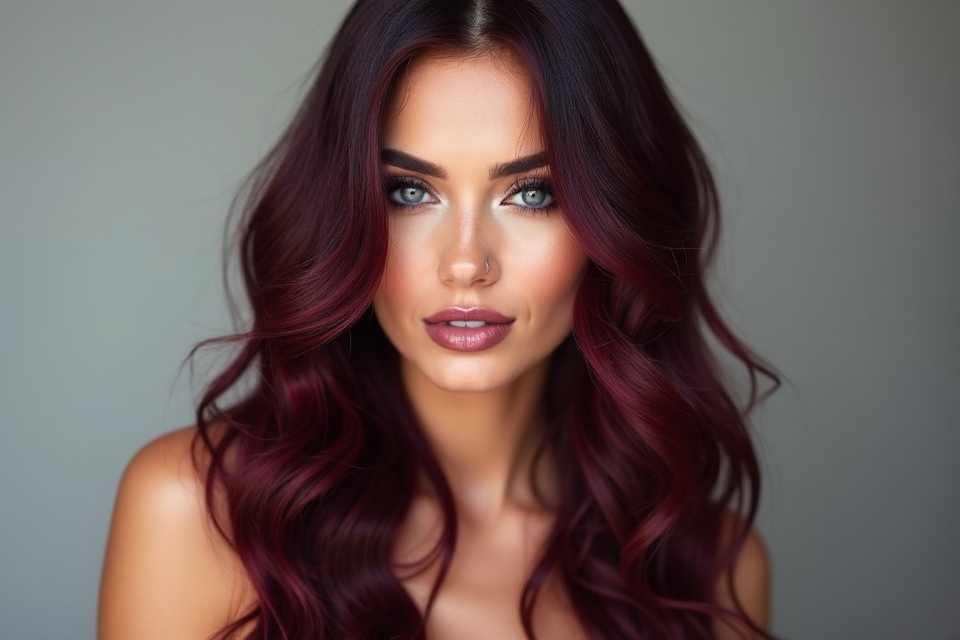
How deep can red go before it stops reading as red at all? Burgundy sits right at that edge: dark enough to pass for brown or black in low light, but unmistakably red-purple the moment the sun catches it.
Eighteen versions follow, from a full-head transformation to a hidden peekaboo streak, plus the two mechanics, gloss and undertone, that decide whether burgundy looks luxurious or simply dark.
What Actually Makes Burgundy Work on Dark Hair
- Burgundy sits on a red-purple base, which needs a permanent color rather than a simple gloss to actually take on dark hair.
- The darker the starting hair, the more subtle the reveal; burgundy on jet-black hair mostly shows in direct sunlight.
- A color-safe, purple-toned routine keeps the wine tone from fading toward brown between salon visits.
A Full Head of Dark Burgundy

A full head of dark burgundy commits the whole canvas to the color, so every angle and every light source shows the wine tone somewhere. By week three, the ends usually show the first hint of fade toward a warmer, less saturated red.
- Every section carries the same depth of color
- Shows up in full sun, subtle indoors
- Needs the most consistent gloss schedule of any version here
Dark Burgundy Ombre

An ombre concentrates the wine tone toward the ends while the roots stay closer to the natural base, so the color builds gradually down the length instead of starting immediately at the scalp.
That gradual build makes the grow-out forgiving; regrowth blends into the transition zone rather than creating a hard line at the root.
- Wine concentrates at the ends, fades toward the root
- Regrowth blends into the existing gradient
- A lower-commitment way to test the color before going full-head
Dark Burgundy Balayage

Hand-painted balayage places wine-toned pieces through a dark base without a hard line anywhere, so the color reads as dimension rather than a flat, single tone. The technique takes more time in the chair than a standard foil service, since every piece gets placed by eye rather than sectioned mechanically.
- Painted freehand rather than foiled in sections
- No hard demarcation line between shades
- Grows out with minimal visible regrowth
Dark Burgundy Highlights

Highlights weave individual wine-toned pieces through the base color rather than covering the whole head, so the effect flashes through as the hair moves instead of sitting as one solid color.
On dark hair specifically, highlights need more lift than they would on a lighter base, since burgundy has to fight through the natural pigment already there to show at all.
Near the crown, three or four foils is usually enough to add visible dimension without turning into a full color service.
“Most colorists apply balayage pieces more heavily toward the crown and face-framing sections on darker hair, since those areas catch the most light and need the strongest concentration of color to actually show.”
Dark Burgundy Lowlights

Lowlights work in the opposite direction from highlights, adding darker wine-toned pieces rather than lighter ones, which builds richness instead of brightness.
This version suits anyone who wants dimension without any lightening involved at all, since every added piece is darker than the surrounding hair rather than lifted from it.
Burgundy and Black Blend

Blending burgundy directly into black keeps the wine tone a quiet secret instead of an announcement, visible only when light hits the hair at certain angles.
It’s a quiet way to wear the color without explaining it at every family gathering; most people simply won’t notice unless the light is right.
- Wine tone hides in shadow, shows in direct light
- Looks like plain black most of the day, burgundy in the sun
- Low-maintenance since regrowth barely shows against black
Where Lowlights Go Wrong on Very Dark Hair
On hair that’s already close to black, lowlights can end up nearly invisible if the wine tone isn’t saturated enough. Ask specifically for a deep, high-pigment burgundy rather than a standard low-light formula.
Dark Burgundy With Purple Undertones

Adding a purple undertone pulls burgundy away from a warm, brick-red direction and toward a cooler plum, which tends to flatter cool and neutral skin more than the warmer versions do. The shift happens at the toning stage, layered over the same base burgundy formula rather than requiring a completely different color.
- A cooler, plum-leaning version of standard burgundy
- Suits cool and neutral skin tones especially well
- A purple-toned gloss keeps the cool cast from fading warm
Dark Burgundy on Curls

On curly hair, burgundy catches light differently with every turn of the curl, since each coil reflects the color at a slightly different angle than the one next to it.
Moisture matters more here than the color choice itself; dry, brittle curls dull even a well-saturated burgundy fast, no matter how good the formula was at application.
- Each curl reflects the wine tone at a different angle
- Dimensional by nature, since the coils do the work
- A leave-in conditioner protects both curl and color together
Dark Burgundy on Straight Hair

On sleek, straight hair, burgundy reads as pure reflective shine, since there’s no texture to break up how the light bounces off the surface.
Where Shine Does All the Talking
That reflectiveness is exactly what shows the color off best in photos and under indoor lighting, where a textured cut might mute it slightly.
A glossing treatment matters more on straight hair than on textured hair, since any dullness shows immediately with nothing to distract from it.
Two assumptions worth dropping about color on curly hair:
❌ Myth: Myth: curly hair can’t hold saturated color as well as straight hair.
✅ Reality: Fact: the curl pattern itself adds dimension a flat, straight application would need highlights to fake.
❌ Myth: Myth: burgundy fades faster on curls specifically.
✅ Reality: Fact: fade rate comes down to porosity and wash routine, not curl pattern on its own.
Dark Burgundy Bob

A blunt bob shows off burgundy cleanly, since the straight perimeter line gives the color one continuous surface to sit on rather than breaking it into pieces.
The color choice and the cut reinforce each other here: a soft, blended color would get lost on such a defined shape, so a saturated, even burgundy suits it better.
- A defined perimeter shows the color as one solid block
- Best paired with an even, saturated formula, not a soft blend
- The curly bob version works the same way with texture added
Dark Burgundy Pixie

A pixie turns burgundy into pure attitude, since so little length means every inch of hair shows the color at close range.
It’s also one of the lower-cost ways to wear the color, given how little product and processing time a pixie-length head actually needs. The trade-off is a tighter touch-up schedule, since new growth shows against such a short base faster than it would on longer hair.
Dark Burgundy Long Layers

Layers break the wine color into light and shadow as the hair moves, instead of letting it sit as one flat plane down the full length.
Movement Is What Sells This One
Longer layers specifically give burgundy more surfaces to catch light from, which matters on longer hair where a single flat tone can start to look heavy.
This version photographs especially well in motion, since the layering means the color shifts slightly with every turn of the head.
Dark Burgundy With a Fringe

A fringe puts the wine color directly at the face, front and center, rather than leaving it to show only in the longer lengths behind it.
Front pieces get handled and styled more than any other section, so they tend to show fade first; a touch-up gloss at the hairline keeps the fringe from looking duller than the rest of the head.
- Color shows immediately, right where the eye lands first
- The fringe fades faster than the rest from daily handling
- A quick root touch-up at the part keeps the color even
Dark Burgundy on Short Hair

Short hair keeps burgundy sharp and comparatively low-cost, since there’s simply less surface area to color at every appointment.
Lower Cost Per Visit, More Visits Overall
The visible regrowth line also shows up faster, so short-hair clients typically book touch-ups on a tighter schedule despite the lower cost per visit.
The trade-off evens out: less product per session, but more sessions overall to keep the shortest hair looking fresh.
Dark Burgundy on Long Hair

Long hair carries burgundy from root to tip, giving the color the most real estate of any length on this list to show its full range, from deep near the scalp to slightly lighter at the sun-exposed ends.
That range comes with upkeep: the ends have been through more washes and more sun exposure by the time they reach that length, so they typically need a stronger formula than the roots to end up looking even.
ℹ️Why Short Hair Costs Less Per Appointment
Less hair means less product and less processing time, which is why a full-color service on a pixie or short bob typically runs noticeably cheaper than the same service on hair past the shoulders.
Dark Burgundy Updo

Pulling burgundy hair up into an updo stacks the color into layers, since twisted or pinned sections catch light differently depending on how they’re angled against each other. The effect works especially well with even a small amount of natural texture, since flat, smooth sections reflect light more uniformly than pieces with visible dimension.
- Twisted and pinned sections create a layered color effect
- Works especially well for formal occasions calling for a jewel-toned finish
- A shine spray over the finished updo intensifies the effect
Dark Burgundy Peekaboo

A peekaboo places wine color underneath the top layer instead of throughout, so it stays hidden during most of the day and only shows when hair moves, gets tucked back, or catches wind.
Color That Exists Without Announcing Itself
It works as a middle ground between committing to visible burgundy and not coloring at all, since the color exists but stays mostly out of sight.
This version also grows out with almost no visible line, since the colored section sits beneath hair that never gets colored in the first place.
Glossy Dark Burgundy Finish

A gloss is what actually makes deep wine look luxurious rather than simply dark; without it, even a well-matched burgundy formula can read flat and lifeless.
Plan on around $40 for a standalone gloss service between full color appointments, a smaller cost than a full re-color but enough to keep the shine and saturation looking fresh.
- A translucent gloss boosts shine without changing the base color
- Refreshes fade between full color appointments
- The single biggest factor separating flat burgundy from luxurious burgundy
Maintenance & Care
Burgundy fades toward a warmer, duller red faster than most other dark colors, since red pigment molecules are physically larger and wash out more visibly than other tones.
A color-safe shampoo, cooler water temperatures, and UV protection on sun-exposed days all slow that fade. A dedicated color-safe routine takes up barely more space in the shower than a regular one and makes a real difference in how long the color holds its depth.
Depth Comes From Gloss, Not Just Pigment
Every version here relies on the same two things: enough pigment to show as burgundy and enough gloss to make that pigment actually shine.
Start with the version that asks the least of the current hair, whether that’s a peekaboo streak or a full lowlight service, and build from there once the color proves itself.
More Inspiration