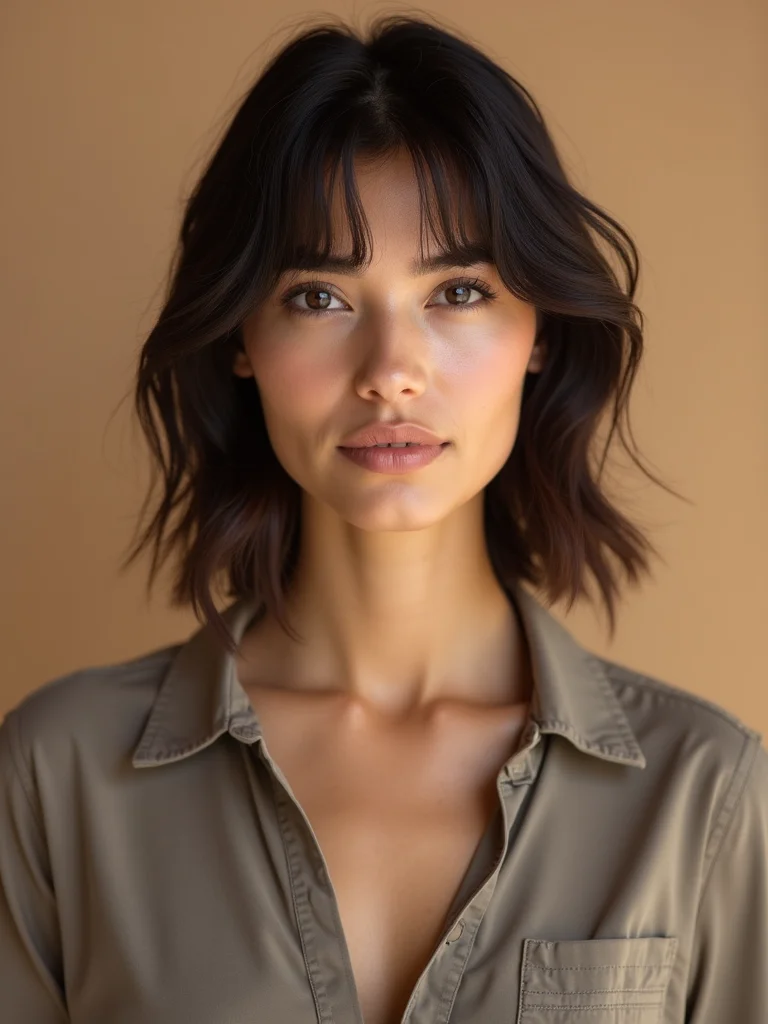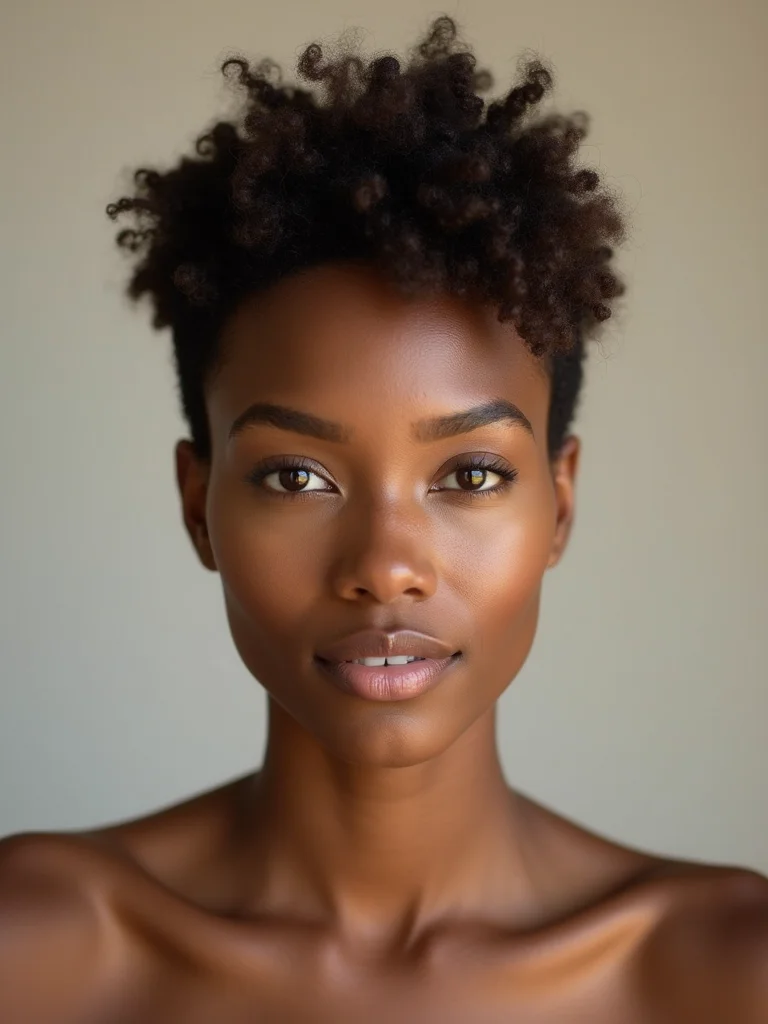
How short is actually too short for coily or 4C hair? Rarely, if at all — a well-cut natural pixie tends to look more finished than longer styles on the same texture, since the cut works with shrinkage instead of fighting it.
Fifteen ways to wear one follow here, from a five-minute wash-and-go to sculpted finger waves, each built around a different curl pattern, density, and amount of daily effort.
Before the Chair
- Most stylists cut coily and 4C hair dry, since it shrinks noticeably once dry and that state shows the real length being worked with.
- Moisture matters more on a short cut than length does — tighter textures run drier, and a leave-in plus regular hydration keeps a crop from feeling brittle.
- A stylist experienced with natural texture makes a bigger difference here than almost any product choice afterward.
Tapered Pixie With Defined Coils

A tapered crop sits at the center of natural-hair pixies, keeping the coils full through the top while the sides taper close to the head. The contrast puts the curl pattern on full display instead of competing with extra bulk at the sides.
Why This Gets Cut Dry
Graduated sides do most of the actual flattering here, drawing the eye toward a face rather than away from it, while the fuller top carries all the visual interest and texture.
A curl cream or leave-in worked through damp coils keeps definition soft rather than crunchy, and the cut holds its shape well between visits since there’s no single length to grow out unevenly.
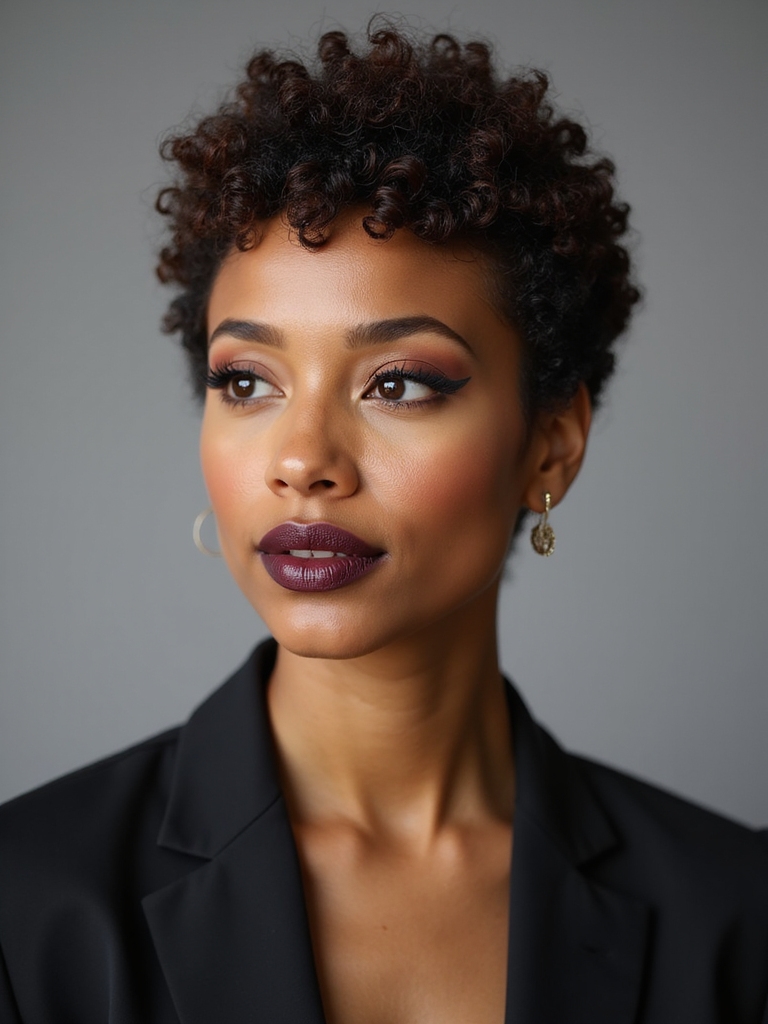
Curly-Fringe Pixie With Crown Volume

A curly-fringe pixie carries the front as a soft fringe of coils sitting over a lifted crown, framing a face with real fullness up top rather than lying flat against the forehead.
Getting the lift right comes down to technique as much as product: coils get defined on damp hair, then the crown gets gently stretched and picked from the root once dry — picking coils that haven’t been stretched first just packs the volume back down.
Rounder and heart-shaped faces tend to suit this version especially well, since the added crown height visually extends the face.
Sleek Sculpted Pixie With a Side Part

A sculpted pixie organizes the coils around a crisp side part for a sharp, deliberate finish, giving the eye a clean line instead of an undefined mass of texture on top.
- A styling gel worked in with a fine comb sets the part while hair is still damp.
- Coils stay defined but close to the head so the part reads sharp rather than soft.
- Polished enough for an office setting, bold enough to carry into evening plans.
Wash-and-Go Pixie for Tight Curls

A wash-and-go asks the least of any look on this list, and it’s the one most people default to on a rushed morning. Product goes onto soaking-wet coils, and the pattern is left alone to dry into its natural shape with no additional tools.
- Work a leave-in through soaking-wet hair section by section, followed by a curl-defining gel.
- Let it dry naturally, or diffuse on the lowest heat setting to avoid stressing the shorter coils.
- Refresh the next morning with a light water mist and a small amount of product, rather than starting over.
Finger-Coiled Pixie With a Shaped Nape

A finger-coiled pixie defines each section by hand, wrapping small pieces of damp hair around a finger until they set into crisp, springy curls, finished off with a clean nape line.
The definition this produces is difficult to replicate with product alone, though it does take real time — often close to an hour for a full head, depending on density and coil size.
Once set, the coils tend to hold their shape for several days, which offsets the time investment considerably compared with a routine styled fresh each morning.
A few terms come up constantly around this cut.
📖Finger coiling
Wrapping small, damp sections of hair around a single finger to set a defined, uniform curl by hand.
📖Shrinkage
The natural difference between a coil’s stretched length and its resting, dried length — often significant on tighter patterns.
Asymmetrical Pixie With Soft Ringlets

An asymmetrical pixie leaves one side noticeably longer, letting soft ringlets fall on a diagonal line rather than sitting evenly on both sides.
That imbalance gives a short cut something to sweep and adjust, which keeps the overall shape from reading as too closely cropped or one-dimensional.
Square and round face shapes tend to benefit most, since the diagonal line visually softens harder angles across the jaw.
Shaved-Side Pixie With a Curly Top

A shaved-side pixie pairs a full, coily top against sides taken down to the skin, building real contrast between bare skin and dense texture.
Keeping the Contrast Sharp
Beyond the visual impact, removing that bulk at the sides noticeably lightens a dense head of hair, so the overall style feels cooler and considerably quicker to manage day to day.
The top stays entirely open to experimentation — worn tall for drama or patted down for a quieter, office-appropriate finish, while the sides need their own separate upkeep schedule.
Textured Pixie With Baby Bangs

A textured pixie with baby bangs crops the front coils into a short, springy fringe sitting high on the forehead, drawing attention directly toward the eyes and brows.
Because the fringe sits so short, very little product actually goes a long way — a small amount of curl cream on just the front is usually enough, and the shortness means it grows into a longer style fairly quickly for anyone who likes to change things up.
Voluminous Pixie for 4C Coils

4C hair in particular tends to build the fullest, most rounded volume of any texture on this list, springing into real shape rather than needing extra work to fake it. Cutting it dry lets a stylist account for exactly how much the coils draw up once finished.
- Insist on a dry cut so the finished shape accounts for real shrinkage rather than guessing at wet length.
- A moisturizing leave-in matters more here than on looser textures, since 4C runs driest of all patterns.
- Fullness comes from the pattern itself — very little added product is actually needed to build the shape.
Cropped Pixie With Twist-Out Texture

A twist-out trades tight coils for a softer, more stretched curl by twisting damp sections, letting them set fully, then unraveling once dry into a looser, more elongated pattern.
This tends to be the version stylists reach for when a client wants visible definition without losing length to shrinkage, since the twisting process itself adds stretch.
- Twist product-coated, damp sections and allow them to dry completely before unraveling.
- Unravel by hand and fluff gently at the roots — combing through undoes the definition entirely.
- Protect the set overnight with satin to extend it across several days.
The basic twist-out process, start to finish:
1Section and Twist
Divide damp hair into even sections and twist each one from root to end while still saturated with product.
2Let It Set Fully
Air-dry or sit under a hooded dryer until every section is completely dry before touching it.
3Unravel by Hand
Gently separate each twist with fingers only, then fluff lightly at the roots for volume.
Pixie With an Undercut and Coil Definition

An undercut takes the sides and back down close while the top stays full of clearly defined coils, pairing bare skin against dense texture in one shape.
An Edge Without Full Commitment
Much like the shaved-side version, removing that underlying bulk makes a dense head of hair noticeably lighter and quicker to style on an average morning.
The top does nearly all the visual work — coils get defined with a gel or cream, and the contrast against the closely cut undercut carries the entire look without needing further embellishment.
Tousled Pixie With Layered Curls

A tousled pixie layers the coils so they fall loosely and softly, building an airy kind of movement rather than one dense, uniform shape.
Internal Layers on Denser Patterns
That looseness is largely what makes the style forgiving to wear day after day, since a slightly undone finish still reads as intentional rather than unkempt.
Fine-to-medium coils tend to suit this version best, since it adds movement without the extra product weight that denser patterns would need to hold a similar shape.
🅰️Fine to Medium Coils
Layers move freely here with almost no added weight, giving the style its signature looseness without extra product.
🅱️Denser, Coarser Coils
A few internal layers help prevent the same style from reading heavy or bulky on thicker patterns.
Finger-Wave Pixie on Natural Hair

Finger waves mold coils into glossy, sculpted ridges entirely by hand, a heritage technique that has shaped Black hairstyling for close to a century. Natural texture tends to grip and hold these waves more readily than straighter hair types.
- Mold a firm gel into damp hair, shaping each ridge with fingers and a fine comb.
- Set under a hooded dryer, or let it air-dry, then finish with a small amount of shine product.
- Plan for real time in the chair and a price closer to a color service than a basic trim — this is a slow, deliberate technique, typically starting around $50, not a quick service.
Highlighted Natural Pixie for Dimension

Highlights placed through the crop catch light across the coils, making the texture itself look fuller and considerably deeper than a single flat tone would.
A short cut also means less hair overall to lift, so color tends to be gentler on the hair and less costly to maintain than the same treatment on longer length.
- Honey, caramel, and copper tones tend to glow especially well against deeper skin tones.
- A hydrating, color-safe routine matters more here than the exact shade chosen.
- A colorist experienced with textured hair is worth seeking out before lifting from a dark base.
A couple of ideas about coloring natural hair are worth correcting.
❌ Myth: Myth: Natural hair can’t handle highlights without serious damage.
✅ Reality: With a hydrating, color-safe routine and a colorist experienced in textured hair, lightened coils can stay healthy and defined.
❌ Myth: Myth: Shorter hair means color fades faster.
✅ Reality: Less hair to lift often means a gentler lightening process overall, not a faster fade.
Heat-Free Low-Maintenance Pixie

A heat-free pixie skips hot tools entirely, relying on product and air-drying — or diffusing on the lowest setting — to define the coils instead.
For natural hair specifically, this tends to be one of the more protective long-term choices available, since repeated heat exposure is a major contributor to weakened texture over time.
A good cut on natural hair barely asks for daily styling — a leave-in worked through, a few minutes of air-drying, and little else — which is largely why people recovering from heat or color damage often stick with it well past the recovery period.
Styling Tips
Coily textures tend to run drier than straighter hair overall, so the routine that keeps a natural pixie looking its best centers almost entirely on moisture: a leave-in after every wash, a curl cream or gel for definition, and a deep-conditioning treatment roughly once a week.
Sleeping on satin — a bonnet or pillowcase — helps preserve both definition and edges overnight. A stylist experienced specifically with natural hair tends to matter more here than any single product choice, since the difference between a crop that springs back to life and one that falls flat usually comes down to whoever held the shears.
Natural Hair Pixie Questions, Answered
?Should a natural-hair pixie be cut wet or dry?
Dry, in almost every case. Coily and 4C hair shrinks substantially as it dries, so cutting it dry lets a stylist see the actual length and shape being worked with rather than guessing at wet length.
?What’s the difference between a TWA and a natural pixie?
A TWA, or teeny-weeny afro, describes a very short crop typically worn right after a big chop. A natural-hair pixie is the wider category — a TWA is its shortest version, with tapers, twist-outs, and longer variations building outward from there.
?Does a wash-and-go work on very tight coil patterns?
Yes, and it’s often the fastest option available on tighter textures specifically, since there’s minimal length for the pattern to fight against on the way to drying.
?How does color affect the health of a short natural cut?
Less hair overall means a gentler lifting process than the same color would require on longer length, though a hydrating, color-safe routine still matters more on lightened coils than on hair that hasn’t been colored at all.
Short, Textured, and Entirely Yours
A natural-hair pixie puts curl pattern, volume, and real shape on full display rather than hiding them under extra length, and the fifteen versions above show just how much range actually exists within that one basic decision to go short.
The right version comes down less to a single ‘best’ cut and more to how much daily time feels realistic, and how comfortable the shrinkage that comes with drying actually feels once it’s lived with for a few weeks.
Hand-Picked for You