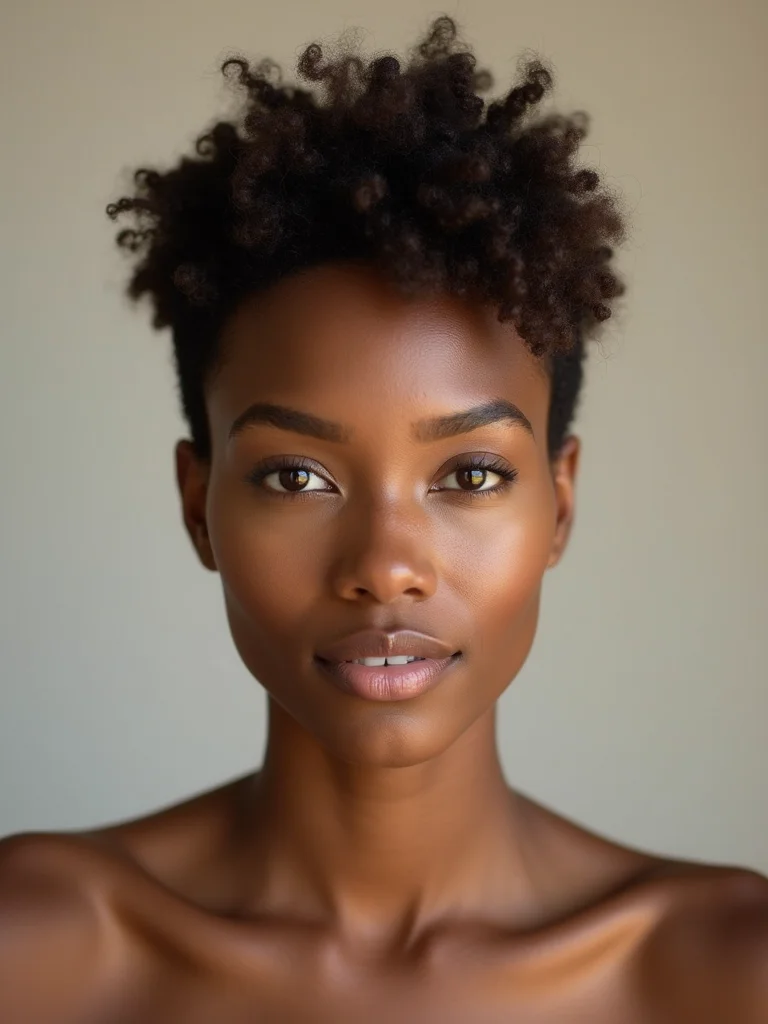
A client came in last spring with a photo of a sleek straight bob, asking me to make her curls behave like that. I turned the idea around, because the best bob for her was not a flattened copy of someone else’s hair. It was a shape cut to let her curls spring and stack the way they naturally want to.
That is what a good curly bob does. It works with your coils instead of against them, using shape and length to control volume so your texture reads as intentional. Below are the versions worth knowing, sorted by shape, curl pattern, and face, plus the cutting, styling, and care details that separate a great curly bob from a frustrating one.
Before You Book
- A curly bob is shaped around your curl pattern and shrinkage, not forced into a straight-hair silhouette.
- Length placement controls volume: chin-length stacks fullness up high, while a lob lets curls fall and lengthen.
- It is almost always cut dry, and the styling routine matters as much as the cut for how it looks day to day.
Matching the Curly Bob to Your Face

Before picking a look, it helps to think about where you want the volume to land, because curls add fullness wherever they sit. The right length and shape can balance your features instead of widening them. A few quick guidelines:
- Round face: aim for length below the chin so curls fall and lengthen rather than puffing at the cheeks.
- Long face: a chin-length bob with width at the sides adds welcome fullness across the middle.
- Square or strong jaw: soft layers and a curl that breaks just past the jaw soften the corners.

The Precision Blunt Curly Bob

A blunt curly bob keeps a strong, even perimeter so the curls stack into a rounded, full shape with real weight at the bottom. It looks bold and architectural, and it suits looser curl patterns that can carry a defined line without frizzing it away.
Best for looser, defined curl patterns
The catch is that blunt and curly only works when the cut respects shrinkage. Cut too short for the spring, and a chin-length goal jumps up to your ears once it dries.
If your curls are tighter, you may prefer a touch of internal layering so the shape does not read too heavy or boxy, while still keeping that clean outline.
Face-Framing Layered Curly Bob

Layers are a curly bob’s best friend, especially around the face. A few shorter, shaped pieces at the front draw soft curls toward your cheekbones and eyes, giving the cut movement and a custom feel rather than one uniform mass. This is the version I cut most, because it flatters almost every curl type.
The key is layering for your pattern: tighter coils need fewer, more careful layers so they do not lose density, while looser curls can take more.
- Ask for face-framing pieces that start at the cheekbone, not the chin, for the softest frame.
- Pair it with a curly layered hair approach through the rest of the head for cohesion.
- Keep weight in the perimeter if your curls are fine, so the ends do not thin out.
The Easy, Wash-and-Go Curly Bob

For a genuine wash-and-go life, this version is built for it. It’s cut and styled to look good with minimal handling, so you can scrunch in product on wet hair, let it air-dry, and walk out the door. It leans into your natural texture rather than asking you to set or smooth anything.
This look forgives second-day and third-day hair, which is the whole point. A quick refresh with water and a little cream brings the curls back without a full wash, and the slightly undone shape only looks better as the week goes on.
A few terms that come up when you talk curly bobs with a stylist:
📖Dry cutting
Cutting the hair dry, curl by curl, so the stylist can see true length and where each curl lands.
📖Shrinkage
How much shorter curls appear when dry versus stretched wet; tighter patterns shrink more.
📖Wash-and-go
Styling soaking-wet hair with product and letting it air-dry into its natural curl with no heat shaping.
📖Pineapple
Gathering curls into a loose, high, gentle bundle at night to protect the shape while you sleep.
Shoulder-Grazing Curly Lob
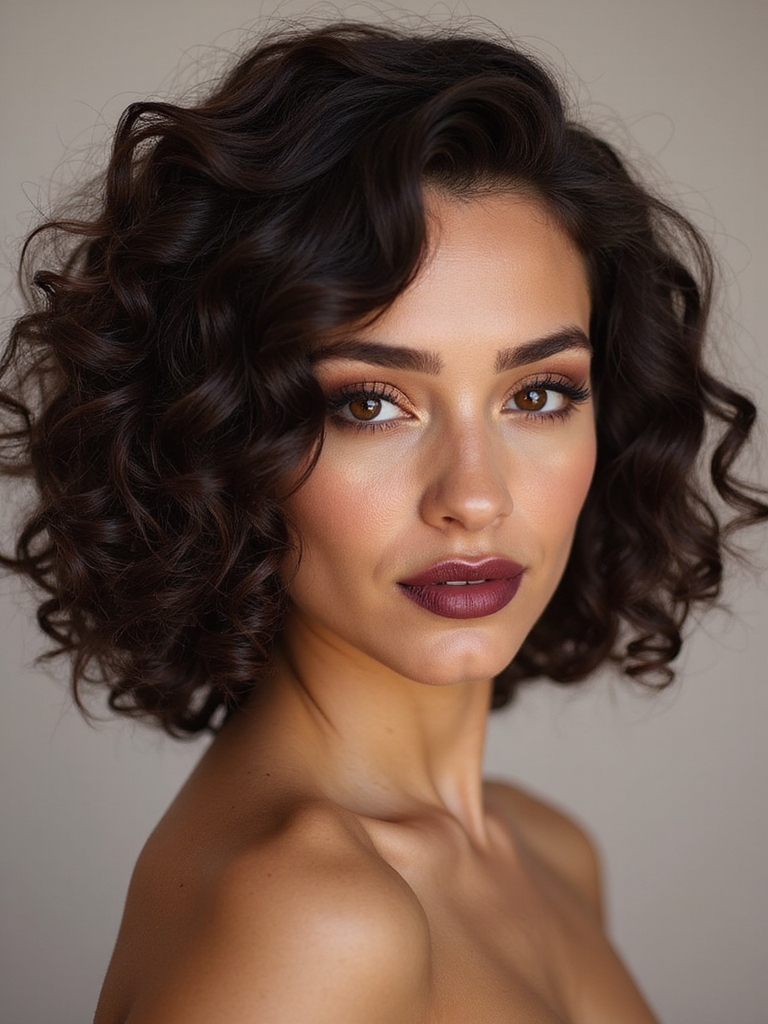
Not ready to go truly short? The curly lob lands around the shoulders and gives you the structure of a bob with the security of more length. Because the weight of longer hair gently pulls the curls down, this length reads as elongating, which makes it a safe, flattering entry point for curl-bob beginners.
It is also the most versatile to style: long enough to pull half-up or tuck behind your ears, short enough to stay bouncy. If the full bob feels like a leap, start here and take it shorter at your next visit.
Asymmetrical Soft A-Line Curly Bob

An A-line shape, shorter at the back and longer toward the front, brings a little edge to curls while solving a common problem: keeping the back from puffing out into a triangle. The graduated length lets the back curls sit close while the front pieces fall longer and frame the face.
On curls the angle is always gentler than on straight hair, because the spring rounds out any sharp line into a soft, stacked shape. That is part of its charm, not a flaw to fight.
If you like the idea, the same logic powers a straight a-line bob, but on curls expect a softer, more organic version of that forward sweep.
Which curly bob length fits your goal?
🎯I want maximum bounce and a bold shape
Go chin-length so the curls stack high and full; just have it cut dry to respect shrinkage.
🎯I am nervous about going short
Start with a shoulder-grazing curly lob; the extra weight elongates and it is easy to take shorter later.
🎯I want low effort day to day
Choose the low-effort, wash-and-go version with soft layers so air-drying looks intentional.
🎯My crown falls flat
Add a deep side part for crown lift, or face-framing layers to redistribute volume.
🎯My curls are tight coils (3c-4c)
Keep layers minimal so you do not lose density, cut dry to nail the shape, and lean on shingling with a heavier cream or butter for definition.
Deep Side-Parted Curly Bob
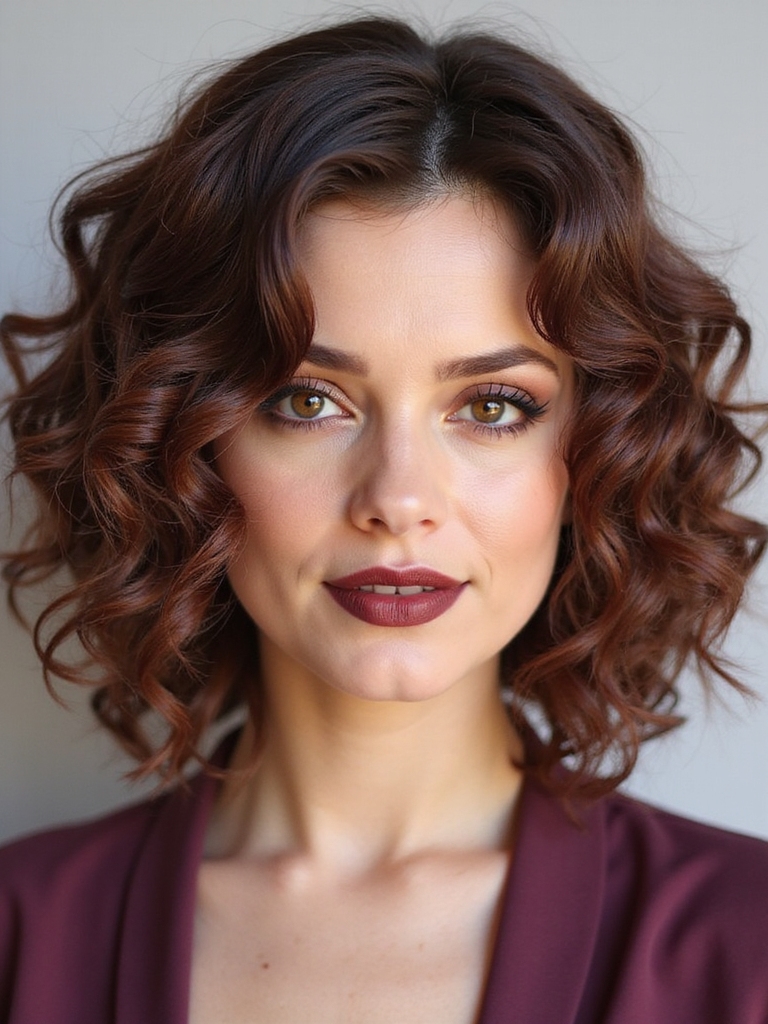
Changing your part is the fastest way to restyle a curly bob, and a deep side part adds instant drama and volume. Sweeping the bulk of your curls to one side creates lush height at the crown and an asymmetry that feels glamorous with zero extra cutting.
A free way to add crown volume
It is also a practical fix if your curls fall flat on top, since the over-direction props them up. I reach for this with clients whose roots go limp by midday.
To set it, part your hair where you want it on wet hair, clip the roots up while it dries, and the lift will hold once the curls are set.
Middle-Part Curly Bob

A center part gives a curly bob clean symmetry, splitting your curls evenly to frame the face on both sides. It is modern, balanced, and especially flattering on oval and heart-shaped faces where it draws a tidy vertical line down the center.
The trade-off is that a middle part shows your roots and any scalp gaps more honestly than a side part does, so it suits dense curl patterns best. If your crown is fine, a slightly off-center part fakes more fullness.
Train a stubborn part by setting it wet and clipping the front sections in place as the hair dries, so it does not wander back to an old habit.
📋What to ask your stylist before a curly bob
- ✓Have you cut my curl pattern before, and can I see examples?
- ✓How are you accounting for my shrinkage at this length?
- ✓Will the layers add volume or remove it for my curl pattern?
- ✓What products and routine will keep this shape at home?
Curtain and Micro Bangs on a Curly Bob

Yes, curls can absolutely have bangs, and a bob is a great place to try them. Curtain bangs part softly and blend into the shape, while curly micro bangs sit high and bouncy for a bold, retro statement. Both rely on cutting dry so the curl lands where you want once it springs up.
The number one rule is to leave them longer than feels right, because curly bangs shrink dramatically as they dry.
- Soft curtain pieces are the low-commitment option and grow out gracefully.
- Bouncy micro bangs are bolder and need trimming more often to keep the shape.
- See curly hair with bangs for more on making fringe and coils get along.
Sculpting a Curly Bob by Cutting Dry

Here is the single most important thing to know before you book: a curly bob should almost always be cut dry. Wet curls stretch out long and straight, hiding their true length and where each one will land once it springs back up.
Always ask: do you cut curls dry?
Cutting dry, curl by curl, lets your stylist see the real shape and place every piece exactly where it belongs. It is the difference between a bob that falls into place and one that surprises you in the worst way when it dries.
Because it takes more time and skill, a specialized dry curl cut often costs more than a standard bob, commonly $75 to $150 or more depending on your area. It is worth asking whether your stylist cuts curls dry before you commit.
A Curl-Specific Styling Routine

How you style a curly bob matters as much as how it is cut, and the good news is that the routine is short once you learn it. The goal is to define curls while they are soaking wet and then leave them alone to dry. Here is the order that works:
- On soaking-wet hair, rake a curl cream or gel through each section so every strand is coated.
- Scrunch upward toward the scalp to encourage the curl to clump and spring.
- Do not touch it again while it dries; handling wet curls is what breaks them into frizz.
Drying Without Disturbing the Curl

Once your product is in, drying is all about gentle airflow, not rough heat. If you air-dry, set the part, clip the roots for lift, and resist every urge to touch the curls until they are completely dry. Touching wet curls separates the clumps and turns definition into a halo of frizz.
If you are short on time, a diffuser on low heat and low speed cradles the curls while drying them in about fifteen to twenty minutes. Cup sections up toward your scalp and hold rather than moving the diffuser around. Once dry, scrunch out any crunch from the gel with a drop of oil for soft, defined curls.
Building a Curl Care Product Routine

Curly hair runs drier than straight hair because the natural oils struggle to travel down a coiled strand, so moisture is the heart of any curl routine. You do not need a huge collection, just a few products that layer well and keep the curls hydrated.
Think of it as a simple stack rather than a shelf full of bottles, and adjust the amount to your curl density and the weather.
- A hydrating, sulfate-free cleanser used less often than you would wash straight hair.
- A rich conditioner or weekly mask, since curls drink up moisture.
- Tighter coils (think 3c to 4c) usually want heavier butters or a thick gel and benefit from shingling, where you smooth product through each section to coat every strand.
- Layer in order: leave-in first, then a cream or gel; the liquid-cream-oil sequence locks moisture into drier, higher-porosity coils.
Color That Adds Dimension to Curls

Color can make a curly bob look even more dynamic, because curls catch the light in three dimensions and show off dimension better than flat hair ever could. Soft, warm highlights painted through the mids and ends make every spiral pop without a harsh line.
Go subtle to protect the curl pattern
Subtle is usually better here. A few face-framing lighter pieces or a gentle balayage gives depth, while heavy, all-over bleach can dry out curls and loosen the pattern, which most curly clients do not want.
Whatever you choose, lean harder on conditioning afterward, since color and curls both demand moisture. A bond treatment during lightening helps the curls stay springy rather than straw-like.
Micro-Trims on a Curl Schedule

Curly bobs do not need trimming as often as straight bobs, which is one of the quiet perks of the cut. Because the shape is built on texture rather than a crisp line, a little grow-out reads as natural rather than messy, so most of my curly clients come in every eight to ten weeks rather than every five.
What curls do need is regular attention to split, dry ends, which travel up the strand and cause frizz if ignored. A small micro-trim to remove damage keeps the curls bouncy and the shape intact without sacrificing length.
A Protective Nighttime Routine for Curls

Half the battle with a curly bob is keeping the curls intact while you sleep, because a cotton pillowcase roughs them up and flattens one side. A few easy nighttime habits mean you wake up with curls that just need a light refresh instead of a full restyle.
These small steps save real time in the morning and stretch your style for days between washes.
- Sleep on a satin or silk pillowcase, or wrap your hair in a satin scarf or bonnet.
- Pineapple longer curls into a loose, high, very gentle gathering on top of your head.
- In the morning, mist with water and a little leave-in, scrunch, and go.
Common Mistakes to Avoid
Most curly-bob disappointment traces back to a few repeat offenders, and I see the same ones again and again when clients come in for a fix. Knowing them ahead of time saves you a frustrating grow-out.
None of these are about your hair being difficult; they are about the cut and routine being matched to your curls in the first place.
- Getting it cut wet: this hides shrinkage and is the top cause of a bob that comes out far shorter than planned.
- Going too blunt on tight curls: a heavy line can read boxy; ask for light internal layers to keep it shaped.
- Brushing dry curls: it shatters the clumps into frizz. Detangle with conditioner in the shower instead.
- Skipping moisture: under-conditioned curls look dull and frizzy no matter how good the cut is.
Curly Bob Questions People Ask
?Should a curly bob be cut wet or dry?
Dry, in almost every case. Wet curls stretch out and hide their true length, so cutting dry lets the stylist see where each curl lands once it springs up. It is the single biggest factor in a curly bob coming out the length you actually wanted.
?How short can I go if my curls shrink a lot?
You can still go short, but plan for the spring. Tighter patterns can shrink several inches, so your stylist should cut with that in mind and leave the hair longer than the finished look. Tell them your shrinkage if you know it, and start cautious.
?Will a curly bob make my hair look bigger?
It can, since curls add fullness wherever they sit, but the right shape controls it. Length below the chin lets curls fall instead of puffing at the cheeks, and light internal layers remove bulk without thinning the curl. Volume becomes a feature, not a surprise.
?How often do curly bobs need trimming?
Less often than straight bobs, usually every eight to ten weeks, because the textured shape grows out softly. The priority is removing split, dry ends that cause frizz rather than chasing a crisp perimeter line.
?What is the best way to refresh curls between washes?
Mix water with a small squeeze of leave-in, roughly one part product to four parts water, in a spray bottle. Mist lightly, scrunch upward to revive the clumps, and add a drop of oil if the ends look dry. Protecting curls overnight on satin first means morning styling takes under a minute.
Curls That Finally Get to Bounce
A curly bob is at its best when it stops imitating straight hair and starts celebrating what your curls already do. Get the length and layers matched to your pattern, cut it dry, and learn the short wash-and-go routine, and you end up with a shape that looks lively and intentional with very little daily effort.
If you have been hesitant, take it one step at a time. Start a little longer than you think, find a stylist who cuts curls dry, and bring photos that show texture close to yours. Your curls do not need to be tamed into something else; they just need a shape that lets them spring. Give them that, and a curly bob will be the easiest haircut you have ever loved.
More to Explore