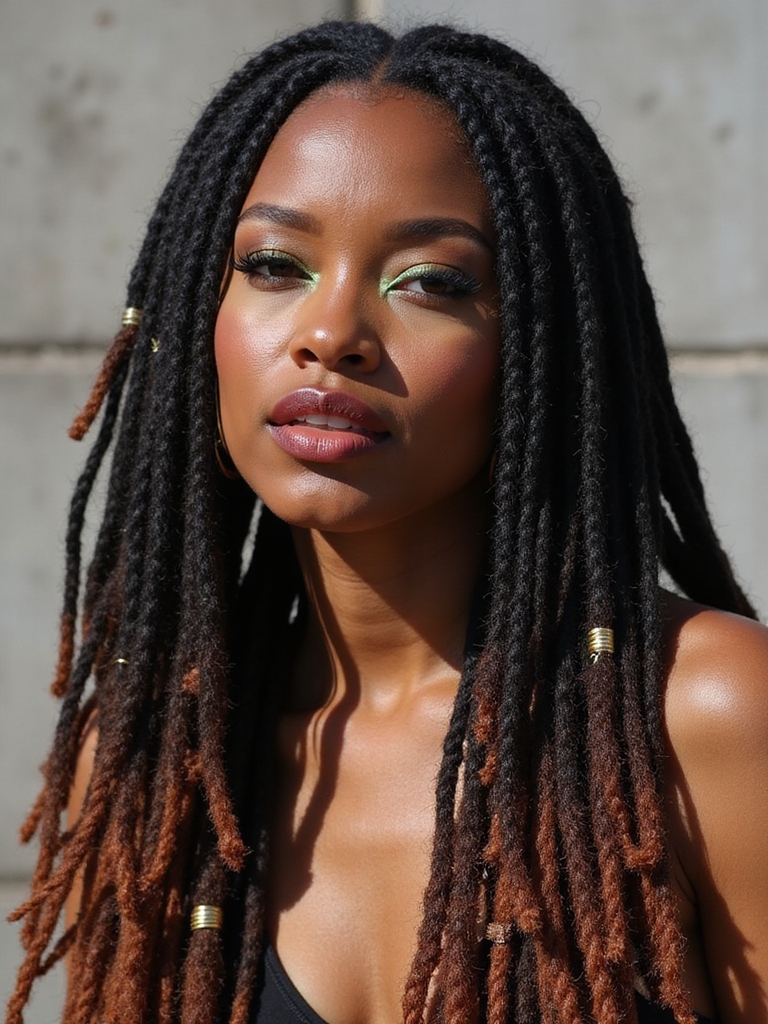
Braids and locs get treated as separate categories more often than they should be, since so many of the most interesting styles actually combine both techniques in the same head. A cornrow section can open into free locs; a handful of locs can twist together into one thick cable; beads can dress up either one.
Fifteen versions follow, spanning protective, decorative, and everyday-practical approaches. The locs hairstyles for women guide covers the broader category if these specific combinations aren’t quite the right fit.
What Decides Which Technique Works
- Loc size decides which braid technique actually works; thin micro locs and thick rope locs need different approaches entirely.
- Faux and feed-in versions add length or fullness without waiting for natural locs to grow to that point.
- Tight, over-manipulated braiding at the root can pull on the hairline over time; ease matters as much as pattern.
Classic Loc Braids

Classic loc braids section the hair and braid at the root before letting the rest of each loc hang free, giving a clean, defined pattern at the scalp with movement below it.
- Braided sections at the root, free-hanging locs below
- A defined, geometric pattern shows at the scalp
- Works on most loc lengths and sizes

Boho Goddess Locs

Goddess locs wrap human hair or synthetic extensions around the natural locs, building a fuller, wavier finish than the natural loc size alone would give.
Fuller, Softer, and Temporary by Design
The wrapped ends get left curly or wavy rather than sealed flat, so the whole style stays soft and worn-in rather than sharp and geometric.
Most people wear this as a protective, temporary style over natural locs, taking it out well before the wrap starts to loosen or the natural hair underneath needs attention.
👍What This Combination Offers
- +A clean, defined pattern at the root
- +Suits most loc lengths without extra length needed
- +Easy to vary the parting pattern for different looks
👎What to Plan For
- –The root braiding needs redoing as new growth comes in
- –Tight sections can pull if placed too close to the hairline
- –Takes longer to install than simply leaving locs loose
Cornrow-to-Loc Hybrids

Flat cornrow sections at the scalp open into free-hanging locs partway down, combining two distinct textures in one continuous style rather than choosing between them.
The transition point takes real skill to place correctly; too abrupt and it looks like two separate styles stitched together, too gradual and the cornrow pattern loses its definition.
- Flat, close cornrows near the scalp; free locs below
- The transition point is the most technically demanding part
- Combines two distinct protective and decorative traditions in one style
Chunky Rope Twists

Chunky rope twists wind two to four individual locs together into one thick cable section, trading the fine detail of individual locs for bold, sculptural volume. The technique works especially well on locs that have thinned slightly with age, since combining several adds back the visual weight a single loc may have lost.
- Multiple locs wound together into one thick section
- Reads bolder and more sculptural than single-loc styles
- Fewer sections overall, which can mean less time in the chair
Micro Loc Braids

Micro locs, thin and numerous, take braiding patterns with far more detail than thicker locs can support, since so many individual sections give a braider more to work with. A single style can involve hundreds of micro locs, which is what makes the intricate geometric patterns possible in the first place.
- Fine, numerous locs support intricate braided patterns
- Installation and braiding both take considerably longer than on thicker locs
- The added detail holds up especially well for special occasions
Feed-In Loc Braids

Feed-in braiding adds extension hair gradually into a loc section as the braid progresses, building length and fullness without a hard, visible starting point where the extension begins.
Building Length Without a Visible Seam
That gradual build is the whole technique: small increments of hair worked in continuously as the braid progresses, never one large addition dropped in at the start.
It works especially well for anyone whose natural locs haven’t reached a desired length yet, adding the visual length now while the natural locs continue growing underneath.
Two assumptions worth dropping about micro locs specifically:
❌ Myth: Myth: micro locs are simply a smaller version of standard locs.
✅ Reality: Fact: the install process, maintenance rhythm, and styling options all differ meaningfully from thicker locs, not just the size.
❌ Myth: Myth: thinner locs are automatically weaker.
✅ Reality: Fact: well-maintained micro locs hold up to styling just as well as thicker ones; density, not thickness alone, determines durability.
Faux Loc Braids as a Protective Switch-Up

Faux locs, installed over natural hair rather than grown from it, give the look and feel of locs as a temporary, removable style rather than a permanent commitment.
Most people wear a faux install for a matter of weeks, since leaving synthetic or human-hair wraps in too long asks too much of the natural hair and scalp underneath.
- A temporary, removable version of the loc look
- Protects natural hair underneath during the wear period
- Should come out within a reasonable window, not left indefinitely
Triangle-Part Locs
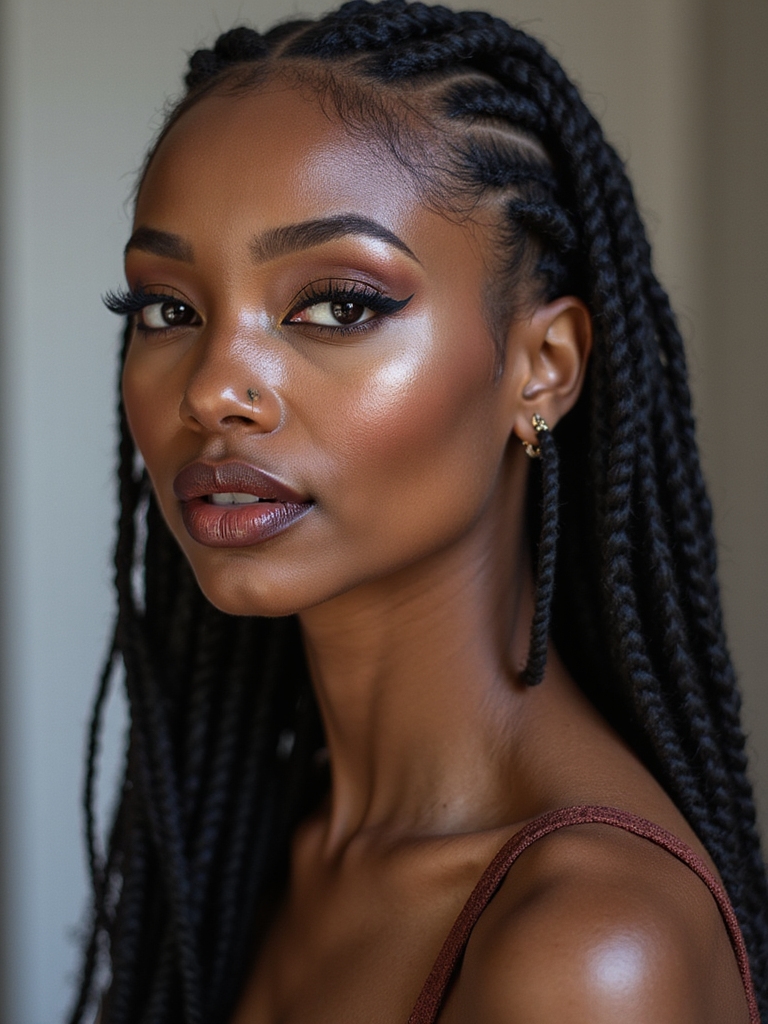
Triangle-part sectioning divides the scalp into triangular rather than square or rectangular segments, distributing tension more evenly across the head than a standard grid pattern does.
The geometric pattern shows clearly at the root once locs are fully installed, giving the whole style a structured, deliberate look from above.
This sectioning approach takes noticeably longer to map out than a simple grid, since each triangle has to be measured against its neighbors to keep the pattern even.
Ombre and Highlighted Loc Braids

Color shows up differently once locs are braided than it does on loose locs, since braiding compresses multiple locs together and changes how light hits the colored sections.
Why Color Placement Has to Account for the Braid
An ombre or highlight placed before braiding can shift position slightly once the braid pattern pulls sections together, so colorists familiar with locs plan the placement with that shift in mind.
Lightening locs specifically takes more care than lightening loose hair, since the interior of a mature loc can process unevenly compared to the outer layer.
Beads, Cuffs, and Shells

Adornment along locs and braids carries a long cultural tradition, with beads, metal cuffs, and shells marking everything from personal style to milestone occasions across different communities.
Modern styling borrows from that tradition while adding practical touches, like sizing cuffs specifically to loc width so they slide on without forcing or damaging the strand.
The weight of heavier adornments matters too; a head full of metal cuffs adds real weight that can pull on locs over an extended period if left in too long.
Half-Up Loc Braid Combos

A half-up style braids or twists the top section while leaving the rest of the locs down, controlling volume at the crown without losing length or movement below it.
It works as a practical everyday option, since it takes less time than a full braided style but still looks more intentional than simply wearing all the locs loose.
💡Sizing Beads and Cuffs Correctly
A bead or cuff that’s too small will crack trying to force it onto a loc; one too large will slide off or click annoyingly with movement. Test on a single loc before committing to a full set.
Braided Loc Updos for Events

Braided sections incorporated into a loc updo add structure and pattern that a simple gathered bun or ponytail wouldn’t have on its own.
For formal occasions specifically, this combination photographs well from multiple angles, since the braided sections catch light differently than the smoother gathered portions.
Building a style like this takes real time, often more than an hour depending on loc count and the complexity of the braided sections involved.
Athletic, Low-Manipulation Loc Braids

Built for movement rather than photographs, this approach keeps locs braided close to the head and secured well enough to hold through actual physical activity.
Low manipulation is the guiding principle: fewer, larger sections mean less daily handling, which matters for anyone active enough to be styling and re-styling multiple times a week otherwise.
- Braided close to the head to minimize movement during activity
- Fewer, larger sections reduce daily manipulation
- Built to hold through workouts, not just to photograph well
“Most locticians recommend booking a trial run of any formal updo at least a week before the actual event, since adjustments to sectioning or placement are far easier to make with time to spare.”
A Real Loc Care Routine

A basic loc care routine comes down to three habits done consistently: a clean scalp, light and regular moisture through the length, and a satin or silk covering at night to reduce friction. None of these habits are complicated on their own; the value comes from doing all three without skipping weeks at a time.
- A clean scalp supports healthier growth at the root
- Light, regular moisture prevents brittleness through the length
- Satin or silk at night protects against friction and breakage
Matching Technique to Loc Size

Loc size decides which braid technique actually works well, more than any other single factor. Micro locs support fine, detailed patterns that thick locs simply can’t replicate, while thick locs carry chunky, sculptural styles that would look lost on thinner strands.
Anyone choosing a technique before their locs reach a certain size or maturity should expect to adjust the plan; a loctician experienced with the specific loc type in question is worth the consultation before committing to a style.
How to Get the Look
Most of these combinations work best with a loctician who has direct experience with the specific technique in question, since braiding around mature locs asks for different skills than starting locs from scratch.
Plan on around $120 for a more involved combination style like a triangle-part or feed-in install, and expect the appointment to run several hours depending on loc count and pattern complexity.
Two Techniques, One Head, Endless Combinations
Every style here proves the same point: braids and locs were never really separate categories, just two techniques that happen to combine unusually well.
Which combination actually fits the maintenance rhythm already in place, rather than the one that looks best in a single photo?
More to Try