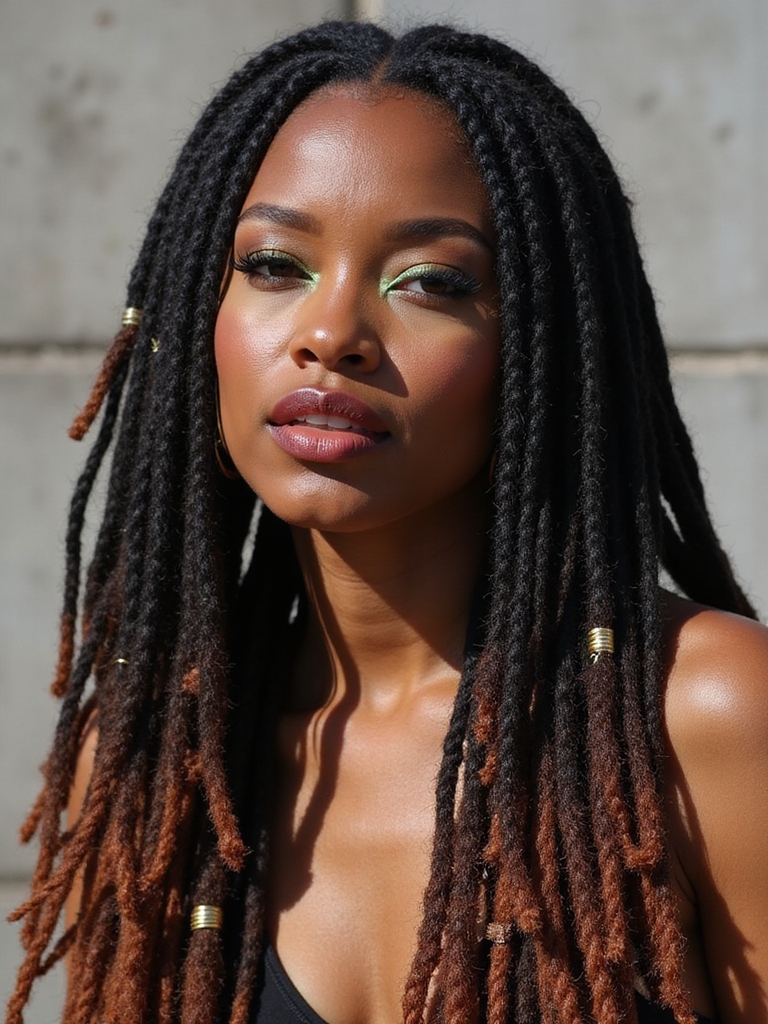
Most people get one thing wrong about curly locs: the curl does not change the loc at all. It changes only the end. Flexi rods, foam rollers, pipe cleaners, or damp braided sections set overnight leave a spiral or wave on the last few inches of each loc, and the loc body holds that shape once it dries fully.
That small change looks like a big one. The set ends flare out from the tip, break the straight column of the loc, and carry more air and movement than the same locs worn sealed. This guide covers how to get there: matching the tool to your loc type, setting it so it holds, and protecting it so the curl lasts past day one.
Rod Size to Loc Weight, at a Glance
| Loc type | Rod size that holds | How long the curl lasts |
|---|---|---|
| Fine locs, microlocs, Sisterlocks-type | Medium to large | Longest, often 4 to 6 days |
| Thick, heavy locs | Small and tight | Shorter, often 2 to 3 days |
What Curly Loc Ends Actually Are

A curly loc is your loc with a set tip. The body keeps growing and locking exactly as it always has, and only the last few inches take on a spiral or wave. That tip is the most workable part of the loc because it carries the least interior density, so it accepts a curl and gives it back at release.
The loc body never changes
The visual difference is easy to spot across a room. A straight loc end sits parallel to the body and falls in a clean column. A set end flares outward, so the whole head looks softer and fuller. Part of that comes from the curl itself, and part from the way a curled tip throws light across several angles.
None of this is permanent. When the set relaxes, the loc returns to itself with nothing changed underneath. That is the appeal for a lot of the loc clients I see: a new look for a week, no commitment to the loc itself.

Match the Curl Pattern to Your Loc Type

Rod choice matters as much as setting time, and it comes down to weight. A thick loc has more mass at the end, so it needs a smaller, tighter rod to hold a curl against that weight. Put a large roller on a thick loc and the wave relaxes to nearly straight within a day. The same large roller on a fine loc gives a soft spiral that lasts much longer.
Knowing your loc type tells you where to start. When a client is unsure, I set one loc as a tester the night before. We check how it holds in the morning, then size the rest of the rods from there. It takes five minutes and saves a whole set from dropping flat by lunch. Browse curly dreadlocks for the range of shapes a set can create across different loc sizes.
- Fine locs, microlocs, and Sisterlocks-type hold well on medium to large rods
- Medium locs take a middle rod size for a defined, lasting spiral
- Thick, heavy locs need small, tight rods to fight the end weight
Curly locs are not a new style. They are your locs wearing a different end for a few days, then handing it back.
Rods, Rollers, and Pipe Cleaners

Three tools do most of the work, and they are all inexpensive. A pack of flexi rods runs about $5 to $12, and a full home set takes one to two hours to wrap. The tool you pick decides the shape of the curl and how long it holds.
- Flexi rods: bendable foam-covered rods wound from the end up and folded to hold. They give a consistent spiral and stay gentle on the loc surface.
- Pipe cleaners: a budget option that wraps tighter, so they produce a smaller, springier curl. Useful on fine locs that can take the tension.
- Foam rollers: best for soft, loose waves on lighter locs, less so on thick ones where they relax fast.
Heatless Methods for Defined Texture

Not everyone wants to wrap dozens of rods. Two heatless methods cover more of the loc length and take less fiddly setup.
Braids for waves, bantu knots for spring
The braiding method divides the locs into sections and braids each one loosely from the mid-length down, left in overnight. Released in the morning, each section shows a wavy, crimped texture along the lower length rather than a spiral at the very tip. It looks less structured than a rod set and covers more of the loc.
The bantu knot method coils each loc, or a small group of locs, into a tight knot against the scalp and lets it dry fully before release. The result is a strong, springy coil with real volume. Both methods are heatless, gentle, and friendly to newer locs that are still settling.
Plan for the drying, though: a braid set wants a full night to take, and bantu knots need several hours of air time, or about thirty minutes under a hooded dryer, before release. Rush either one and the wave falls out by afternoon, the most common mistake with first-time home sets.
A few terms that come up when you set loc ends:
📖Flexi rod
A bendable, foam-covered rod wound from the loc tip upward, folded at both ends to hold. The most forgiving tool for most loc weights.
📖Bantu knot
A better fit than a rod for locs too short to wrap, or for anyone chasing a tighter coil than a rod set typically gives.
📖Pineapple
Not a curl-setting method on its own; a nightly habit that protects whatever curl is already set from friction and flattening.
Half-Up Styles and Freeform Sets

A half-up on curly locs lands differently from the same style on straight ones. The curled ends that fall below the gathered section fan and spiral away from the hanging locs, so the lower half looks soft and dimensional rather than a flat column. The contrast between a sleek gathered top and a textured bottom is what makes it look pulled-together.
Freeform curly styles set all or most of the locs and then leave the full head loose, letting the curled ends move on their own. This is the lowest-effort way to wear a set, and it shows off the texture at its fullest. For more dressed looks, loc updos build beautifully on a fresh set of curled ends.
I always tell clients to plan a half-up or updo for the day after setting, when the curl is at its tightest. By day three the softer fall actually suits a loose, freeform style better.
Keeping the Curl Fresh Past Day One

The set itself is only half the job. How you sleep on it decides whether you get three days or six out of one wrap. The single most effective habit is the pineapple: gathering the locs loosely at the very top of the head so the curled tips sit high inside a bonnet instead of pressed flat against it.
During the day, the rule is to leave the ends alone. Running fingers through curled tips breaks the pattern faster than anything else, so handle them as little as you can. Protective styles like the ones in protective hairstyles also keep the ends tucked and the curl intact between sets.
- Pineapple the locs at night so the tips never press flat
- Keep handling to a minimum during the day
- Refresh a relaxed end with a light mist of water, not more product
Products That Help the Curl Hold

What you put on the ends before wrapping changes how firmly the curl sets. The goal is a light, clean hold that gives the loc surface something to grip, with nothing heavy that slows drying or builds up inside the loc over time. A pea-sized dab per loc is plenty. Use more and the ends stay damp at the core, so the curl never fully locks in. Less truly is more here.
- Water-based curl gels or creams applied lightly to the end give the cleanest, longest hold
- Look for light-hold formulas with aloe or flaxseed, which dry without residue
- Skip heavy butters and oils on the ends before setting; they slow drying and soften the hold
If a set droops early instead of lasting the full stretch, try this before redoing the whole head:
1Isolate the loose ends
Check which specific ends have actually relaxed rather than assuming the whole set needs rewrapping.
2Re-wet, don’t re-oil
A light water mist reactivates the bend better than layering more product onto an already-dry end.
3Reset only what’s loose
Rod or knot just the relaxed ends again instead of committing to a full-head redo over a partial problem.
Nighttime Protection and Frizz Control

A satin or silk bonnet gathered loosely over the full set removes the surface friction a cotton pillowcase creates against the loc texture. That friction is what breaks the curl down and roughs up the outer locs by morning. Removing the friction source works better than any product you apply afterward to smooth frizz that has already formed.
- A loosely gathered satin bonnet protects the whole set at once
- For longer locs, add a satin pillowcase for the length that hangs past the bonnet
- A satin-lined bonnet with a wide opening fits a fuller curled set comfortably
Home Set or Salon Set?
You can set curly loc ends at home, and most people do once they find the rhythm. A full flexi-rod wrap on a medium head of locs takes me about an hour and a half the first few times. It speeds up once your hands learn the motion. After the first pack of rods, the cost is close to nothing.
A salon set runs roughly $40 to $80 depending on your loc count and length, and it buys you two things. You get a faster, even wrap, and a proper dry under a hooded dryer so the curl truly holds. I usually suggest a salon set for a big event and a home set for ordinary weeks. One client of mine books a professional set before every family wedding and handles the months in between herself.
Curly Loc Questions, Answered
?How long do curly ends on locs actually last?
Most rod or braid sets hold three to five days before the ends begin returning to their natural state. Finer locs hold longest, sometimes six or seven days with consistent satin protection and minimal handling. Thick locs relax fastest because of the weight at the end.
?Do the locs need to be fully dry before removing the rods?
Yes, completely dry. Even slightly damp ends give a curl that loosens within hours. After washing, allow at least four to six hours of air drying, or thirty minutes under a hooded dryer, before you start the set.
?Will setting curls damage my locs?
Not when it is done heatless. Flexi rods, pipe cleaners, braids, and bantu knots all shape the ends without heat, so there is nothing to weaken the loc. Keep products light and water-based to avoid buildup deep inside the loc.
The Curl Was There All Along
Curly locs are an extension of the style you already wear, not a transformation of it. The same locs that have been growing and locking simply carry a different end for a few days. A rod or braid set reveals a texture the loc can already hold, then releases it with nothing changed underneath.
Start with the tool that matches your loc weight, set on fully dry locs, protect the ends overnight, and handle them as little as you can during the day. Do that, and the locs do the rest: holding the shape, carrying the weight, and returning to themselves when you are ready to take the set down.
More Ideas Here