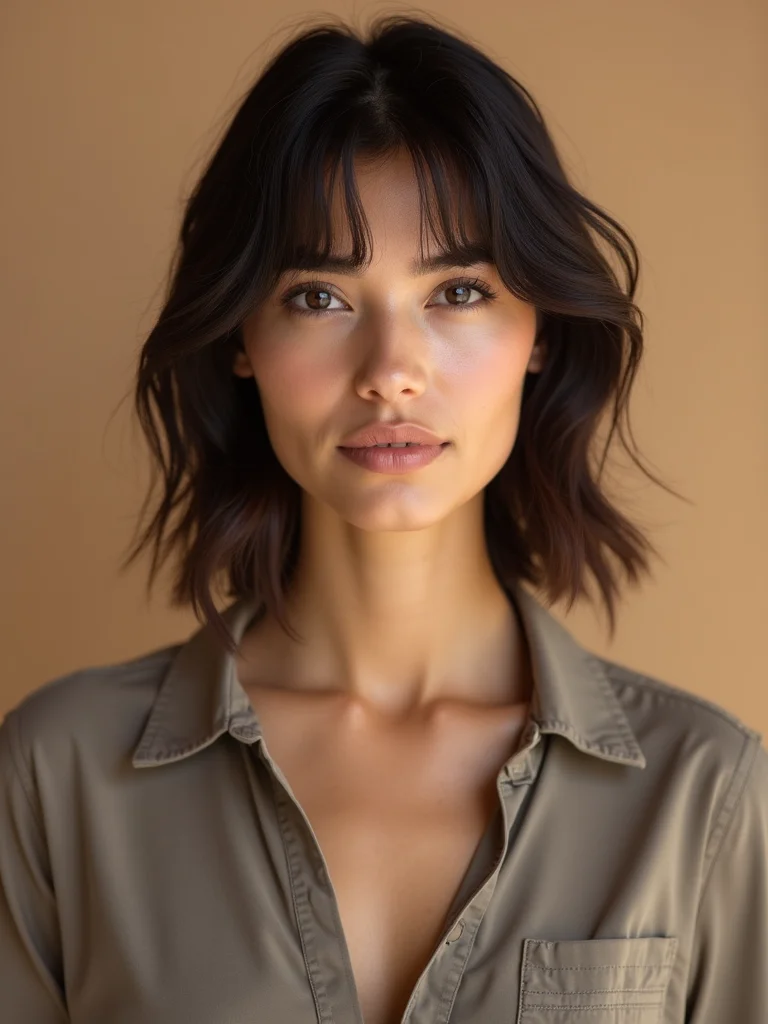
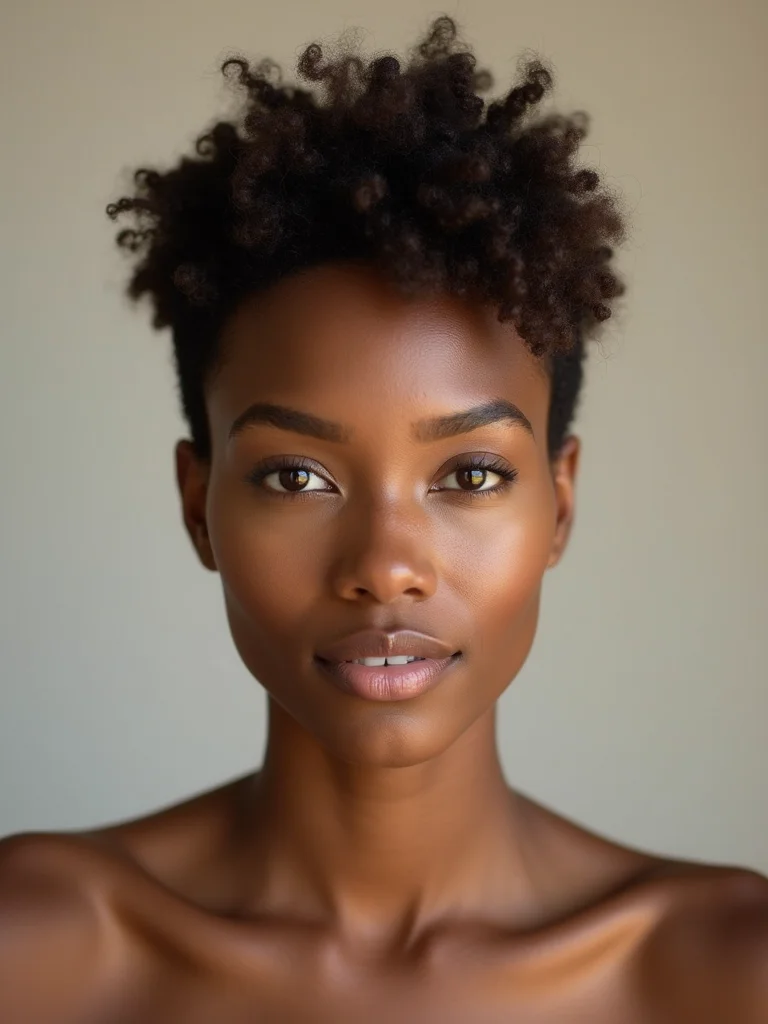
Curtain bangs on straight hair have nowhere to hide. Every strand shows exactly where the fringe falls, which means placement and finish do all the work that texture handles automatically on wavy or curly hair.
Fifteen versions follow, each built around how straight hair actually behaves: no natural bend to lean on, more visible shine, and a sharper line between styled and unstyled. The curtain bangs guide covers the wider category if length or texture varies from what’s here.
The Short Version
- A round brush and blow-dryer train the sweep direction on straight hair more reliably than any product alone.
- Straight hair shows a crisp part line clearly, so part placement matters as much as fringe length.
- Face-framing pieces cut for straight hair need slightly more length than the same cut on wavy hair, to make up for the lack of natural lift.
Soft Center-Part Curtain Fringe for Straight Hair

A center part splits the fringe evenly down the middle, letting both sides sweep back in a symmetrical curve. On straight hair, this reads especially clean, since there’s no natural texture to soften the line where the part meets the fringe. It’s usually the first cut a stylist suggests for a first-time curtain fringe, since it’s forgiving of small trims and grows out without a jarring middle stage.
- An even, symmetrical sweep on both sides
- The center part shows clearly on unstyled, straight hair
- Works on nearly any length, from a bob to long hair
Soft, Wispy Feathered Bangs With Light Layers

Feathering removes weight from the ends of a curtain fringe, breaking it into thinner, layered pieces that catch movement.
This works especially well on fine, straight hair, where a blunt, dense fringe can end up looking heavier than the rest of the head can support.
| Part Style | Best For | Upkeep |
|---|---|---|
| Center part | Symmetrical, balanced framing | Regrowth shows evenly on both sides |
| Deep side part | More drama, asymmetry | Regrowth shows faster on the heavier side |
Long Curtain Bangs That Taper Into One-Length Hair

A long curtain fringe that tapers gradually into the rest of a one-length cut removes the visible break between fringe and length that shorter versions have. A stylist typically cuts this one wet and dry, checking the taper against straight hair’s natural fall before committing to the final line.
- Tapers gradually into the length, with no distinct cutoff line
- Blends into one-length hair with no visible seam
- The lowest-maintenance version here, since regrowth barely shows
Blunt Ends With an Airy Curtain Fringe

Blunt ends on a curtain fringe keep a crisp, defined line at the bottom, while the overall shape still lifts and sweeps back and away from the face.
Precision at the Edge, Movement Overall
Straight hair shows a blunt line more clearly than any other texture does, since there’s no natural wave to soften where the cut ends.
Getting the balance right, blunt at the edge but airy in how it falls, takes a stylist who’s comfortable with precision cutting on straight hair specifically.
🅰️Tapered Into Length
No visible break; the fringe blends into the surrounding length with almost no seam.
🅱️Distinct Fringe Line
A clear separation between fringe and length that reads as an intentional, styled feature.
Sleek Glass Hair With a Sharp Center Part

Glass hair, smoothed to a mirror-like finish, pairs naturally with a curtain fringe, since straight hair already carries the reflective surface the whole look depends on.
A flat iron run through the fringe section by section achieves the same glassy finish as the rest of the head, so the fringe doesn’t end up looking separately textured from everything around it.
A sharp center part finishes the effect, giving the whole style one clean, symmetrical line running from the part down through the ends.
Chin-Grazing Curtain Bangs for a Minimalist Look
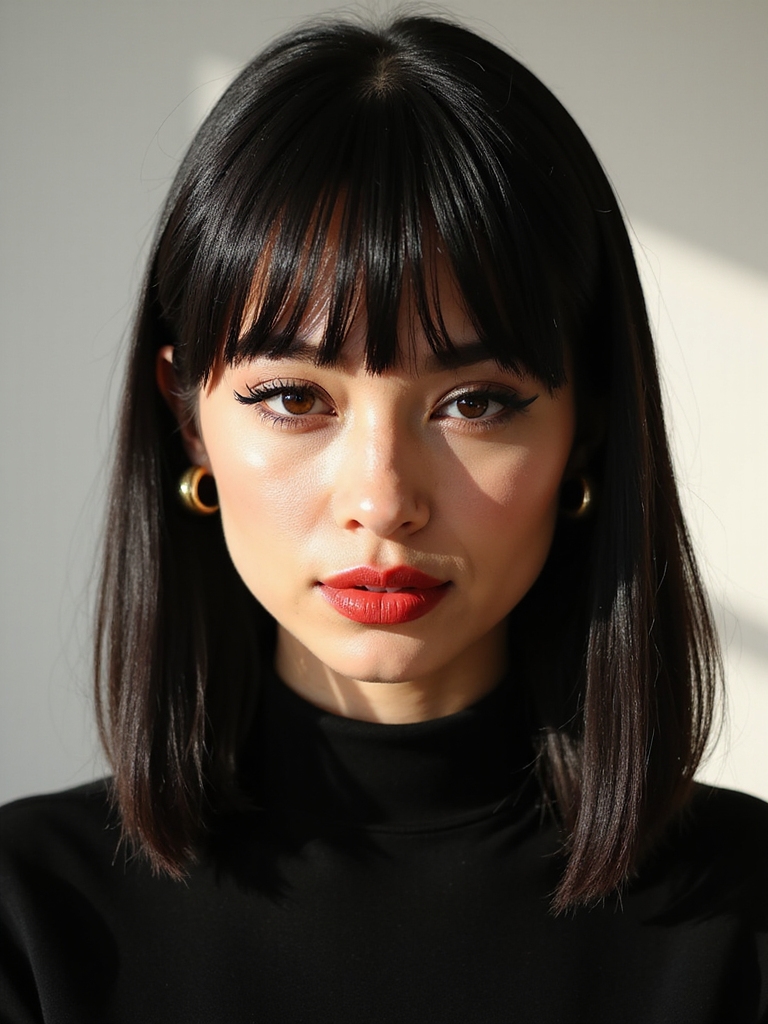
A chin-grazing length keeps the fringe subtle, closer to face-framing layers than a true statement fringe. It works well for anyone easing into curtain bangs for the first time, since the shorter length still frames the face without committing to a full sweep across the forehead.
- Chin-length keeps the effect subtle, closer to face-framing than a full statement fringe
- Blends easily into the rest of a longer cut
- Minimal daily styling required once the direction is trained
Feathered Fringe With Layers on Fine, Straight Hair

Fine, straight hair carries less natural volume than most other textures, so a fringe cut for it needs feathering to avoid reading as one dense, heavy block.
Layering throughout the fringe, not just at the very ends, distributes what little natural volume exists more evenly across the whole section.
A lightweight, root-lifting product helps more here than a heavier styling cream would, since fine hair weighs down fast under too much product.
Razor-Feathered Micro Curtain Bangs for an Edge

Razor-cutting the ends of a short curtain fringe at an angle leaves feathered, uneven edges along the whole line, distinct from the clean line a shears cut would leave.
On straight hair, that texture holds up especially well, since nothing is working against the deliberately roughed-up finish the way natural movement would on wavier hair.
- A razor cut adds texture straight hair doesn’t have naturally
- Feathered edges replace one blunt, heavy line
- Reads edgier than a standard blunt curtain fringe
Curved Face Frame With Tapered Inner Corners

A curved face frame follows the curve of the jawline, with the inner corners tapered shorter than the outer edges.
This shape flatters straight hair particularly well, since the curve shows clearly against a smooth, unbroken surface, where texture would otherwise blur it.
- Follows the natural curve of the jawline
- Inner corners taper shorter than the outer edges
- The curve shows clearly on smooth, straight hair
Soft Diagonal, Side-Swept Face-Framing Bangs

A diagonal sweep runs the fringe at an angle across the forehead, landing somewhere between a full curtain fringe and simple face-framing layers.
An Angle, Not a Straight Sweep
Straight hair holds a diagonal line more precisely than textured hair does, since nothing pulls the angle back toward its natural fall.
A deeper look at the underlying technique lives in the face-framing curtain bangs breakdown, for anyone who wants more detail on the angle itself.
Shoulder-Length Lob With a Flowing Curtain Fringe

A shoulder-length lob gives a curtain fringe enough length below it to blend into, so it doesn’t read as an isolated section at the front of the head. The extra length also gives the fringe more weight to work with, which helps it hold its trained sweep between wash days.
- Enough length below the fringe for it to blend naturally
- Works on straight hair without needing added texture
- A versatile length between short and long
A couple of terms worth knowing for straight-hair fringe cuts specifically:
📖Glass hair
A completely smooth, high-shine finish achieved with a flat iron and heat protectant, most visible on straight hair.
📖Feathering
A thinning technique that removes weight from the ends, breaking up what would otherwise sit as one dense block.
Deep Side Part With Elongated Curtain Bangs

A deep side part sends most of the fringe to one side, creating a longer, more elongated sweep than a center part gives the same length of hair. The curtain bangs side part breakdown covers part placement in more depth for anyone deciding between the two options.
- Most of the fringe shifts to one side, elongating the sweep
- Reads more dramatic than a soft center-part version
- Shows regrowth at the part line faster than a soft part does
Cheekbone-Skimming Layered Curtain Bangs

Cheekbone-length curtain bangs sit at a classic, versatile length, long enough to sweep back and short enough to still frame the face directly.
Layering throughout keeps the length from reading as one heavy piece, letting the fringe move naturally with the rest of the style.
This length works across nearly every straight-hair face shape on this list, and stylists suggest it more often than any other curtain length for exactly that reason.
A deep side part on straight hair does more of the visual work than people expect, since the hard line of the part becomes part of the style, not just where the hair happens to fall.
High-Shine Blowout With Rounded Curtain Ends

A round-brush blowout curves the ends of the fringe under and back, adding volume and shine at the same time. A light shine serum finishes the look, sealing the cuticle so straight hair reflects light evenly without stray flyaways catching the eye.
- A round brush curves the ends under, giving them shape they wouldn’t hold naturally
- Adds volume specifically at the crown and fringe
- A high-shine finish shows best on freshly washed, straight hair
Clip-In Curtain Bangs for a No-Commitment Switch-Up

Clip-in curtain bangs test the whole look without cutting anything, matched to hair color and blended in along the part.
A quality set typically runs around $35 to $45, about half what a professional cut and color-match session would cost, which makes it a reasonable way to confirm the style is worth committing to before booking an actual cut. Most people trim the ends once, roughly every eight months of regular wear, to keep the fringe reading as natural.
- Zero commitment; removable at the end of any day
- Matched to hair color for a blended, natural look
- A practical way to test the style before a real cut
Styling Tips
Straight hair holds a trained direction longer than textured hair does, but it also shows product buildup and grease faster, so less is more with styling products here.
A round brush and blow-dryer combination trains the sweep direction more reliably than any product alone; heat sets the shape while cool air locks it in place before reaching for anything else. A small amount of dry shampoo at the roots on day two buys another full day before the fringe needs a fresh blow-dry.
Curtain Bangs on Straight Hair: Common Questions
?Do curtain bangs need daily heat styling on straight hair?
Not necessarily. A trained sweep, set with a round brush at the salon or during the first few home styles, tends to hold its shape through several wears before it needs another blow-dry.
?Will curtain bangs work on very fine, straight hair?
Yes, with the right cut. Feathering and light layering keep fine, straight hair from looking weighed down, which a blunt, dense fringe often does on this texture specifically.
?How is a center part different from a deep side part on straight hair?
A center part reads as symmetrical and even, while a deep side part reads as more dramatic and shows regrowth faster on the heavier side. Straight hair displays both part styles more clearly than textured hair does.
?Can clip-in curtain bangs really pass as real hair?
Usually, yes, when they’re color-matched carefully and blended at the part. The main giveaway tends to be texture mismatch, so choosing a set that matches the natural shine level of straight hair matters more than color alone.
?What’s the biggest mistake people make cutting curtain bangs for straight hair?
Cutting the fringe too short without accounting for how straight hair falls with zero lift. A length that looks right on a stretched or wet section can end up shorter and blunter than intended once it’s fully dry and settled.
Straight Hair Shows Every Detail, So Use That
Every version here works with straight hair’s biggest trait: no texture to hide behind.
Whichever length and part combination looks most appealing, bring it to a consultation along with an honest answer about how much daily styling time is realistically available.
Don’t Miss These