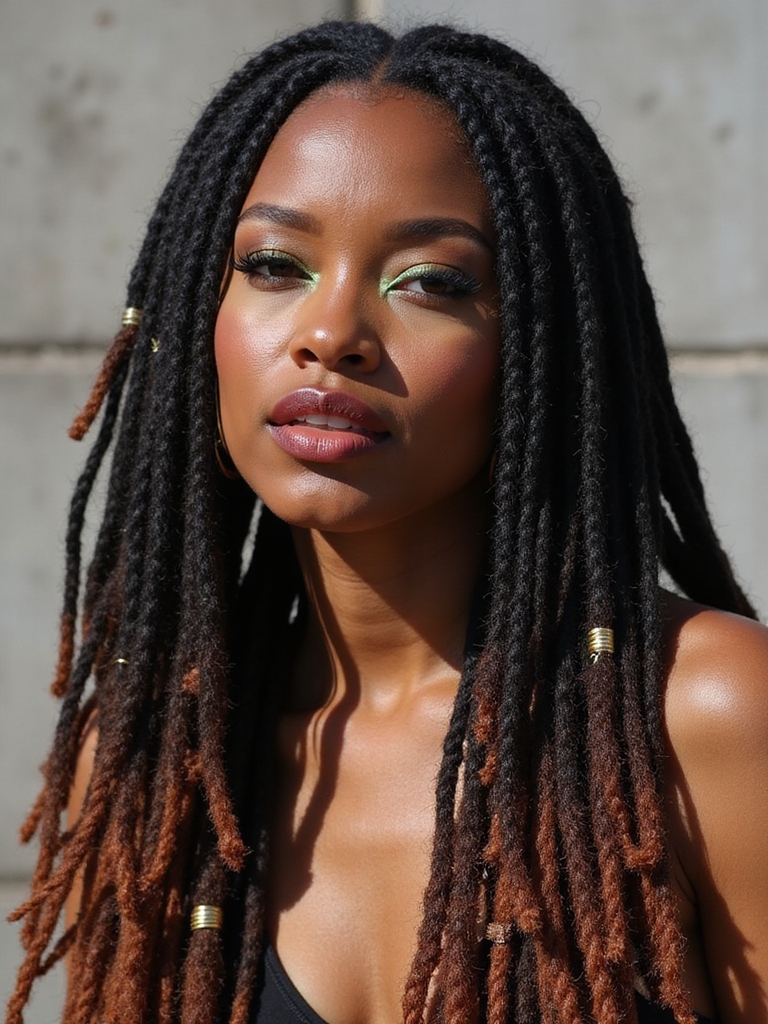
There is a particular weight to locs at shoulder length, somewhere between the heavy column of a long mature set and the close-to-scalp feel of starter locs. Bob dreadlocks hairstyles swing when you move, frame the face at the jaw and collarbone, and hold a shape shorter or longer locs quite can’t.
This is also a real milestone in the loc journey, the first stage with enough length for a defined hemline. Locs carry deep personal and cultural meaning for many who wear them, so this is worth treating with care. A full range of variations below, with honest notes on shaping, color, and upkeep.
Loc Bob Essentials
| What to know | Why it matters |
|---|---|
| The cut is permanent | You cannot un-cut a loc, so a loc bob is a real commitment best shaped by a loctician. |
| Grow, then shape | Most loc bobs happen by growing to shoulder length first, then trimming sections into the shape you want. |
| Upkeep is the roots | Locs need retwisting or interlocking on a five-to-six-week cycle, usually $75-150, plus residue-free products. |
| Protect at night | A satin bonnet or pillowcase keeps the locs neat and slows lint and frizz between maintenance visits. |
Sleek Micro-Loc Bob

A full set of micro locs at jaw length holds far more individual sections than a standard loc bob, so up close the surface looks rich and detailed, and from across a room it appears as one smooth, full mass. The hemline is precise and continuous because each fine section ends at a similar point.
The sleek quality comes from the consistency of the small sections themselves. A center or side part with clean edges is the only styling it really needs. Just know that micro locs take the most time and skill to install and maintain, so they are the biggest commitment here. See more dreadlocks styles for length ideas.
- Suits anyone chasing density and a polished, fine-textured bob.
- The most sections means the longest maintenance sessions.
- A clean part along the hairline is most of the styling.

Chunky Shoulder-Grazing Bob

Thick locs carry real weight. At shoulder length they hang with enough individual heft to form a clear, defined hemline that moves as one unit when you turn your head. Because each section is chunky, the full set has fewer locs in it, which shows as visible gaps between locs worn straight and a full, thick profile when they are gathered.
That graphic weight is the whole appeal: each thick loc lands at the hemline with a presence that’s visible from across the room. It is a bolder, more architectural look than a fine-loc bob.
Day to day, a clean center or side part and smoothed edges cover the whole routine. The thickness does the rest.
👍Micro locs suit you if
- +You want a dense, fine, polished texture with a precise hemline.
- +You like a clean, low-styling look that needs only a good part.
- +You are happy to invest in longer maintenance sessions.
👎Think twice if
- –You want a fast install or low time in the chair.
- –You prefer a bold, chunky, graphic loc instead of fine detail.
- –You are not ready for the upkeep that many small sections require.
Layered Bob With Face-Framing Locs

A layered loc bob keeps the front sections longer than the back, so the locs frame the jaw and cheekbones while the back stays shorter. On permanent locs this often happens on its own, since the front hair usually grows from a shorter baseline and catches up unevenly.
Grown in or trimmed
A loctician can also build it deliberately, trimming the back sections shorter once the whole set has reached shoulder length. Either way, the longer front pieces create a softer, more graduated silhouette than a blunt bob.
It is a flattering choice if a uniform hemline feels too heavy for your face. The framing draws the eye up toward your features.
Side-Parted Blunt Bob

Setting the part two to three inches off center divides the set into a larger section that falls over one eye and a smaller one tucked behind the ear. The blunt hemline runs straight across both at the same length, so you get a crisp horizontal line below an asymmetrical part above.
That combination, horizontal precision at the bottom and diagonal asymmetry up top, is what gives the look its quiet drama. It looks polished and a little editorial without much daily effort.
- Set the deep part with a rattail comb for a clean line.
- Keep the blunt hemline trimmed even so the precision holds.
- Smooth the edges along the deeper-parted side to finish it.
💡Maintenance Is the Roots
A loc bob lives or dies at the roots, not the ends. Plan a retwist or interlocking session on roughly a five-week cycle to keep the new growth tidy and the shape sharp, and ask your loctician for a gentle hand, since retwisting too tight repeatedly is hard on the hairline. Between visits, residue-free shampoo and a satin bonnet do most of the work.
Asymmetrical Loc Bob

Here the locs on one side of the part sit noticeably shorter than the other, often by two inches or more at the ends. The contrast is most visible from the front and the profile, where the long side frames the face while the short side leaves the neck open.
On permanent locs, this can develop from natural uneven growth or be created by trimming one side shorter. Worn with intention, the difference looks like a bold, editorial choice, striking in a way few loc bobs on this list match.
Curly Loc Ends Bob

Setting the ends of shoulder-length locs on flexi or perm rods overnight makes the tips spiral outward into a flared, rounded profile. From the front, the curled ends fan across the jaw and collarbone in a soft arc. The hemline rounds out into a soft curve.
Getting an even curl
The effect feels soft and romantic, softening the whole character of the bob. In my chair, this is the fix suggested most when a client loves her locs but wants more movement at the hemline.
The most common cause of an uneven curl is mismatched rod sizes across the set, so use the same rod size and the same wrapping technique throughout. For more, see our curly locs guide.
🅰️Let it grow in
On permanent locs, a layered or asymmetrical bob can develop naturally as the front grows faster than the back. It costs nothing and feels soft and organic, but you do not control the exact shape.
🅱️Have it trimmed
A loctician can cut a precise A-line, stacked, or blunt bob once you reach shoulder length. You get the exact shape, but remember the cut is permanent, so be sure before the scissors come out.
Color-Blocked Bob With Highlights

Color-blocking places a lighter or brighter shade on one side of the part or across the front few sections, with the rest left natural or darker. I only send loc-color clients to a colorist who works on locked hair, never to a box dye. At bob length the full hemline is visible at once, so the contrast registers immediately and lands bold and deliberate. The key is who does it:
- Place the brighter shade at the front or one side, where the bob’s full hemline shows it off.
- Two clear color zones look bolder than scattered highlights at this short length.
- Keep it tonal for a subtle effect, or high-contrast for a true graphic statement.
Center-Part Bob With Clean Lines

A clean center part is the most symmetrical, precise way to wear a loc bob, and the part itself is the whole foundation. A slightly curved or off-center line changes how the entire style looks from the front, so it is worth getting right.
Set the part with a rattail comb from the center of the forehead to the crown, then check it straight on in a mirror rather than looking down at it, since the top-down view distorts how straight it actually is. Smooth the edges and the look is done.
How to color a loc bob without damaging it:
1Book a loc-experienced colorist
Locked hair saturates and processes differently from loose hair, so this is not a job for a general colorist or a box dye.
2Allow extra processing and rinse time
The dense loc interior takes longer to take color and longer to rinse fully, so nothing stays trapped inside to break the loc down.
3Condition the lightened sections
Any lightened length will be the driest part of your set, so keep it moisturized to avoid weak, brittle ends.
Short Stacked Loc Bob

A stacked loc bob is trimmed shorter at the nape and back than at the front, building a graduated profile that lifts toward the crown. From the side, the short nape locs sit close to the head while the front and side locs swing down toward the jaw.
A shape that needs a specialist
It is the most structured loc style you can wear at a shorter length, and it takes a loc specialist to trim the back into that clean graduation. The shaping is deliberate, not something that happens on its own.
Viewed from the side, the graduation adds visible height at the crown, which is the whole reason to choose it over a flat, uniform back.
Wavy Textured Bob Locs

Braiding the locs in small sections while damp and releasing them once fully dry leaves a loose, undulating wave along the lower length. The result is a slightly wider, softer hemline than straight locs make, with movement that looks natural and organic.
It is a great middle ground. You get more dimension than a straight loc bob without the tighter, more defined spiral of a rod set. The wave loosens gradually over a few days, which most wearers like.
- Braid on damp locs and let them dry fully, ideally overnight.
- Smaller braids give a tighter wave; larger braids give a looser one.
- Re-braid every few days if you want to keep the wave crisp.
Boho Bob With Beads and Cuffs

Cuffs placed at different heights along the surface locs catch the light in sequence as the bob swings, adding a kind of quiet animation that bare locs do not have. Wooden beads threaded near the tips add a contrasting texture and a little weight. Adornment like this carries long cultural roots, so worn with intention it adds meaning as well as personality.
At bob length the locs are short, so a little adornment goes a long way. Cluster a few cuffs and beads, and let the structure of the bob carry the rest. Less is more here.
- Place cuffs at varied heights so they catch light as you move.
- Keep the density light; the short length means less is more.
- Wooden beads near the tips add the most movement.
Tapered Nape Bob Locs

Tapering the nape means trimming the lowest locs at the back shorter than those above, so the length grows as the eye moves up from the neck to the crown. From behind it looks clean and intentional, which matters in settings where the back of your head is on view for a while, like meetings or formal events.
The taper also lifts some weight off the nape, so the bob sits lighter against the neck. It is a small, precise change that makes a uniform back look more finished.
Ombre Bob for Soft Dimension

At bob length, an ombre gradient runs over a shorter span than on long locs, so the fade from dark to light happens faster within each loc. The hemline ends up noticeably lighter than the roots, for a warm, dimensional contrast that shows clearly from a short distance.
Where the gradient should start
On a shoulder-length set, start the gradient about a third to halfway up from the tips. That gives the lighter color enough room to look like a genuine gradient rather than dipped ends.
As with any loc color, keep the lightened lower sections conditioned, since they will be the driest part of the set.
Bob Locs With Scalp Designs

Scalp designs treat the visible skin between sections as a canvas for razor or clipper patterns, with geometric lines or freehand shapes cut at the crown, sides, or nape. Up close the individual pattern shows; from a distance it comes across as an unusually detailed, textured loc style.
It works best on shorter loc bobs and on sets with a wider parting grid, where more scalp shows naturally between sections. The designs need a clean-up within about three weeks to stay crisp, so factor that into your maintenance.
Angled Bob With Sharp A-Line Shape

The A-line is the most geometric loc bob of all: the hemline runs on a diagonal from a shorter nape to longer front sections that reach toward the collarbone. On locs the angle looks especially crisp, because each loc ends at a precise point along the line instead of tapering gradually the way blow-dried hair would.
It takes deliberate trimming, with the nape kept short and the length increasing toward the front, so it is a job for a loctician’s precise eye. Done well, it is the sharpest, most modern shape on this list.
- Have a loc specialist trim the angle once you have shoulder length to work with.
- The crisp diagonal suits anyone who wants a bold, architectural line.
- Keep the front sections trimmed even so the angle stays clean.
Common Mistakes to Avoid With a Loc Bob
The biggest mistake is cutting too soon. Because you cannot un-cut a loc, shaping a bob before the set has grown to a true shoulder length, with mature, settled locs, can leave you stuck with a length you did not want and months of waiting to fix it. Grow to length first, then let a loctician shape the bob you actually want. This is the one decision I beg clients to be patient about, every time.
The quieter mistakes are about upkeep. Heavy, waxy products build up inside locs and never fully wash out, so stick to residue-free options. Skipping retwists too long lets the roots loosen and the shape blur, while over-tight retwisting strains the roots, so a steady five-or-six-week rhythm and a gentle hand at the scalp protect both the look and your hairline. For more shape ideas, see our wider dreadlocks bob gallery.
The Bob Is Never the End of the Story
Shoulder length is a milestone, not a destination. The bob is the first length where locs carry enough weight and definition to hold a clear, deliberate line, and it is also the length everything longer grows from. Plenty of wearers spend months of the loc journey looking forward to exactly this stage.
What you find when you arrive is a complete style with its own decisions: the thickness of your sections, your natural curl, your face, your setting. Pick the variation that fits your set as it is right now, lean on a loctician you trust for any cutting, and protect the upkeep. Whatever you choose, the bob is a chapter, not the last page.
More to Try